Automation
GM to Boost Factory Automation 20% by 2028 to Offset UAW Costs
The automaker is building its own robots in Indiana and scoring suppliers on automation plans as labor contract costs add $575 per vehicle.
Key takeaways
- GM plans to increase factory automation by 20% by 2028 to offset $575-per-vehicle labor cost increases from its UAW contract.
- The automaker is assembling proprietary robots at its Kokomo, Indiana plant and requiring suppliers to submit automation plans as part of contract bids.
- UAW President Shawn Fain has criticized automation as a threat to workers, setting up a likely clash when contracts expire in 2028.
- Ford faces even higher labor cost increases at $900 per vehicle, intensifying pressure across the industry to boost productivity.
- GM employs about 100 robotics and AI specialists developing advanced manufacturing systems to compete with lower-cost rivals.
General Motors is planning a significant expansion of automation across its North American manufacturing facilities, targeting a 20% increase in robots and automated equipment by 2028, according to people familiar with the company's strategy.
The push comes as GM works to absorb higher labor costs from its 2023 contract with the United Auto Workers, which the company estimates adds approximately $575 per vehicle to production expenses. Ford, by comparison, faces an estimated $900 per vehicle increase from its own UAW agreement.
Building robots in-house
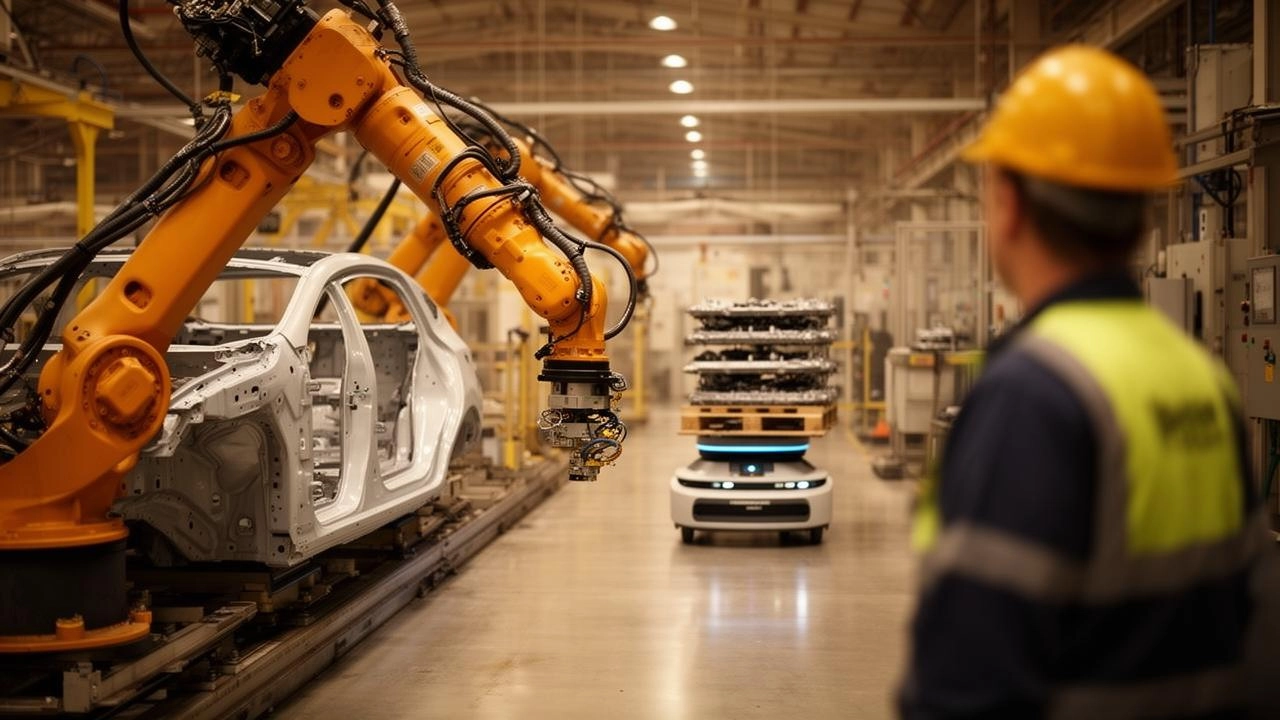
GM has taken the unusual step of assembling its own robots at a facility in Kokomo, Indiana, focusing initially on autonomous mobile robots that transport components within plants. The company employs roughly 100 specialists in robotics, artificial intelligence, and hardware engineering working on these advanced systems.
The automaker is pursuing a dual approach—developing proprietary equipment while continuing to purchase robotic systems from external vendors. This strategy gives GM both cost control and access to cutting-edge commercial technology.
Supplier automation mandates
The automation drive extends beyond GM's own factory floors. Parts suppliers bidding on new contracts must now submit detailed automation plans for their production lines. GM uses a scorecard system to evaluate suppliers' automation capabilities, and those ratings factor into purchasing decisions—effectively raising the bar for suppliers who want to compete for GM business.
Union pushback intensifies
The UAW, which represents approximately 50,000 GM workers, has voiced strong opposition to expanded automation. Union President Shawn Fain warned at a June convention that artificial intelligence and automation threaten worker livelihoods. "The fruits of our labor are multiplying like never before, but workers are not reaping those fruits," Fain said. "That is theft."
Mikell Taylor, GM's director of robotics strategy, offered a different framing in a February podcast appearance, arguing that manufacturers need to design processes leveraging both human and machine strengths to achieve optimal efficiency and quality.
Why it matters
With labor contracts for GM, Ford, and Stellantis expiring in spring 2028, automation and job security are set to dominate the next round of negotiations. GM's 20% automation target puts a concrete number on what has been an abstract concern for unions—and signals that automakers view technology investment as essential to competing with lower-cost rivals, including Tesla's non-union U.S. plants. The outcome will shape not just wages and headcount, but the fundamental economics of American auto manufacturing for years to come.
GM declined to confirm the specific 20% figure but said automation supports safety, quality, and efficiency as global competition intensifies.
These details were first reported by Automation Watch.