GLM-5.3 Reaches Frontier Performance With 750B Parameters
Zhipu AI's latest model matches leading Western systems through aggressive post-training and rapid release cycles, not distillation.
Chinese lab matches frontier models at fraction of the size
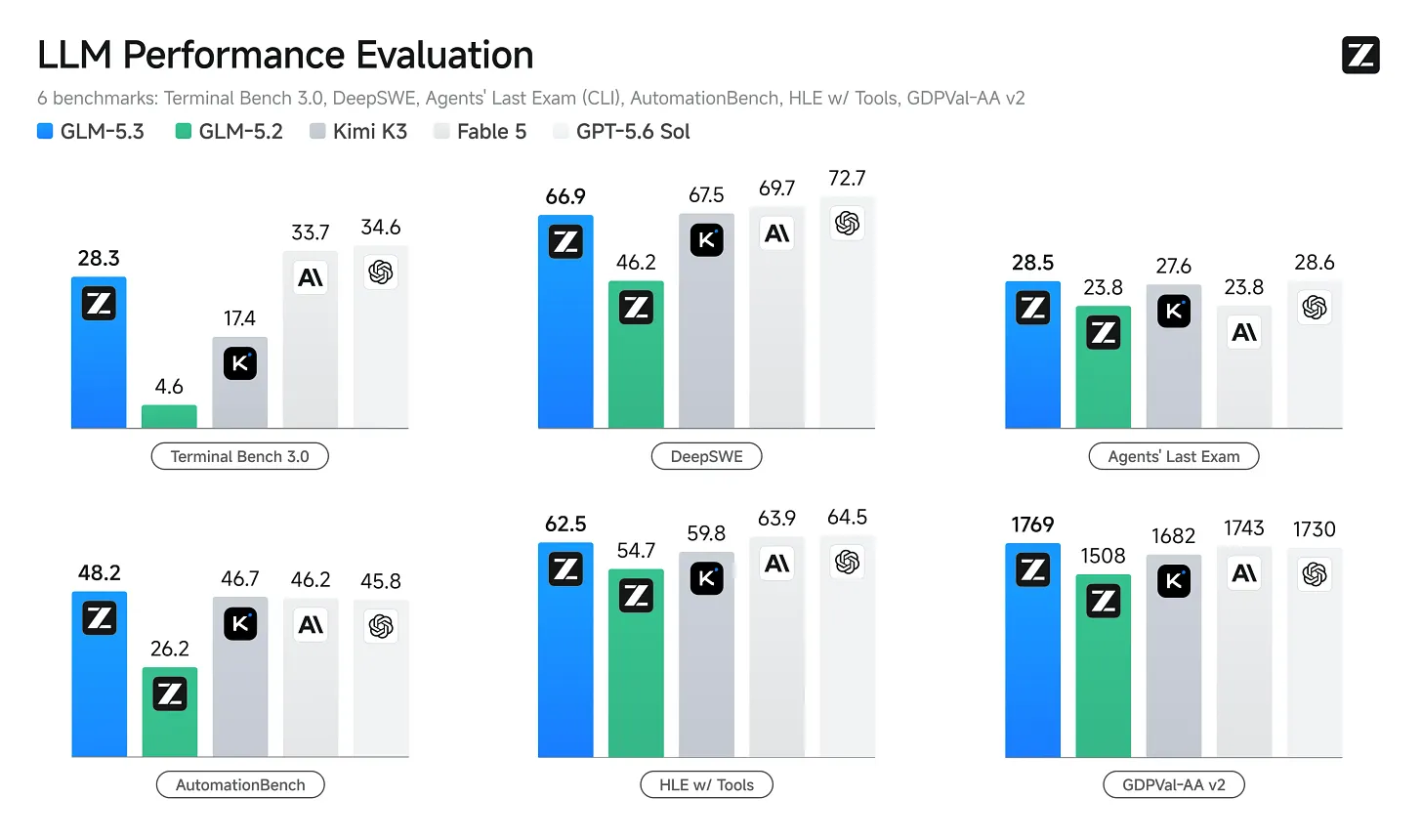
Zhipu AI announced GLM-5.3, a model that achieves performance comparable to Claude Opus and GPT-4.5 on agentic coding benchmarks while using only 750 billion parameters—roughly one-third the size of competing systems like Moonshot AI's Kimi K3. The model surpasses Kimi K3 on multiple benchmarks and rivals leading Western models on several coding tasks, according to details first reported by AI Watch.
The company attributes the gains entirely to scaled post-training rather than a new base model. GLM-5.3 uses the same foundation as GLM-5.2, released in June 2024, but with substantially extended reinforcement learning across more environments, diverse tasks, and greater compute allocation.
How Zhipu maintains competitive parity
The performance raises recurring questions about how Chinese labs keep pace with better-resourced American counterparts. The explanation appears less about distillation—copying outputs from frontier models—and more about structural advantages in development cycles and organizational focus.
Zhipu likely releases models in days rather than the months-long safety testing cycles at OpenAI and Anthropic. This compressed timeline allows Chinese labs to continue optimizing on public benchmarks while Western models sit in pre-release evaluation. With progress moving quickly, this timing gap may be the largest factor keeping Chinese offerings at the frontier, particularly as SpaceX's xAI adopts similarly rapid release patterns.
The company also benefits from narrower scope. GLM-5.3 remains text-only, avoiding the complexity of multimodal capabilities, and likely targets fewer use cases than models supporting OpenAI's or Anthropic's broad enterprise customer bases. This focus simplifies post-training assembly and allows concentration on high-value applications like agentic coding.
Why it matters
If model improvement loops increasingly depend on user data, faster release cycles give Chinese labs longer market exposure before superior models undercut demand. This dynamic creates competitive pressure that could accelerate capability diffusion—including dual-use cybersecurity capabilities—across the global economy. Zhipu acknowledges GLM-5.3's "substantial improvements in vulnerability discovery, exploit analysis, and complex multistep security tasks" and plans staged access with safety evaluations. But as the company notes, true open-weight releases make individual safeguards largely symbolic when the lowest common denominator determines actual risk.
Deep technical lineage
Zhipu's competitiveness also reflects institutional strength. The company, founded in 2019, evolved from Tsinghua University's data mining group, which released the original GLM architecture in March 2021. The team has iterated through eight major versions since then, building expertise in efficient training that predates most commercial labs.
The emerging reinforcement learning data industry in China may also play a role, with American data companies reportedly selling RL environments to Chinese labs. This allows downstream models to benefit from similar training infrastructure used by Western frontier labs, then reach market faster.
Zhipu reports reaching $1 billion in annual recurring revenue, driven largely by on-premises deployments. The company plans API access soon and open-weight release via Hugging Face within two weeks.
These details were originally reported by AI Watch in their analysis of the GLM-5.3 release.
This is an original analysis by the Omega editorial team. Source reporting: AI Watch.
Want systems like this working for your business?
Book a Call