Policy
Gary Gensler warns AI spending boom will trigger recession by 2028
The former SEC chair sees parallels to dot-com bust in current infrastructure investment cycle, citing $800 billion annual spending and opaque financing.
Key takeaways
- Former SEC Chair Gary Gensler warns AI infrastructure spending of $800 billion annually has created a bubble likely to burst before the 2028 election.
- Big Tech companies are spending five times more in 2026 than three years ago, with Gensler comparing the cycle to railroads, 1920s electricity, and 1990s internet buildouts.
- Neocloud companies leasing supercomputing capacity are identified as the most vulnerable segment, while major tech firms are expected to survive.
- Gensler expects a downturn comparable to the dot-com bust, not the 2008 financial crisis, driven partly by opaque financing structures.
- Market analyst Ed Yardeni disagrees, calling it a "self-correcting bubble" with no irrational exuberance in current valuations.
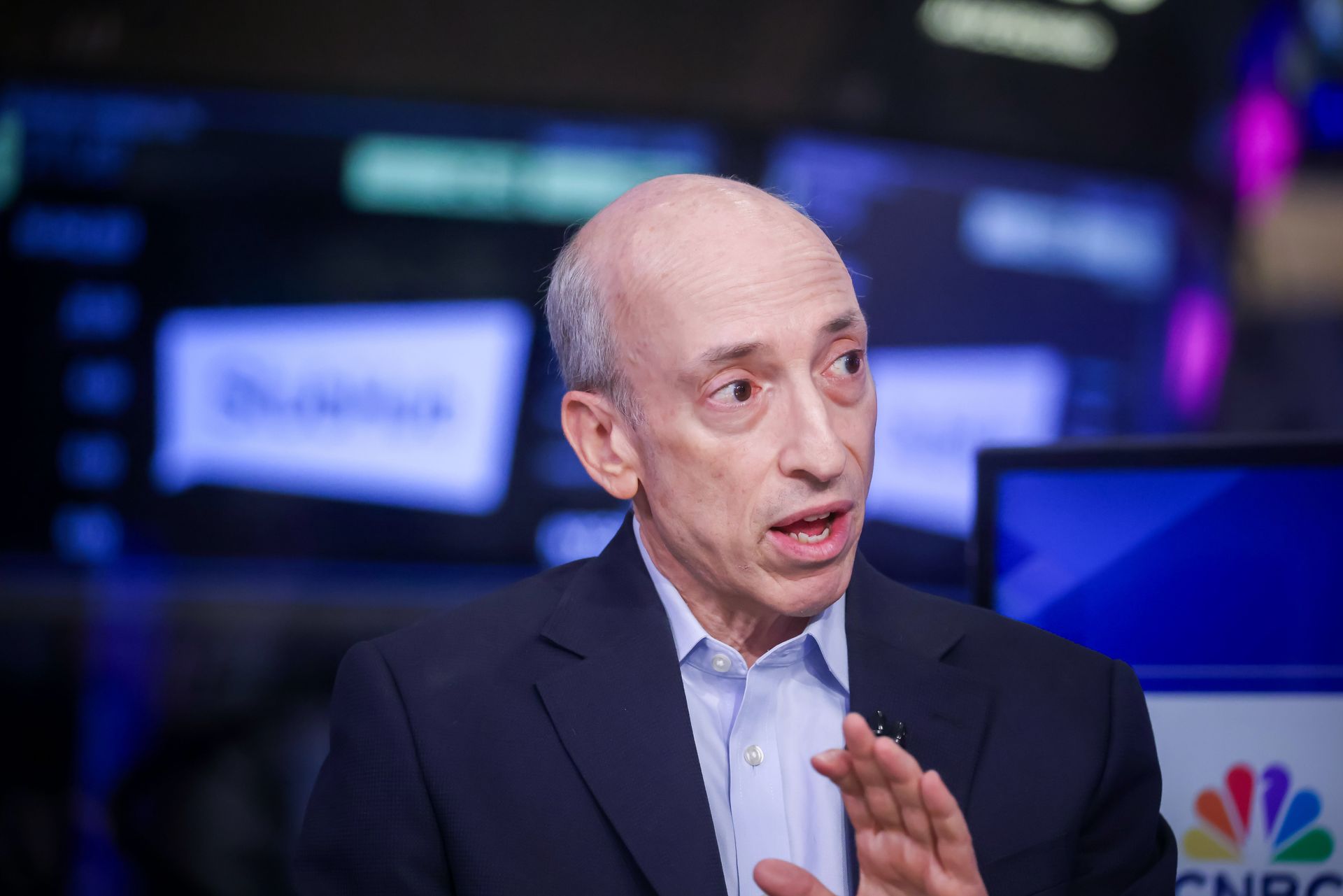
Former Securities and Exchange Commission Chair Gary Gensler has issued a stark warning that artificial intelligence investment has already formed a bubble destined to burst, likely triggering an economic recession before the 2028 presidential election.
In remarks to CNN, Gensler — who led the SEC from 2021 through early 2025 and now teaches at MIT — pointed to the extraordinary scale of capital flowing into AI infrastructure. By some estimates, that spending has reached $800 billion annually. Major technology companies are deploying five times more capital in 2026 than they did just three years earlier, he noted.
Historical patterns in technology buildouts
Gensler drew comparisons to previous technology cycles that followed similar trajectories: massive infrastructure investment driven by expectations of future returns, followed by sharp corrections once reality failed to match projections. He cited railroads, the electrification boom of the 1920s, and the internet expansion of the 1990s as precedents.
"History tells us that when you have a new technology and a significant investment ... you come to a point where it plateaus. It retrenches," Gensler said, according to CNN. The only uncertainty, he suggested, is whether the resulting downturn will be mild or severe.
Financing structures raise red flags
Beyond the volume of spending, Gensler expressed concern about how these investments are being financed. He highlighted circular deal structures and complex off-balance-sheet arrangements that obscure the true extent of financial exposure across the sector. "I think history will show that they loaned too much money, too fast," he said.
He identified so-called neoclouds — companies that lease supercomputing capacity to AI developers — as particularly vulnerable. "The major companies will survive. It's these neocloud companies where we're going to see some breakage and bankruptcies," he told CNN.
Timing and severity estimates
Gensler expects the correction to unfold before November 2028, comparing its likely impact to the dot-com crash of the early 2000s rather than the more devastating 2008 financial crisis. "I would be battening down some hatches," he said.
Not all market observers share this view. Ed Yardeni, president of Yardeni Research, called Gensler's scenario plausible but disagreed that a burst is imminent. Yardeni characterized the current situation as "a self-correcting bubble," noting that semiconductor manufacturers now trade at price-to-earnings ratios below the broader market average. "There is no irrational exuberance in valuations," he told CNN.
Why it matters
Gensler's warning carries weight given his recent regulatory role overseeing capital markets and his academic expertise in financial systems. If the AI infrastructure buildout does follow the pattern of previous technology cycles, the economic consequences could reshape corporate technology strategies and influence the political landscape heading into the next presidential election. Business leaders making long-term capital allocation decisions face the challenge of distinguishing between sustainable AI applications and speculative excess.
These details were first reported by CNN.