Federal Judge Blocks Montana AI Deepfake Disclosure Law
A preliminary injunction halts enforcement of a 2025 statute requiring disclaimers on AI-altered campaign materials, citing First Amendment concerns.
Federal court restricts Montana's AI campaign disclosure requirement
A federal judge has blocked enforcement of Montana's law mandating disclosures on AI-generated political advertisements, finding the statute likely violates First Amendment protections. Senior U.S. District Judge Susan Watters granted a preliminary injunction Wednesday against Senate Bill 25, which required disclaimers on campaign materials using artificial intelligence within 60 days of an election.
The ruling came in a lawsuit brought by former state Senator Dan Bartel and his political committee, Accountability in State Government, which had faced complaints over mailers attacking Republican legislative candidates during primary elections. Judge Watters concluded Montana "failed to prove that the purported risks of generative AI technologies could not be adequately managed" through less restrictive means.
SB 25, passed by the Montana Legislature in 2025 with bipartisan support and signed by Governor Greg Gianforte, required disclaimers on political ads using AI-generated or digitally altered content to "injure the reputation of the candidate or party or otherwise deceive a voter." The law applied only to materials distributed within 60 days of an election.
Why it matters
The decision illustrates the legal tension between protecting voters from AI-manipulated political content and preserving robust political speech rights. As generative AI tools become more accessible, states attempting to regulate their use in campaigns face constitutional scrutiny under existing First Amendment precedent. Montana's approach—requiring disclosure rather than outright prohibition—still failed to survive judicial review, suggesting narrower regulatory paths may be necessary.
The case behind the ruling
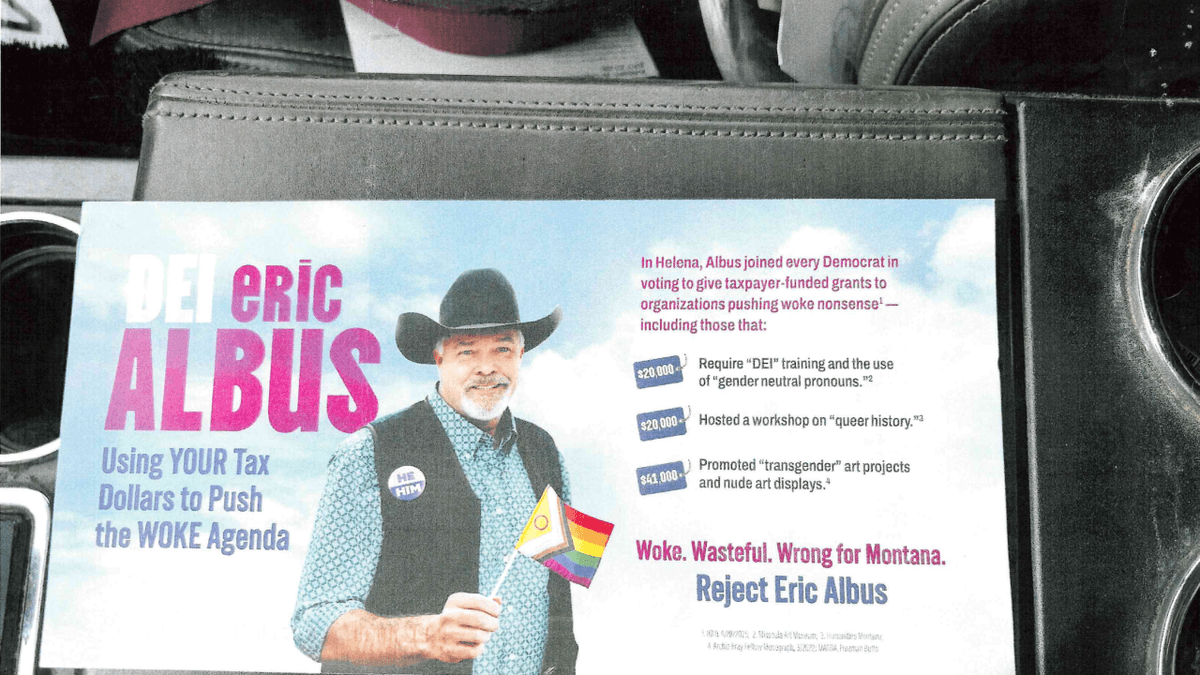
Bartel's political committee distributed mailers during GOP primaries that included altered images of candidates. One mailer depicted Representative Eric Albus wearing a pronoun pin and holding a pride flag, attacking him as "woke" for supporting a state cultural grant bill. Albus told reporters that constituents believed the manipulated image was authentic, and the mailers "polarized the Hi-Line community."
Montana's Commissioner of Political Practices had already dismissed complaints against Bartel, determining the mailers qualified as satire and parody under an exemption in the law. Bartel's attorney argued the injunction remained necessary to prevent future enforcement uncertainty.
Judge Watters identified a critical flaw in the statute: it discriminated based on viewpoint by restricting AI-generated content that criticized candidates while permitting content that praised them. The injunction currently applies only to Bartel and his committee, following recent Supreme Court precedent favoring limited relief.
What comes next
In court filings, Bartel indicated his committee plans to distribute additional AI-generated mailers targeting Democratic legislative candidates in October. Montana Attorney General Austin Knudsen's office, which defended the law, expressed disappointment and stated it is reviewing options for appeal.
Albus, who won his primary and advanced to the general election, said he hopes the Legislature will consider alternative approaches to address AI manipulation in campaigns while respecting free speech protections.
These details were first reported by KTVH in Helena.
This is an original analysis by the Omega editorial team. Source reporting: AI Watch.
Want systems like this working for your business?
Book a Call