Event-Driven Architecture Powers AI CMS Automation at Scale
Cloud-native pipelines handle metadata generation, content tagging, and freshness monitoring while editors focus on judgment calls.
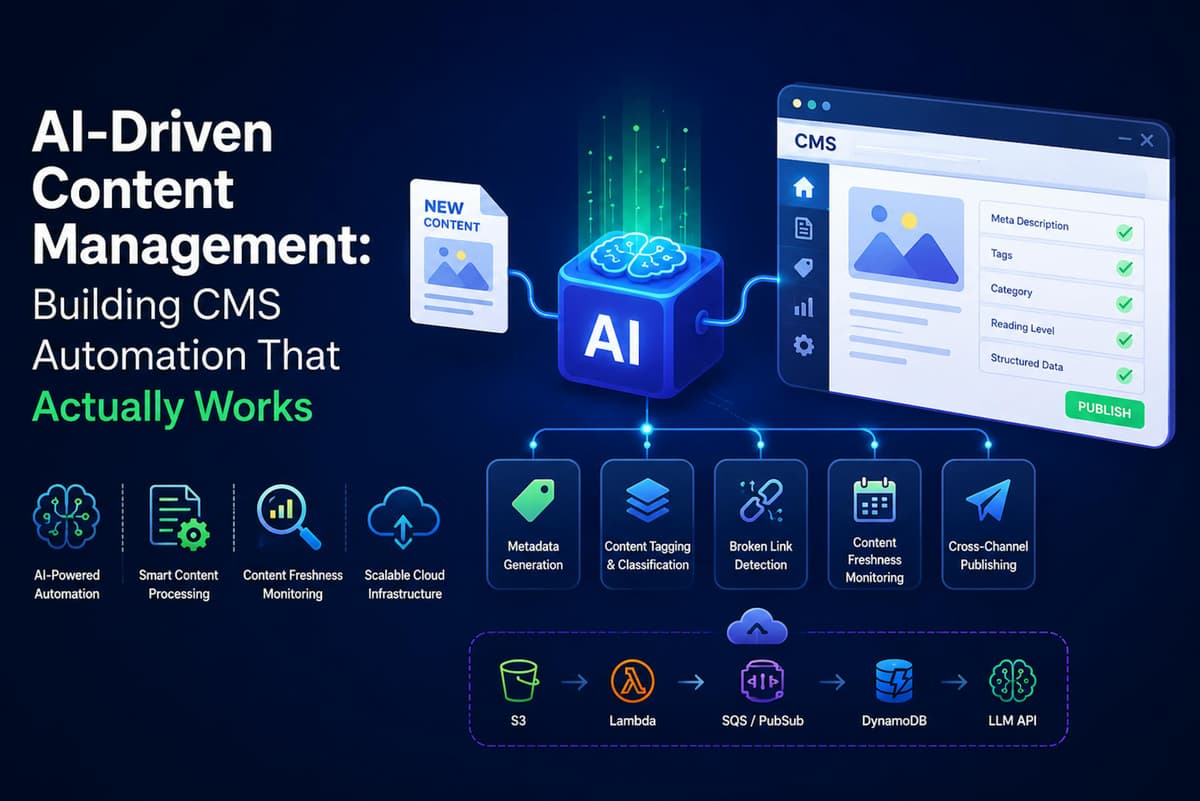
The Automation Opportunity in Content Operations
Content management systems handle editorial workflows designed for human-scale operations. That model breaks when organizations manage tens of thousands of product pages, localized variants, and multi-channel content. The bottleneck isn't editorial judgment—it's the mechanical work that accumulates at scale.
AI-powered CMS automation addresses this by targeting rule-based tasks that humans execute inconsistently under volume: metadata generation, content classification, broken link detection, and freshness monitoring. According to a technical breakdown first reported by Automation Watch, the highest-value applications aren't content generation but systematic enrichment of existing workflows.
Why it matters
Editorial teams spend significant time on repetitive tagging, metadata entry, and content audits—work that doesn't require human judgment but consumes editorial capacity. Event-driven automation shifts that burden to serverless functions and LLM APIs, letting editors focus on tone, accuracy, and strategic decisions while increasing throughput without quality degradation.
Where Automation Delivers Measurable Value
The practical applications center on consistency at scale. Automated metadata generation applies alt text, meta descriptions, and structured data markup at content ingestion. Content tagging systems analyze articles and assign topics, products, and audience segments without manual classification. Continuous crawling detects broken links and routes them for resolution. Freshness monitoring flags outdated statistics, deprecated product references, and time-sensitive claims that need editorial review.
Cross-channel publishing automatically reformats and distributes content from a single source to email, social platforms, and the CMS itself.
Cloud-Native Architecture Requirements
The technical implementation relies on event-driven design. S3 events, webhook receivers, or message queues trigger serverless processing functions—eliminating polling loops and batch job spikes. A Lambda function can intercept new content uploads, call an LLM API to generate structured metadata, and push enriched content back to the CMS without human intervention.
Idempotent processors ensure the same input produces identical output regardless of execution count. S3 event deduplication and conditional database writes enforce this behavior. Asynchronous processing with status tracking lets users see real-time progress rather than waiting for synchronous operations.
Cost controls matter at scale. LLM API calls carry per-request charges, making rate-limiting, batching, and caching essential. Frequently requested analyses—common product descriptions or shared content blocks—should be cached to reduce per-unit processing costs.
Content Freshness as a Systematic Process
Outdated content creates SEO liability and erodes trust. Manual audits don't scale across large content libraries. Automated freshness monitoring uses pattern matching to identify year references, statistics, and time-sensitive claims. Cloud functions can run daily audits, flag potentially stale content, and route flagged items to editorial teams for review.
The system produces prioritized lists showing which articles contain outdated references, when they were last updated, and which specific elements need attention.
The Editorial Handoff Model
Automation changes what editors do, not whether they're needed. Well-designed systems route enriched content to editors with mechanical work already complete—metadata generated, tags applied, freshness flags raised. Editors then handle judgment calls: tone refinement, accuracy verification, strategic framing.
The key metric is editorial throughput: content items reviewed and published per editor per day. Automation that increases this number without reducing quality validates the system design.
Automation Watch detailed these implementation patterns in a technical breakdown of cloud-native CMS automation architectures.
This is an original analysis by the Omega editorial team. Source reporting: Automation Watch.
Want systems like this working for your business?
Book a Call
