Enterprise
Enterprise AI Spending Data Reveals Fast Model Switching, Rising Open-Weight Adoption
Databricks launches public index tracking real-world model usage across 10,000+ companies, showing fragmented provider loyalty and token costs that don't predict task costs.
Key takeaways
- Enterprise loyalty to single AI providers collapsed from 64% to 28% between July and November 2024 as organizations adopted multi-provider strategies.
- Open-weight models grew from 7.3% to 30.9% of enterprise token traffic in four months, with three models ranking in the top 10 for coding performance.
- Token prices mislead on true costs: models with identical benchmark scores showed 32x cost differences per completed task based on reasoning efficiency.
- AI spending follows extreme power-law distribution, with 99th-percentile users spending 281 times more than median users weekly.
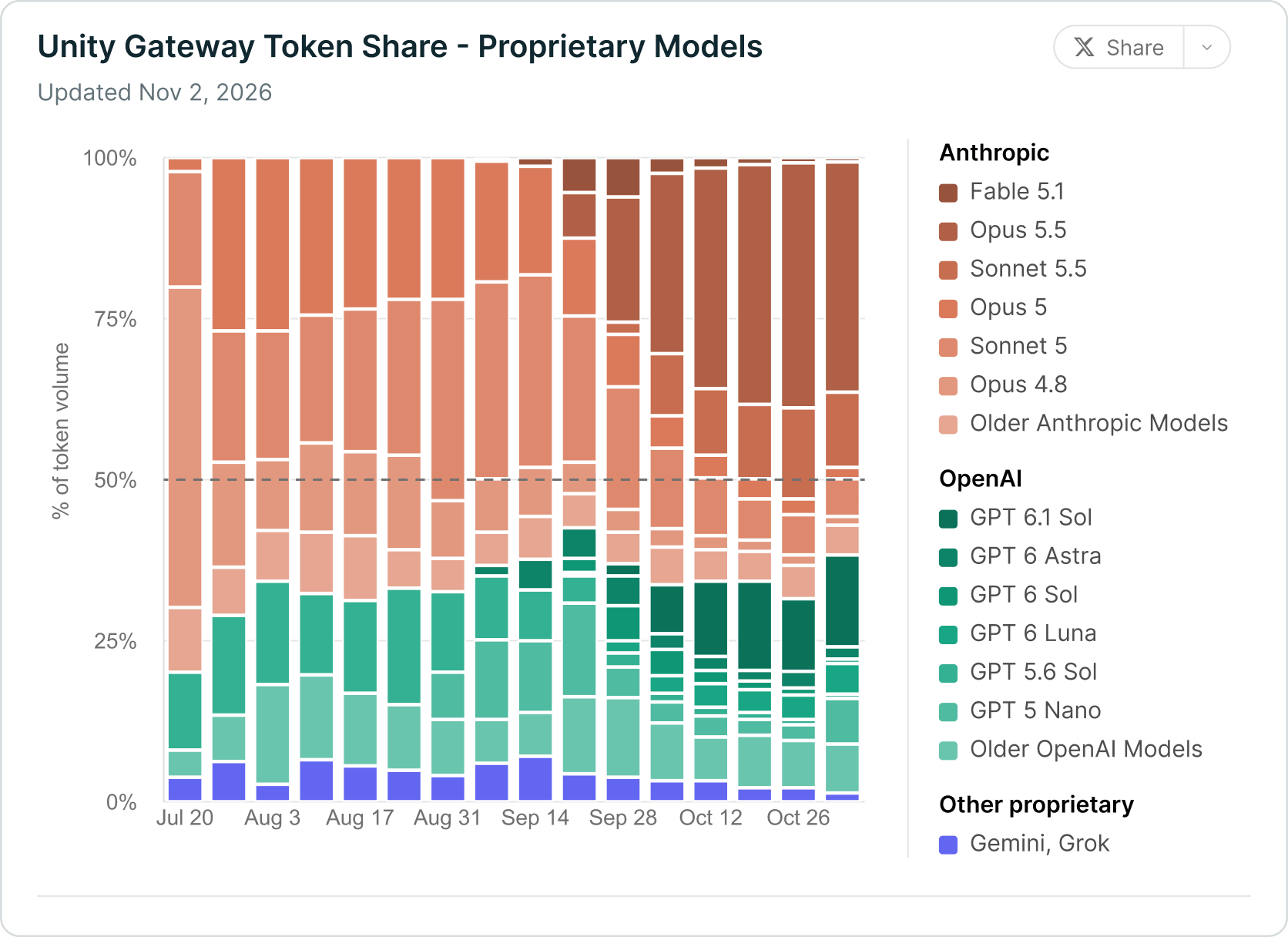
- Model market share shifts rapidly based on quality: Claude Opus 5.5 captured 37.9% of proprietary tokens within six weeks of launch.
Enterprise AI model preferences are shifting weekly, not quarterly
Databricks has published a continuously updated index tracking how thousands of enterprises actually use AI models, revealing adoption patterns that challenge conventional wisdom about model selection and costs. The Databricks AI Index combines anonymized usage data from more than 10,000 companies with coding-agent benchmarks derived from real development workflows.
The data shows enterprises are abandoning single-provider strategies faster than expected. In July 2024, roughly 64% of organizations using Databricks Unity Gateway relied on one model provider; by November, that figure had dropped to 28%. Model loyalty is equally fragile. When Anthropic released Claude Opus 5.5, its share of proprietary-model tokens jumped from 7.2% to 37.9% in six weeks, pushing Anthropic's overall enterprise share from 57.6% to 68.8%.
Open-weight models are capturing meaningful enterprise workloads. Their share of token traffic grew from 7.3% in July to 30.9% in November—more than quadrupling in four months. Three open-weight models now rank in the top 10 for coding task success rates, including DeepSeek V4.1 and GLM 5.3, both achieving 93.1% pass rates.
Why it matters
This data exposes a gap between how enterprises think about AI costs and how they actually accumulate. Organizations that optimize for advertised token prices may be overspending, while those locked into single providers are missing quality improvements available elsewhere. The index provides a rare view into aggregated enterprise behavior rather than vendor claims or synthetic benchmarks.
Token prices don't predict actual task costs
The index reveals a counterintuitive cost dynamic: lower token prices frequently lead to higher costs per completed task. GPT-6 Luna and Claude Opus 5.5 both achieved 89.1% success rates on coding benchmarks, but Luna cost $0.05 per task versus $1.62 for Opus 5.5—a 32-fold difference. Gemini 3.8 Flash, despite low token pricing, became one of the most expensive models at $11.97 per task because it required an average of 140 reasoning turns.
Cost per task depends on how much work a model must perform: extra turns, lengthy outputs, and failed attempts all consume tokens. For coding agents specifically, efficiency matters more than list prices.
Spending concentration remains extreme
AI consumption follows a power-law distribution. The median enterprise user spent $2.49 weekly on AI, while 99th-percentile users spent $699.74—281 times more. Median spending doubled over six weeks, but high-percentile spending remained flat, suggesting broader adoption among typical users while power users maintain consistent consumption.
Methodology and access
The index draws on aggregated, anonymized data from Unity Gateway spanning September 21 through November 7, 2026. Coding benchmarks use real pull requests from Databricks' private codebase evaluated against hidden tests, reducing benchmark contamination risks. Databricks updates the index weekly as new models launch.
Databricks reports evaluating new flagship models roughly every 3.7 days when including regional labs, up from weekly releases of major proprietary or open-weight models. The company uses a Day 1 internal rollout process to assess new releases within days of launch.
The full index and methodology details were published by Databricks on their corporate blog.