Automation
Duco cuts financial onboarding costs 70% with Bedrock agents
The fintech rebuilt its AI stack on Amazon's managed services to process 20 billion monthly transactions with tenant-isolated agentic workflows.
Key takeaways
- Duco reduced onboarding costs for new reconciliations by 70 percent and achieved 10× faster deployment using Amazon Bedrock AgentCore.
- The platform maintains strict tenant isolation with dedicated AWS infrastructure per client, including separate databases, encryption keys, and agent runtimes.
- A skills architecture using MCP resource types cut context from 200,000 tokens to 20,000 tokens, measurably improving agent response quality.
- Duco assigns different foundation models to specific roles — Claude Opus for planning, Sonnet for reasoning, Haiku for routing, and Nova 2 Pro for summarization.
- One global bank increased straight-through processing by more than 20 percent through better match rates and allocation rules powered by agentic workflows.
Duco, a financial operations platform serving more than 200 clients including seven of the world's top 20 banks, has rebuilt its AI infrastructure on Amazon Bedrock and Bedrock AgentCore, achieving a 70 percent reduction in onboarding costs and a tenfold improvement in deployment speed for new reconciliation processes.
The company processes 20 billion transactions monthly, automating more than 20,000 data workflows for tier-one financial institutions. Its shift from traditional machine learning models to agentic AI addresses a core limitation: classical models amplify learned patterns but cannot adapt to novel scenarios or rapidly evolving data formats without extensive retraining.
Why it matters
Financial institutions operate under strict regulatory frameworks that demand both speed and auditability. Duco's implementation demonstrates how agentic AI can deliver measurable efficiency gains in highly regulated environments without sacrificing compliance or data isolation — a blueprint for enterprise adoption in sectors where governance cannot be compromised.
Architecture built for isolation
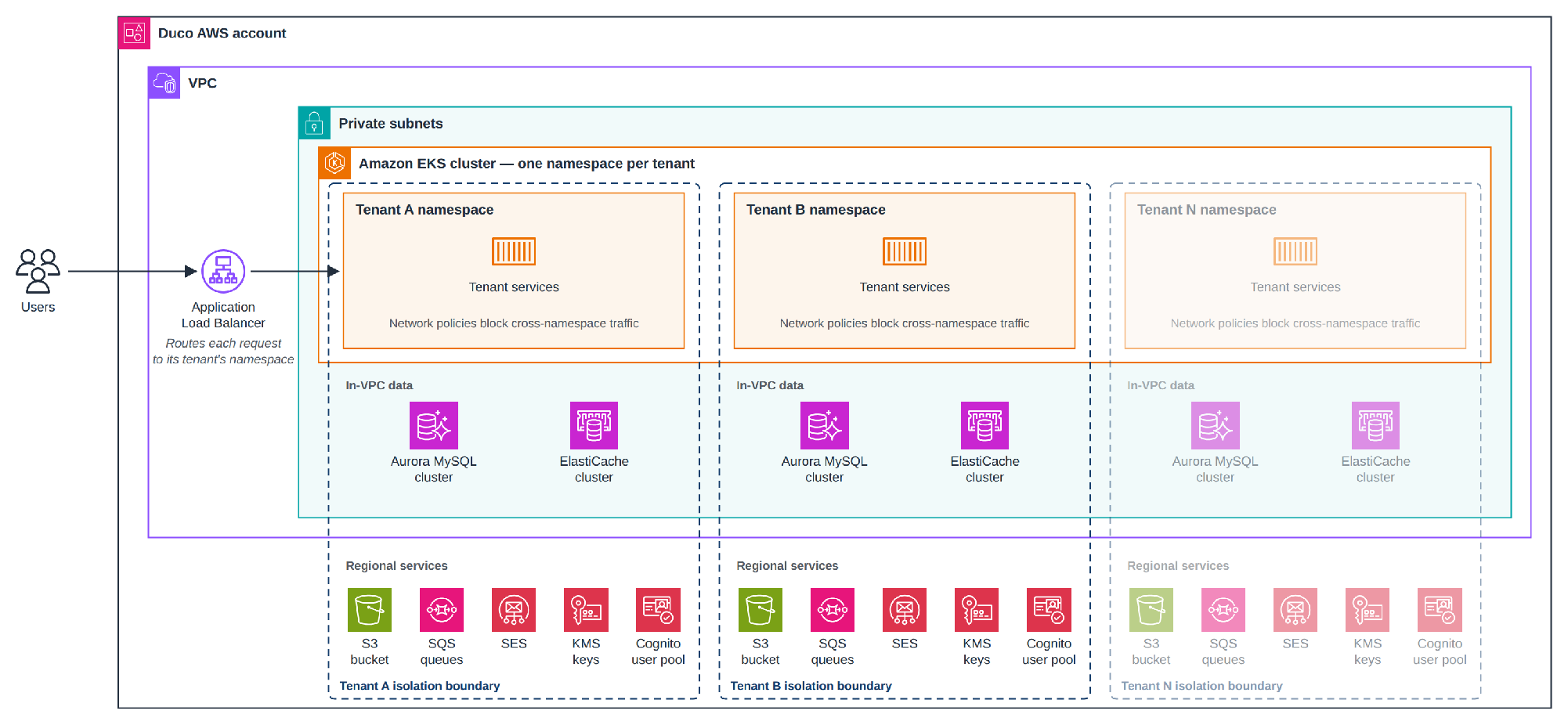
Duco operates as a multi-tenant SaaS platform with strict per-tenant isolation enforced at every layer. Each client receives dedicated AWS infrastructure: separate Aurora MySQL databases, S3 buckets, KMS encryption keys, and Cognito user pools. No data infrastructure is shared across tenants.
The company runs one Amazon Bedrock AgentCore runtime and Gateway per tenant, each configured against that tenant's Cognito pool and Kubernetes namespace. Every request carries a JSON Web Token validated before agent logic executes, and user identity passes through to downstream services. Agents reach tools only through the tenant's dedicated Gateway, which routes calls to container-based Model Context Protocol servers running in isolated Amazon EKS namespaces.
This design ensures that each agent accesses only one bank's data, context, and reasoning — a non-negotiable requirement for regulated institutions.
Solving context bloat with on-demand skills
Duco faced a technical challenge common to production agent systems: with 300 to 400 tools exposed per tenant, approximately 200,000 tokens of tool descriptions loaded into context before work began, degrading response quality as conversations lengthened.
The engineering team created a skills architecture using MCP resource types to move tool descriptions out of static context. Three meta-tools — load_skill, find_tool, and invoke_tool — replaced the bloated payload, reducing main context from 200,000 tokens to roughly 20,000 tokens while preserving prompt caching. The team validated improved agent response quality through rigorous evaluation.
Multi-model strategy by workload
Rather than committing to a single foundation model, Duco assigns each role to the model best suited for it. Anthropic Claude Opus handles complex planning, Claude Sonnet manages main reasoning and reconciliation logic, Claude Haiku routes lightweight decisions for cost efficiency, and Amazon Nova 2 Pro summarizes tool outputs. The architecture allows model swapping without disrupting the stack.
Production impact
Duco now deploys new reconciliations ten times faster than before. One global bank achieved a 70 percent decrease in onboarding costs and increased straight-through processing by more than 20 percent through improved match rates.
Agents handle exception investigation by triaging new breaks, checking context, pulling evidence from source systems, and recommending decision-ready cases with supporting evidence. Analysts review the work and make final calls, with every decision recorded in the audit trail.
Rob Gates, Duco's Chief Architect and Innovation Officer, noted that traditional machine learning models "can only amplify what they've already learned — they can't help with the next step or find new problems."
The implementation supports SOC 2 and DORA compliance requirements with comprehensive observability, human-in-the-loop controls for high-risk actions, and fail-safe defaults that prioritize client protection.
These details were first reported by AWS in a machine learning blog post.