Drone Food Delivery Adoption Hinges on Public Trust, Not Just Speed
Chinese survey data reveals consumers weigh visibility, pricing fairness, and governance alongside convenience when evaluating aerial delivery services.
Public perception shapes drone delivery acceptance
As drone-based food delivery moves from pilot programs to everyday infrastructure, a new study reveals that consumer adoption depends on far more than speed and convenience. Research examining 314 Chinese consumers found that acceptance of aerial delivery services is shaped by trajectory visibility, pricing fairness, platform governance, and how the technology fits into shared public spaces.
The findings, published in Humanities and Social Sciences Communications, challenge the assumption that drone delivery evaluation mirrors traditional e-commerce adoption. When automation becomes physically present—audible, visible, and moving through neighborhoods—consumers evaluate not just whether it works, but whether it belongs.
Why it matters
Companies investing in drone delivery infrastructure often focus on operational metrics: flight time, payload capacity, regulatory clearance. This research demonstrates that commercial viability depends equally on social acceptance factors that don't appear on engineering spec sheets. For technology leaders, the implication is clear: public-facing automation requires public-facing design—in interfaces, pricing models, and governance transparency.
Four evaluation dimensions beyond utility
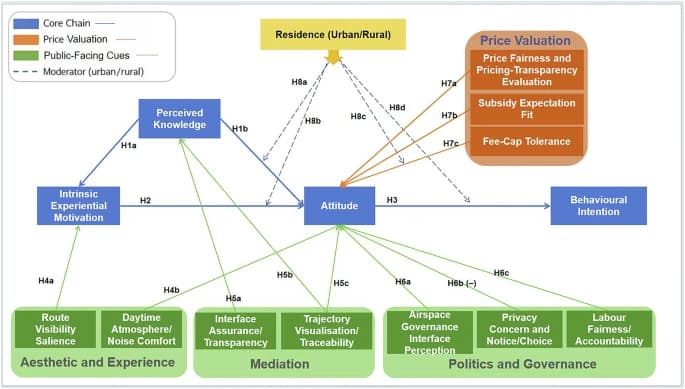
The study identified four distinct ways consumers assess drone food delivery services:
Sensory fit and co-existence: Can drones operate in everyday environments without creating unacceptable noise, visual clutter, or safety concerns? Aesthetic and experiential factors influence whether consumers view the service as compatible with their neighborhoods.
Mediated intelligibility: Platform interfaces that display flight paths and delivery status don't just inform—they make an otherwise opaque aerial operation feel traceable and controllable. The research found trajectory visualization was associated with both perceived knowledge and overall attitude toward the service.
Public legitimacy and governance: Privacy expectations, accountability mechanisms, and platform governance practices shape whether consumers view drone operations as legitimate uses of shared airspace. In China's evolving regulatory environment—with new mandatory standards for operational identification and real-name registration—these governance signals carry weight.
Exchange acceptability: Price fairness, subsidy expectations, and fee caps function as normative boundaries. Consumers judge not only whether drone delivery works, but whether its economic terms constitute an acceptable exchange. Perceived pricing unfairness can override functional appeal.
Urban-rural differences proved minimal
Contrary to expectations, the study found limited variation between urban and rural respondents. Only marginal differences appeared around fee-cap tolerance, and these were not statistically robust. This suggests that concerns about visible automation in shared spaces transcend residence type.
Implications for platform design
The research positions attitude as an "evaluative gateway" through which diverse public-facing cues are consolidated. For drone delivery operators, this means interface design, pricing transparency, and governance communication aren't peripheral concerns—they're core adoption drivers.
The study employed ordinal confirmatory factor analysis and structural equation modeling with weighted least squares estimation, analyzing survey data through a framework combining social cognitive theory and goal-directed behavior models.
These findings were first reported by Le Cao in Humanities and Social Sciences Communications, published by Springer Nature.
This is an original analysis by the Omega editorial team. Source reporting: Automation Watch.
Want systems like this working for your business?
Book a Call