Dexterity's Mech Robot Tackles Warehouse Labor Gaps with AI
The superhumanoid system uses dual autonomous arms and Beckhoff controls to automate truck loading at FedEx and other distribution centers.
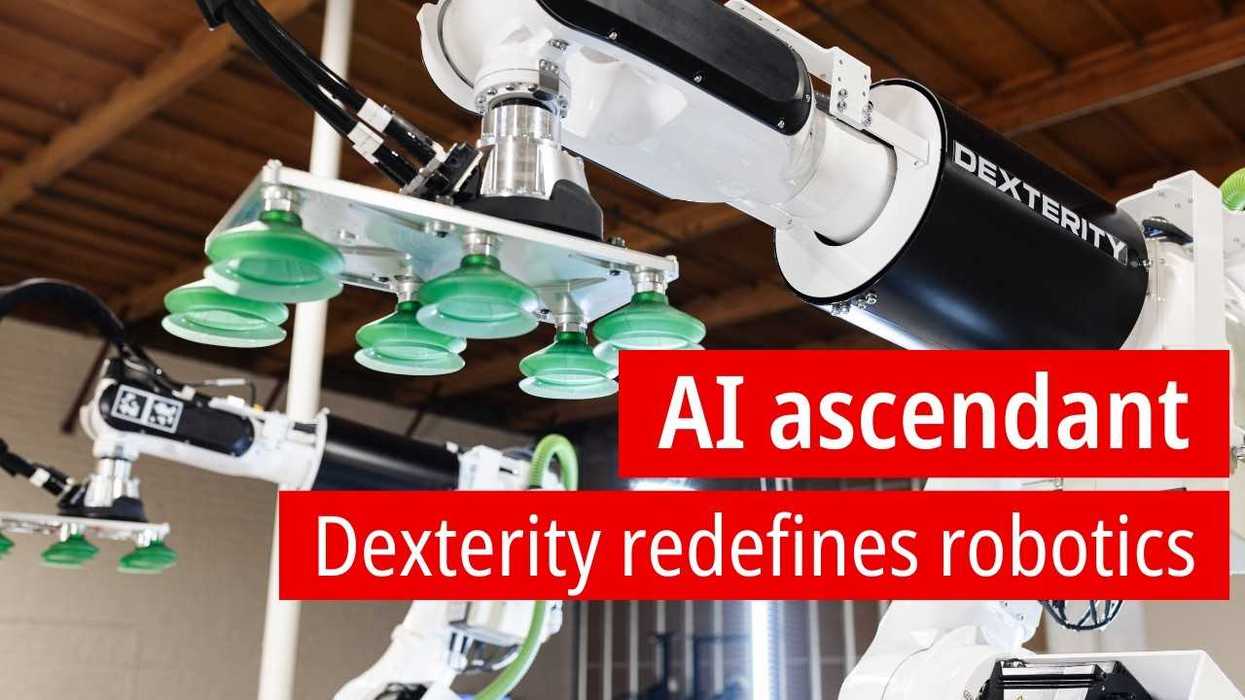
Humanoid robotics enters the warehouse
Distribution centers confronting persistent labor shortages and demanding physical work now have a new automation option: Dexterity's Mech, a dual-armed robot designed specifically for logistics operations.
The system combines two autonomous robotic arms with tactile sensing capabilities mounted on a mobile platform. This configuration enables the Mech to perform repetitive warehouse tasks—particularly truck loading and unloading—with flexibility that approaches human capability while eliminating safety risks associated with physically strenuous work.
FedEx deployment shows real-world application
Delivery giant FedEx has already put the technology to work, partnering with Dexterity to automate trailer loading and unloading operations. The collaboration allows the company to redeploy workers to other critical functions while maintaining safety standards and service levels.
The Mech's design addresses a fundamental challenge in warehouse automation: adapting to variable conditions. Traditional fixed automation struggles with the unpredictability of parcel handling, where package sizes, weights, and orientations constantly change. The robot's advanced sensing and AI-driven planning enable it to adjust to these variations in real time.
Technical foundation enables scale
Dexterity selected Beckhoff's EtherCAT-based control architecture to power the Mech's physical AI platform. This unified control system integrates diagnostics and safety features that simplify both initial deployment and ongoing troubleshooting—critical considerations for organizations planning to deploy robot fleets across multiple facilities.
The architecture's standardization also streamlines commissioning processes, reducing the time and expertise required to bring new units online. For logistics operators evaluating automation investments, deployment speed and operational complexity often matter as much as the robot's core capabilities.
Why it matters
Warehouse automation has historically required significant infrastructure investment and works best with predictable, repetitive tasks. Dexterity's approach with the Mech represents a shift toward more adaptable systems that can handle variable work without extensive facility modifications. As labor markets remain tight and throughput demands continue rising, technologies that combine human-like dexterity with consistent performance become increasingly valuable for distribution operations. The FedEx deployment provides early validation that AI-powered humanoid robots can deliver practical value in high-volume logistics environments.
Broader automation trajectory
The partnership between Dexterity and Beckhoff reflects a broader trend in industrial automation: combining advanced robotics with standardized control platforms to create scalable solutions. As AI capabilities mature, the gap between what robots can do and what human workers handle daily continues to narrow, particularly for physically demanding tasks in structured environments like warehouses.
Details of the Dexterity Mech system and its deployment were reported by Automation Watch.
This is an original analysis by the Omega editorial team. Source reporting: Automation Watch.
Want systems like this working for your business?
Book a Call
