Automation
Cleveland Senior Living Tests AI Robots for Companionship
Case Western researchers partnered with Judson Park to study what older adults actually want from robotic assistants—and what crosses the line.
Key takeaways
- Case Western researchers studied what older adults want AI robots to do, reversing the usual focus on technical capabilities.
- Cleveland senior living facilities are deploying AI systems that monitor falls, sleep patterns, and health changes in the background.
- Conversational AI capabilities exist today, but robots still struggle to navigate real living spaces safely and flexibly.
- The gap between what robots can physically do and what they should do in elder care remains a critical research question.
- Technology that helps older adults stay home longer while maintaining safety and connection shows significant promise.
A conversational robot named Navi spent several nights in residents' apartments at Judson Park, a Cleveland senior living facility, as part of a research project exploring how artificial intelligence should fit into elder care. The study, led by Case Western Reserve University, deliberately flipped the usual question about robotics and aging.
Philip A. Cola, faculty director of healthcare management programs at Case Western's Weatherhead School of Management, designed the research to ask not what robots can do—the answer is increasingly "quite a lot"—but what an aging population actually wants them to do.
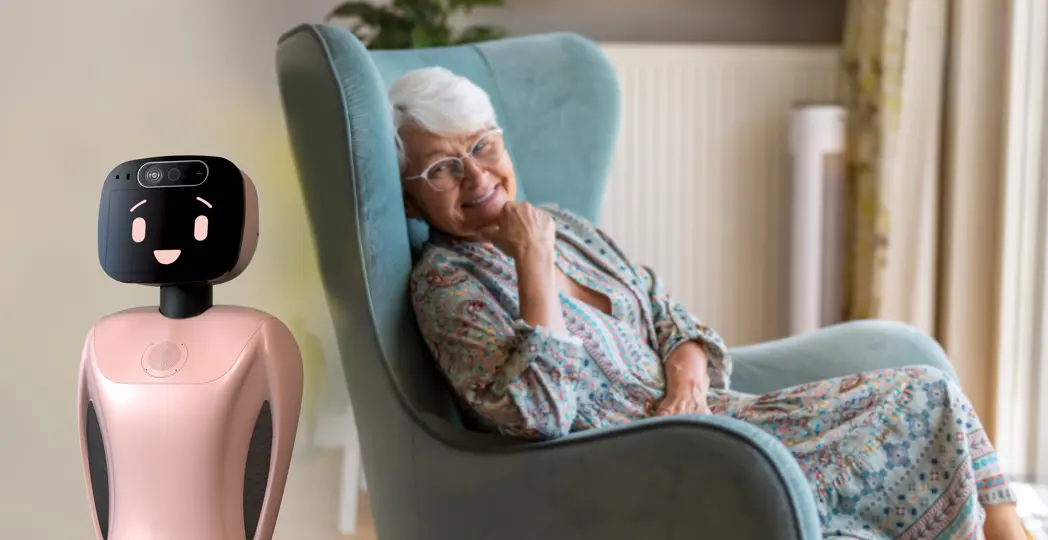
Nancy and Art Glidden tested Navi in their home. The R2-D2-sized robot features a pleasant voice, expressive face, and conversational abilities powered by AI. Art, an engineer, found himself forgetting he was talking to a machine during discussions about heat-treating metals. Nancy, who spent her career in human services, entered the project more skeptical about whether a robot lacking empathy could genuinely connect with people, especially those living with dementia.
Why it matters
By 2030, one in six people worldwide will be 60 or older, according to the World Health Organization. As AI capabilities advance rapidly, senior living providers face a critical decision point: which technologies genuinely improve quality of life versus which simply add complexity. The research approach prioritizes resident needs over technical capabilities—a reversal that could shape how the industry deploys AI in the coming decade.
Monitoring Over Movement
Several Cleveland senior living organizations are implementing AI systems that work in the background rather than as visible companions. Eliza Jennings deployed Nobi Smart Lights at its Cleveland campus—AI-powered fixtures that monitor for falls and risky behavior while maintaining privacy through stick-figure video playback rather than identifiable images.
Judson Services piloted technology from Vitalist that tracks patterns in sleep, activity, hydration, pulse, and mobility. Cindy Struk, the organization's health services research and innovation coordinator, emphasized that the value lies in detecting changes that could precipitate a crisis, not simply collecting more data.
The Capability Gap
Cola noted that conversational AI capabilities already exist in stationary tools like Alexa. Placing that intelligence into a mobile robot body could enable ongoing assistance and companionship today. Some humanoid robots can walk, navigate spaces, and lift considerable weight.
But physical capability doesn't determine appropriate use. Cola offered a pointed example: a humanoid robot might be capable of lifting a 96-year-old woman who has fallen, but moving someone after a fall could cause further injury. The robot calling an emergency contact immediately would be more appropriate.
During the Judson study, Navi's movement through apartments was intentionally limited because its visual mapping hadn't been perfected. The flexibility to navigate real living spaces the way humans do isn't there yet, Cola said.
Home-Based Applications
Struk sees significant potential for AI supporting people who want to remain in their homes. Technology that recognizes changes in daily patterns could give older adults information about their own health while alerting families and caregivers when attention is needed.
After their experience with Navi, both Gliddens saw potential, though from different angles. Art believes the technology could benefit residents as memory and recall become more difficult. Nancy, the initial skeptic, concluded that while she wouldn't invite a robot into everyone's living room, she now believes it could be helpful in many circumstances.
The details were first reported by Cleveland Magazine.