Policy
China Produces 60% of Elite AI Researchers, U.S. Retains Edge by Attracting Them
A new study reveals the global talent pipeline that powers frontier AI development—and why immigration policy matters more than ever.
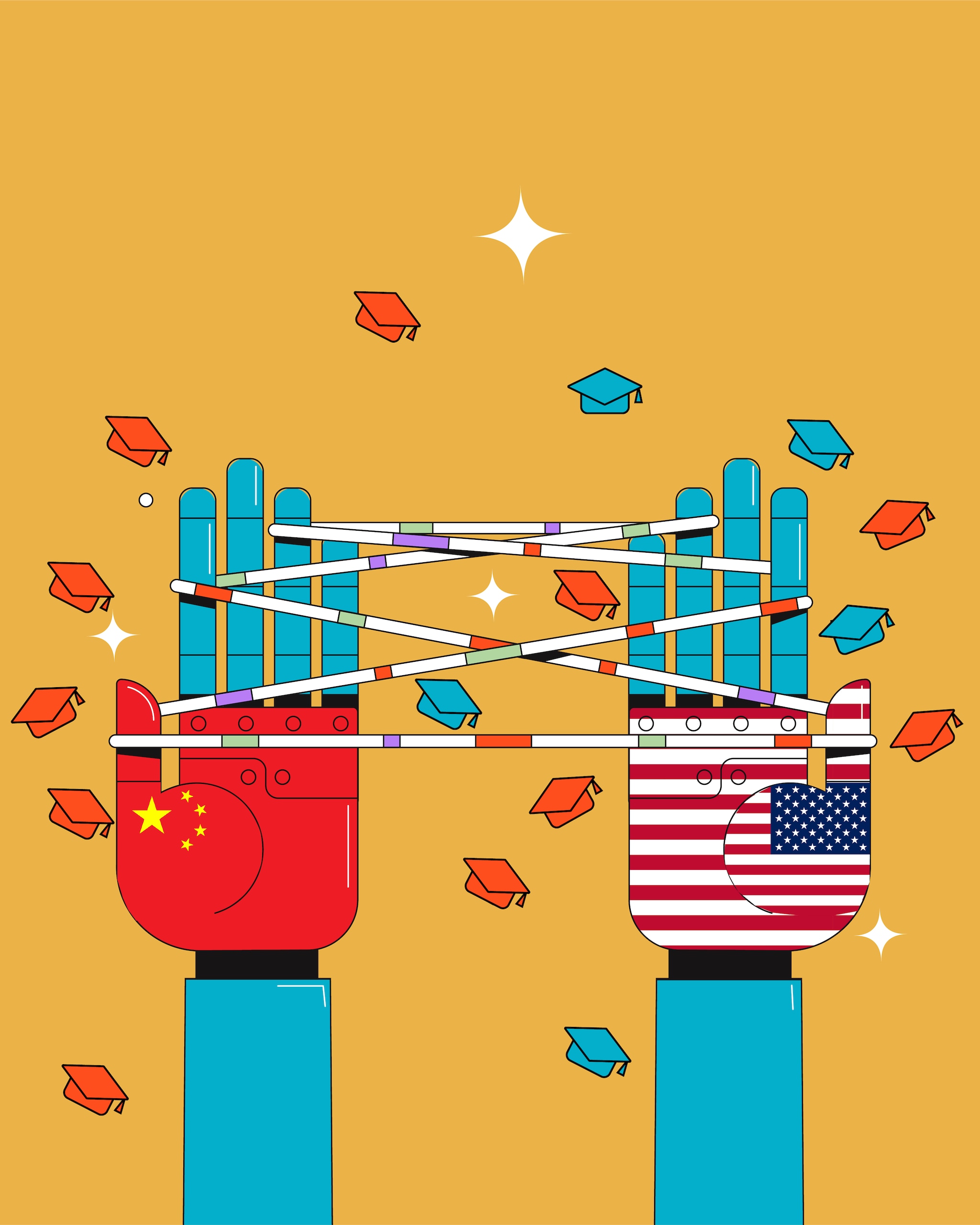
Key takeaways
- China produces 60% of elite AI researchers at the undergraduate level, compared to just 13% in the United States, according to a Carnegie study of over 10,000 top researchers.
- The U.S. maintains its AI edge by attracting global talent—roughly 70% of top researchers working in America are of Chinese or Indian origin.
- China now retains 41% of all top AI researchers globally, showing significant improvement in keeping homegrown talent after decades of STEM investment.
- Restrictive immigration policies pose a strategic risk to U.S. AI development, potentially doing more damage than foreign competition.
- China awards 1.7 million STEM bachelor's degrees annually compared to 500,000 in the U.S., creating a talent pipeline advantage that takes decades to build.
The Global Competition for AI Talent
The artificial intelligence revolution hinges less on computing power or capital than on a single resource: elite research talent. A comprehensive Carnegie China study tracking over 10,000 leading AI researchers reveals a striking imbalance in where that talent originates—and where it ultimately works.
Nearly 60 percent of researchers whose work was accepted at NeurIPS 2025, a premier AI conference, earned their undergraduate degrees in China. The United States, by comparison, produced just 13 percent. Yet America maintains a decisive advantage in a different arena: attracting and retaining top researchers from around the world, particularly from China and India.
Why it matters
The composition of AI research teams directly shapes which nations lead in developing frontier models. With Chinese and American talent together comprising roughly 70 percent of top researchers working in the United States, immigration and visa policies have become strategic technology decisions. Restrictions that limit access to global talent pools could undermine the U.S. position in AI development more effectively than any foreign competitor.
The Talent Pipeline in Practice
The career trajectories of prominent researchers illustrate how this pipeline functions. Kaiming He, recently tenured at MIT, won China's national physics olympiad before studying at Tsinghua University and completing doctoral work in Hong Kong. His 2015 paper on deep residual learning, co-published while at Microsoft Research Asia's Beijing lab, became the most-cited research paper of this century according to Nature. The techniques He developed now underpin virtually all generative AI models, including ChatGPT and Gemini.
Similarly, Fei-Fei Li—widely regarded as the "godmother" of AI—grew up in China's Sichuan province before moving to Princeton University, where she pioneered computer vision research. Advanced Micro Devices recently acquired her company, World Labs, for $8.2 billion.
China's Retention Gains
While the United States excels at attracting talent, China has made significant progress in retention. The Carnegie study found that 41 percent of all top AI researchers now work in China, with the majority of Chinese-educated talent remaining in the country. This represents the payoff from more than two decades of deliberate investment in STEM education—China now awards approximately 1.7 million bachelor's degrees annually in science, technology, engineering, and mathematics fields, compared to 500,000 in the United States.
The Policy Paradox
America's rapid progress in frontier AI depends substantially on researchers who originate from its primary technological competitor. When OpenAI livestreamed its Images 2.0 launch in April, observers noted that CEO Sam Altman was surrounded by young Asian researchers, at least half of Chinese origin. Unconfirmed reports suggested Meta AI chief Alexandr Wang's lab was initially composed of 50 percent Chinese talent.
This creates a strategic tension: legitimate national security concerns about technology transfer must be balanced against the reality that restricting access to global talent could slow American AI development more than it protects sensitive capabilities. The Carnegie analysis suggests that small policy adjustments—such as revoking a Trump-era presidential proclamation that restricted entry for some Chinese graduate students and researchers—could signal openness without compromising security.
The Long Game
Talent cultivation operates on multi-decade timescales, making China's STEM education advantage difficult to replicate quickly. Europe, Britain, Canada, and Australia are also attracting more AI talent than they produce domestically, while South Korea and Singapore have made notable gains.
The details in this analysis were first reported by Damien Ma, director of Carnegie China in Singapore, writing in The Washington Post. The underlying message is clear: in a marathon competition for AI supremacy, human capital remains the indispensable ingredient—and access to global talent pools may prove as strategically important as any domestic research program.