China Embeds AI Across Research Labs to Test Central Planning
Beijing's national experiment links universities, state labs, and tech firms to determine whether artificial intelligence can overcome the limits of government-directed science.
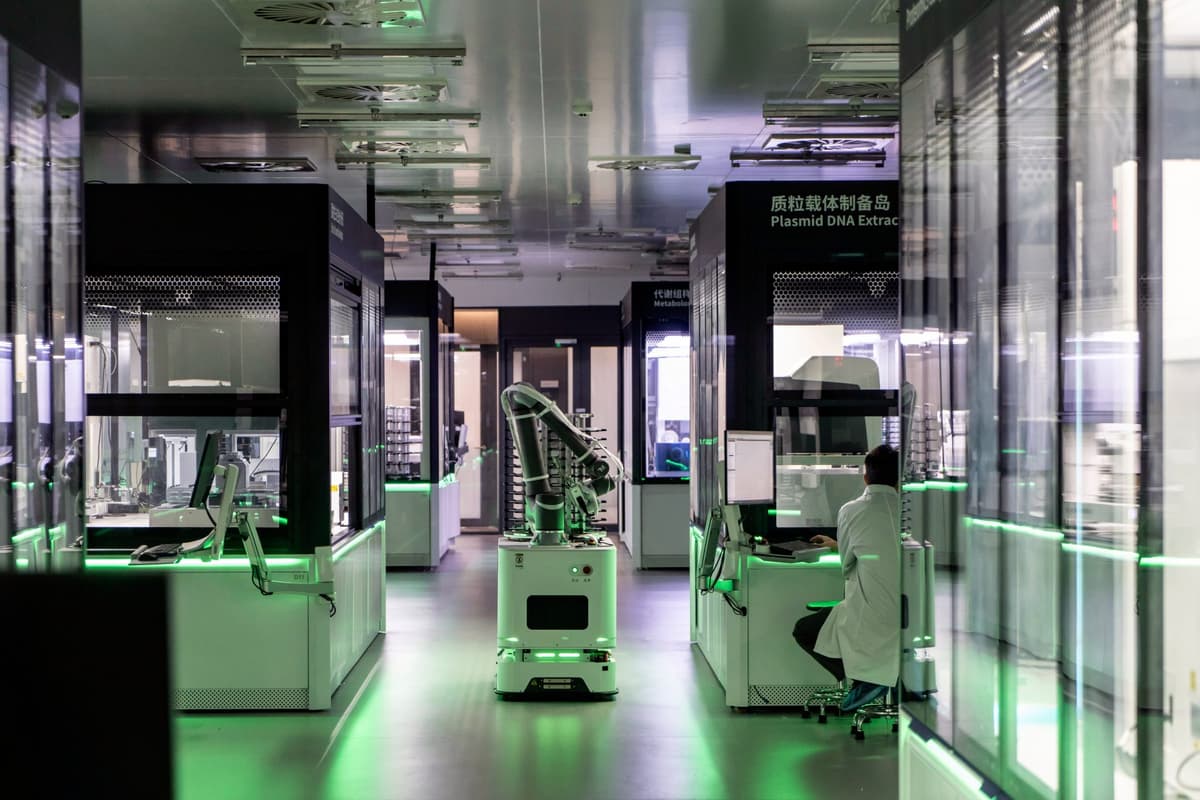
China's National AI-Science Integration
China is conducting an unprecedented experiment in scientific organization: embedding artificial intelligence agents and automation throughout its national research apparatus to determine whether technology can compensate for the inherent limitations of centralized planning.
The effort connects universities, state laboratories, and technology companies under coordinated industrial policy. According to the 2026 "AI plus education" action plan issued by China's education ministry and four partner agencies, the initiative calls for scientific agents, interdisciplinary research platforms, intelligent laboratories, and autonomous experimental clusters. A national computing platform will pool computing power, data, models, and tools for universities nationwide.
Municipal programs reinforce this strategy. Beijing and Shanghai are developing dedicated AI-for-science initiatives, while a platform from the Shanghai Academy of Artificial Intelligence for Science integrates more than 400 scientific models and tools. According to the 2026 Nature Index, China now ranks first globally in research output across leading journals, with particular strength in chemistry, materials, and applied sciences.
Why it matters
This campaign represents a fundamental test of whether AI can resolve a longstanding tension in scientific progress: centralized systems excel at mobilizing resources toward defined objectives, but breakthrough discoveries often emerge from decentralized experimentation and unconventional ideas that bureaucracies struggle to recognize in advance. If China succeeds, it could shift the competitive balance in technological leadership. If the effort amplifies conformity instead, it will demonstrate the limits of state-directed innovation even with advanced tools.
The Central Planning Problem
Governments have historically accelerated technological development when outcomes are clearly defined—nuclear weapons, spaceflight, and vaccines all required public funding and institutional coordination. But scientific discovery begins before either the objective or the appropriate measure of success is known. Researchers cannot reliably predict which questions will prove important or which impractical ideas will acquire unexpected applications.
This creates a knowledge problem for centralized research systems. Administrators must allocate resources according to judgments that can only be validated after research concludes. Political priorities and easily measured outputs—publication targets, patent counts, official priority areas—consequently determine which projects receive support. Since 2020, China's government has sought to reduce the importance of these metrics in scientific evaluation, acknowledging that centrally imposed indicators can generate output without corresponding advances in knowledge.
AI could alter this dynamic. Models capable of processing scientific literature, analyzing experimental data, and generating hypotheses may help governments identify promising research more accurately. Automated laboratories can test numerous possibilities at lower cost. Yet AI cannot eliminate uncertainty about which discoveries will ultimately matter, and it may reinforce conformity if researchers train the same models on the same knowledge toward centrally selected objectives.
Three Possible Outcomes
The most probable scenario, assigned a 50 percent likelihood, is selective acceleration: AI increases research productivity without overcoming fundamental limitations of central direction. China makes rapid advances in materials, energy technologies, pharmaceuticals, and engineering—fields where objectives are comparatively clear and manufacturing capacity provides immediate feedback—while Western countries retain advantages in fundamental research through more decentralized institutions.
A second scenario, at 40 percent probability, involves accelerated conformity: universities and laboratories adopt similar models, use identical datasets, and pursue government-selected priorities. Automated experimentation increases result volume, but flawed assumptions spread system-wide. Reported productivity rises without comparable increases in important discoveries.
The least likely outcome, at 10 percent probability, is that AI substantially reduces the knowledge problem facing research planners, enabling a series of major discoveries that validate centralized direction and prompt other governments to adopt similar approaches.
Export controls on advanced chips compound these challenges by making computing capacity scarce, increasing the likelihood it will be assigned to officially designated priorities rather than distributed through competitive allocation.
These details were first reported by GIS Reports.
This is an original analysis by the Omega editorial team. Source reporting: AI Watch.
Want systems like this working for your business?
Book a Call