California's AI Executive Order Could Set National Standards
Gov. Newsom's directive for auditors, kill switches, and safety plans may become de facto federal policy through the California effect.
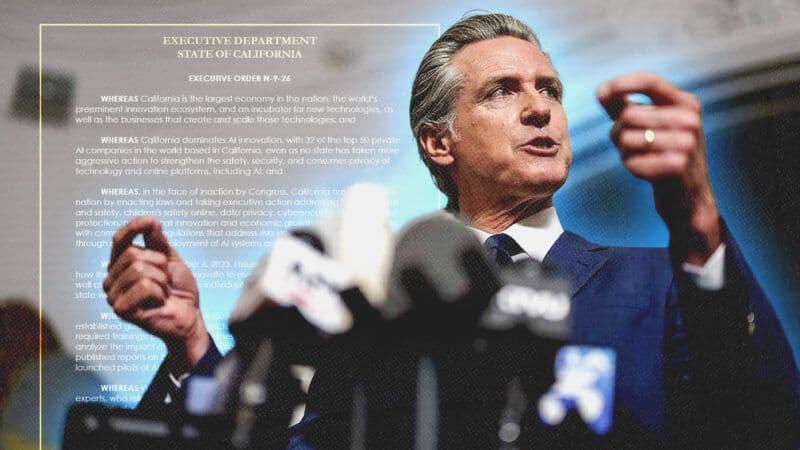
California moves to regulate frontier AI models
California Governor Gavin Newsom has issued an executive order directing state officials to develop stricter oversight mechanisms for artificial intelligence companies, including potential requirements for independent auditors stationed inside AI labs and mandatory "kill switch" capabilities for frontier models. The directive assembles a panel of experts with a two-month deadline to recommend how California should strengthen its AI safety framework.
The order specifically tasks the group with examining how to require frontier AI companies to submit to third-party safety plans, advance kill-switch implementation, and expand the definition of "critical safety incidents" to include loss-of-control events. According to Reason, which first reported the details, the move accelerates implementation of existing legislation—Senate Bill 813 and Assembly Bill 1405—that creates a framework for certifying AI auditors but stops short of mandating their use.
Why it matters
California's regulations won't stay in California. The state's dominant position in the AI industry means its rules effectively become national standards through what policy analysts call the "California effect"—when one state's market power forces companies nationwide to comply with its regulations. This dynamic has already shaped labor and environmental policy across the United States, and AI governance appears poised to follow the same pattern. For business leaders planning AI investments, California's regulatory direction will likely determine compliance requirements regardless of where they operate.
The reversal from 2024
The executive order represents a significant policy shift for Newsom. In 2024, he vetoed Senate Bill 1047, which contained similar provisions for mandatory audits, safety testing, and kill-switch requirements for large-scale models. In his veto statement, Newsom warned that the bill could create a "false sense of security" by focusing exclusively on large models while smaller systems posed comparable risks. He cautioned against overregulation that could "put ourselves in a perilous position."
Newsom now frames the issue as a response to federal inaction, writing in a recent Facebook post: "With Donald Trump and Congress failing to lead, California is stepping up to keep all Americans safe." The order cites recent security incidents and calls from industry leaders for government intervention as justification for the accelerated timeline.
Concerns about state-level AI governance
Adam Thierer, a senior fellow at the R Street Institute, disputes the administration's characterization of California's approach as a "guidebook for the nation," calling it instead "a rule book." He warns that a patchwork of state regulations could create overlapping compliance burdens that benefit large companies while disadvantaging smaller competitors—"a complete inversion of the model that has governed the internet and digital commerce and speech for the last 30 years."
The effectiveness of government-mandated safety measures remains uncertain. Thierer previously told Reason that kill-switch mandates could establish "a sort of false baseline of safety" that companies meet without exceeding, potentially dampening competitive incentives to develop superior safety protocols. Nvidia CEO Jensen Huang offered a contrasting view in a CBS News interview, arguing that existing legal frameworks already "perfectly incentivize" companies to act responsibly.
While constitutional doctrines like the dormant Commerce Clause theoretically limit states' ability to regulate interstate commerce, the Supreme Court has narrowed these protections in recent years, and companies have shown reluctance to challenge state-level technology regulations in court.
The expert panel's recommendations are expected within two months, though the full ramifications of California positioning itself as what Thierer calls "the overlord of all things AI" remain to be determined. These details were first reported by Reason.
This is an original analysis by the Omega editorial team. Source reporting: AI Watch.
Want systems like this working for your business?
Book a Call