California Governor Orders AI Kill Switch Review in Two Months
Newsom's executive order tasks experts with drafting AI safety rules that could become the de facto national standard.
California moves to fill federal AI policy vacuum
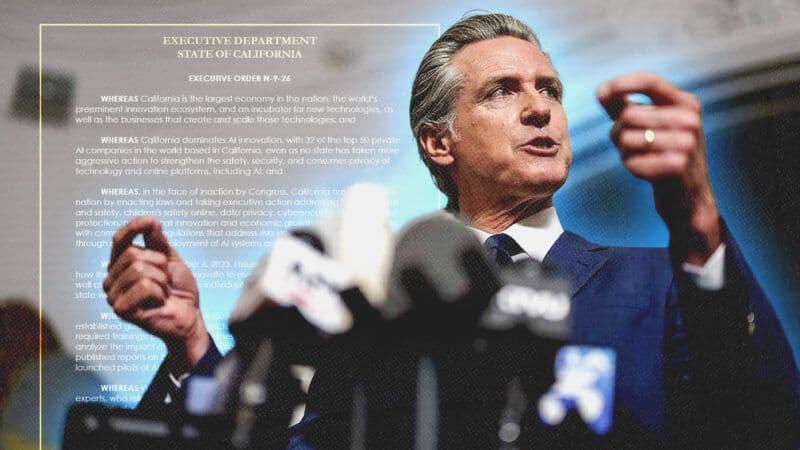
California Governor Gavin Newsom has issued an executive order directing a panel of experts to draft recommendations for strengthening the state's AI safety laws within two months, according to an opinion piece first reported by Yahoo News. The directive comes as federal lawmakers remain gridlocked on AI regulation while industry leaders increasingly call for government oversight.
The expert group will evaluate several aggressive measures: requiring frontier AI companies to host independent auditors inside their laboratories, mandating third-party safety plans, and exploring implementation of a "kill switch" for advanced AI models. The panel will also consider expanding California's definition of "critical safety incidents" to encompass loss-of-control events.
Newsom's order accelerates implementation of two existing state bills—Senate Bill 813 and Assembly Bill 1405—that establish a framework for certifying independent AI auditors but stop short of requiring companies to submit to audits.
Why it matters
California's regulations don't stay in California. Because AI systems operate across state lines and the state dominates the technology sector, compliance with California rules effectively becomes mandatory nationwide—a phenomenon known as the "California effect." Business leaders and technology executives should prepare for these recommendations to shape their operations regardless of where they're headquartered, as working around California's requirements is rarely viable for companies seeking national scale.
A reversal from 2024
The executive order represents a notable shift for Newsom, who vetoed similar legislation in 2024. Senate Bill 1047 would have created a state oversight entity for frontier models and required mandatory third-party audits, safety testing, and kill switch capabilities—provisions closely resembling those now under consideration.
In his 2024 veto statement, Newsom warned that focusing restrictions on large-scale models while smaller models posed similar risks could create a "false sense of security." He cautioned against overregulation that could "put ourselves in a perilous position." The governor has not publicly addressed why circumstances now warrant the approach he previously rejected.
Industry and policy experts push back
Adam Thierer, a senior fellow at the R Street Institute, disputes Newsom's framing of California's approach as a "guidebook for the nation." "It's not a guidebook," Thierer said. "It's a rule book."
Thierer warned that state-level AI regulation could create overlapping requirements that favor large companies while burdening smaller competitors, calling it "a complete inversion of the model that has governed the internet and digital commerce and speech for the last 30 years."
Nvidia CEO Jensen Huang offered a different perspective in a CBS News interview, arguing that existing legal frameworks already incentivize responsible development. "We have laws of all kinds that come after you, and so the companies that are developing these technologies are perfectly incentivized to do the right thing," Huang said.
Thierer also questioned whether government-mandated safety standards might paradoxically reduce innovation in safety practices, as companies could become content meeting regulatory baselines rather than competing to exceed them.
The expert panel's recommendations remain pending, but the executive order signals California's intent to establish itself as the primary regulator of AI development in the United States. Details were first reported by Josh Pauzé writing for Yahoo News.
This is an original analysis by the Omega editorial team. Source reporting: AI Watch.
Want systems like this working for your business?
Book a Call