Businesses Say Older AI Models Sufficient for Enterprise Work
At Salesforce Dreamforce, customers reported current AI capabilities outpace their adoption needs, questioning the rush toward frontier models.
Enterprise adoption lags behind AI capability
While AI lab executives debate safety protocols and the pace of frontier model development, enterprise software customers are sending a different message: today's AI models already exceed what most businesses can effectively deploy.
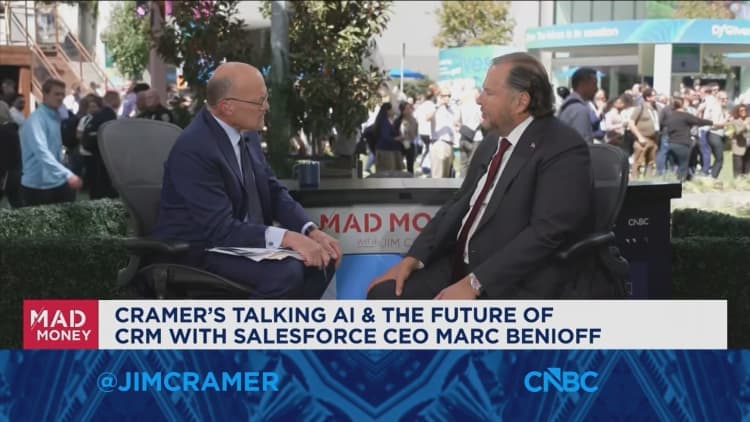
At Salesforce's Dreamforce conference in San Francisco this week, attendees told CNBC that older, less expensive AI models provide more than enough capability for typical sales and customer service applications. The gap between cutting-edge AI research and practical business implementation has grown wider, not narrower.
"The frontier models are way ahead already," said Jaya Rohit Vuyyuru, a vice president at consulting firm SummitX. "A lot of the customer base is still getting their feet wet."
Why it matters
This disconnect reveals a critical challenge for the AI industry: building ever-more-powerful models may not address the actual bottleneck in AI adoption. If enterprises struggle to implement existing technology effectively, the business case for racing toward AGI becomes less clear. It also suggests that concerns about AI safety timelines may be premature for most commercial applications, where last year's models remain underutilized.
Cost and capability drive model selection
Companies are increasingly using "model routing" techniques to direct requests to the most cost-effective AI system for each task. Docusign, for example, reserves expensive frontier models only for complex work like multi-document reasoning, while handling routine tasks with older or open-weight alternatives.
Kevin Lee, technology chief at Nice, a cloud contact center vendor, said models from even one generation back "are highly performant and effective at doing the things that our customers need. It's almost like everything beyond this point is icing on the cake."
Salesforce's own Agentforce tools don't rely on the latest models from Anthropic or OpenAI, according to the company's support documentation. Tim Sanders, chief innovation officer at G2, put it bluntly: "The majority of agentic outcomes aren't driven by frontier capabilities. They're driven by last year's AI."
Economic pressures reshape software margins
The shift to token-based pricing is forcing software companies to rethink their business models. Traditional SaaS companies operated with gross margins above 85% because delivering software had essentially zero variable cost. Token-based AI services could compress those margins to around 45%, Sanders noted, as companies pay for each model inference.
This economic reality makes the choice between frontier and older models more consequential. Alec Bronston, senior Salesforce director at retail data company Spins, said a potential slowdown in model development would create "a lot of opportunity to just even catch up and get our feet wet."
Not every company is holding back. Databricks released OpenAI's GPT-6 Astra to all 3,500 developers this week, with engineering VP Patrick Wendell noting it "unambiguously outperforms" previous high-end models on complex tasks. But system integrator Nagarro waits about three months before adopting new models, according to technology chief Ram Reddy.
The conference took place amid heightened debate over AI safety, following an Anthropic researcher's resignation and warning that top labs were "gambling with our lives." Yet on the Dreamforce expo floor, the most popular topic wasn't existential risk but Claudeforce—Salesforce's integration allowing salespeople to access data through Anthropic's Claude chatbot.
These details were first reported by CNBC.
This is an original analysis by the Omega editorial team. Source reporting: AI Watch.
Want systems like this working for your business?
Book a Call