Building Automation Market to Hit $182.6B by 2033
Shift from hardware sales to data ownership and recurring services is reshaping commercial real estate valuations and vendor economics.
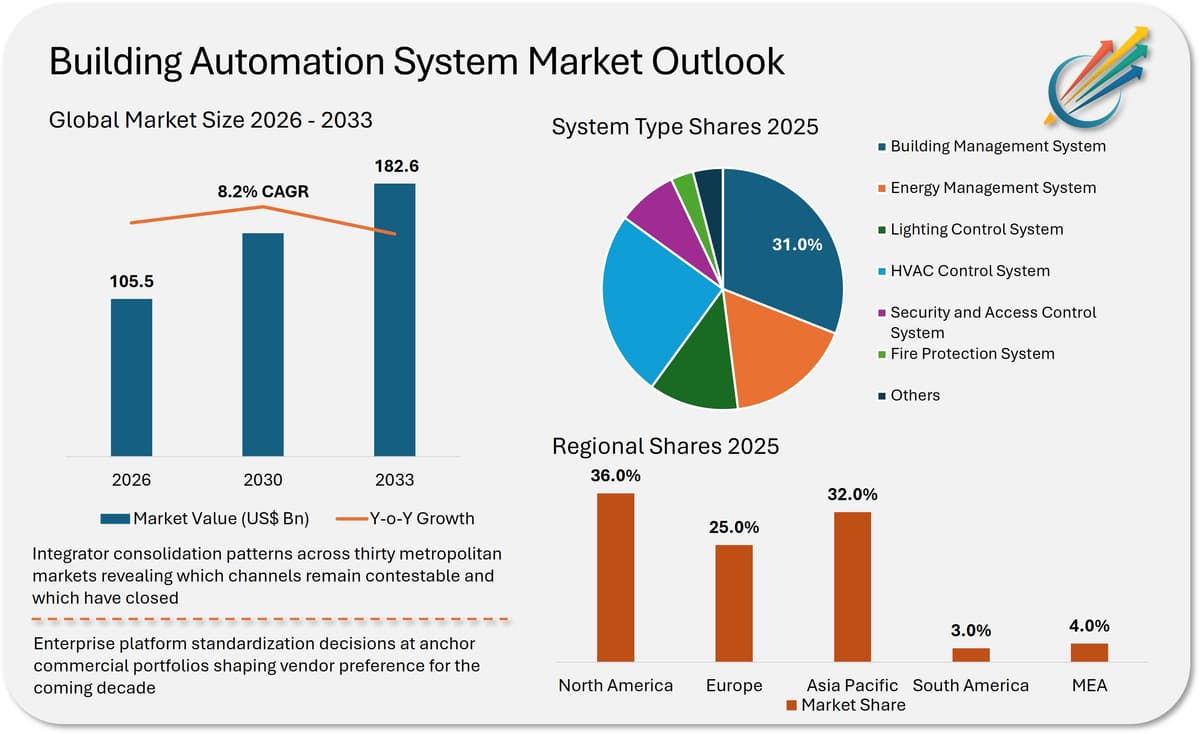
Building intelligence becomes a valuation lever
The global building automation system market is projected to grow from $105.5 billion in 2026 to $182.6 billion by 2033, expanding at an 8.2% compound annual growth rate, according to research from Market Minds Advisory first reported by Globe Newswire. The forecast reflects a fundamental shift in how commercial real estate owners view automation—no longer as discretionary capital expenditure but as a strategic asset that directly affects property valuations.
Energy price volatility, decarbonization mandates, and the operational demands of hybrid work have compressed traditional payback calculations. Buildings without intelligent systems are being repriced in the market, and the platform architecture decisions made in the next 18 months will determine which assets remain competitive through upcoming leasing cycles.
Why it matters
Commercial real estate owners who treated building automation as a facilities line item five years ago now compete against those who positioned it as core infrastructure. That gap is widening. The shift from hardware-centric procurement to platform-level commitments means portfolio owners making standardization decisions in the next four to six quarters will lock in operational advantages that later movers cannot easily replicate. For technology vendors, the economic center of gravity has moved from one-time installation revenue to recurring analytics and managed services—a transition that fundamentally changes competitive positioning and valuation multiples.
Cloud deployment and open protocols dominate specifications
Cloud-based deployment models are displacing on-premise architectures in new commercial projects, while hybrid approaches have become the practical default for large portfolio owners balancing data residency requirements with analytics capabilities. Open protocols, particularly BACnet, are emerging as the specification standard in tier-one projects, eroding the proprietary lock-in that historically protected vendor installed bases.
HVAC control remains the largest energy-related load category targeted by retrofit programs. Commercial offices and data centers account for the largest share of new project initiations, with healthcare and educational institutions accelerating due to regulatory pressure and tenant requirements around indoor air quality and energy reporting.
Data ownership becomes the binding constraint
The traditional hardware-led commercial model is fragmenting. Whoever controls the operational data layer controls the analytics roadmap, making contractual data rights a more critical commercial question than hardware margins. Cloud-hosted analytics and managed services create annuity-style cash flows that markets value differently from installation revenue, prompting strategic acquisitions across the sector.
System integrators are consolidating into multi-disciplinary platforms. Independent integrators face a strategic choice between scaling into regional platforms, specializing in defensible verticals like data centers, or being absorbed by larger vendors or mechanical contractors.
Cybersecurity emerges as procurement filter
Operational technology procurement is migrating from facilities teams into shared governance with corporate IT. This shift means vendors now face buying committees that evaluate cybersecurity architecture, identity management, and cloud integration with the same rigor applied to enterprise software. Within three years, cybersecurity posture is expected to become the dominant procurement filter for enterprise buyers—more critical than energy efficiency in vendor selection.
The retrofit opportunity in mature markets will outpace new construction demand through the forecast period, representing a larger near-term addressable market than greenfield commercial projects. Building performance standards in major jurisdictions have shifted from voluntary frameworks to enforceable regulations with financial penalties, compressing what was a steady demand curve into a concentrated specification wave.
These findings were detailed in research from Market Minds Advisory and first reported by Globe Newswire.
This is an original analysis by the Omega editorial team. Source reporting: Automation Watch.
Want systems like this working for your business?
Book a Call