BMW and Mistral AI Deploy Large Industry Models for Crash Tests
Automaker trains specialized AI on petabyte-scale simulation archive to accelerate vehicle safety engineering.
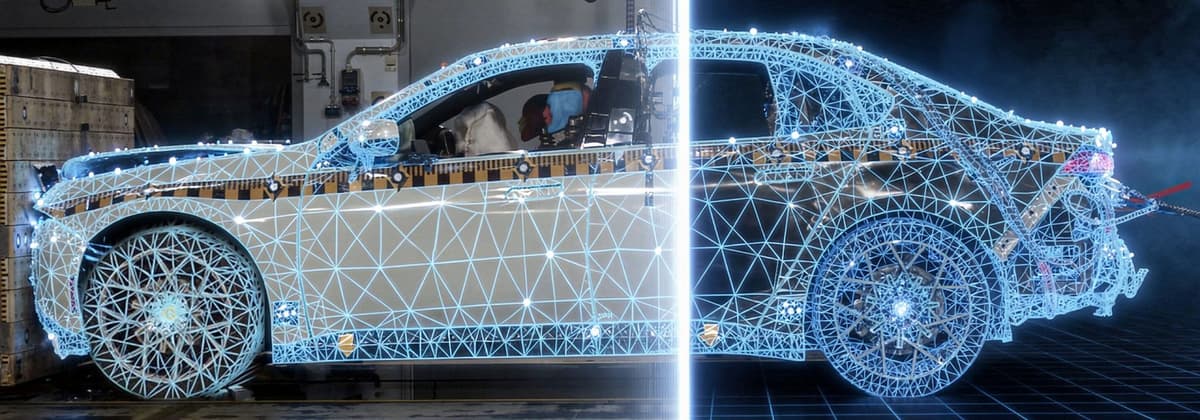
BMW Group is deploying artificial intelligence trained specifically for automotive engineering to analyze the massive datasets generated by virtual crash testing, working with French AI startup Mistral AI to build what the companies call Large Industry Models.
The automaker runs thousands of virtual crash simulations each week, generating more than a petabyte of historical data on material behavior, deformation patterns, and impact force distribution. That archive now serves as training material for AI models designed to identify structural weaknesses and energy absorption patterns faster than traditional analysis methods.
Why it matters
This represents a shift from general-purpose AI to domain-specific models trained on proprietary industrial data. For sectors like automotive where physical testing is expensive and time-consuming, AI that understands engineering constraints and material physics could compress development cycles while maintaining or improving safety outcomes. The approach also signals how manufacturers with deep data archives can create competitive advantages through specialized AI rather than relying solely on off-the-shelf foundation models.
Training AI on engineering physics
BMW distinguishes these systems as Large Industry Models rather than general large language models. According to Dr. Franz Decker, the company's CIO and Senior Vice President, the partnership combines BMW's engineering datasets with Mistral AI's model training capabilities to build AI that supports complex development tasks.
The specialized models are trained to understand the interplay between physics, material behavior, and data analysis specific to crash scenarios. They can identify where vehicle structures absorb energy, how materials respond under stress, and which anomalies in simulation results require engineer review.
Marjorie Janiewicz, Chief Revenue Officer at Mistral AI, described the collaboration as an example of how industry-specific AI models can address complex engineering challenges that generic systems cannot handle.
Engineers retain control
BMW emphasized that AI serves as a copilot rather than a replacement for human engineers. The technology is designed to help engineers navigate complex data landscapes more quickly and identify patterns earlier in the development process, enabling more precise decisions based on simulation analysis.
The company views crash simulation as a starting point for deploying application-specific AI solutions across other areas of vehicle development and its broader value chain. BMW positions the use of industrial data as central to translating artificial intelligence into measurable value creation.
The details were first reported by BMW Group in a company announcement.
This is an original analysis by the Omega editorial team. Source reporting: AI Watch.
Want systems like this working for your business?
Book a Call