AI
AWS Bedrock adds persistent memory to knowledge base agents
New AgentCore memory integration lets AI assistants remember user context across sessions while enforcing document-level access controls.
Key takeaways
- AWS Bedrock now stores and retrieves user conversation context automatically within knowledge base queries, eliminating the need for custom conversation databases
- The system enforces document access controls by user email while using immutable Cognito sub claims to isolate memory between users
- Two extraction strategies capture both incidental facts users mention and explicit preferences about how they want information presented
- IAM session tags provide policy-level enforcement of memory isolation, preventing application bugs from leaking conversation history across users
- The integration works with existing ACL-enabled data sources including S3, SharePoint, Google Drive, and Confluence without requiring vector store setup
Amazon Web Services has integrated AgentCore memory capabilities directly into its Bedrock Managed Knowledge Base service, allowing AI agents to remember user context across conversations while maintaining strict document access controls. The feature addresses a longstanding challenge in enterprise AI applications: how to personalize responses based on past interactions without compromising security.
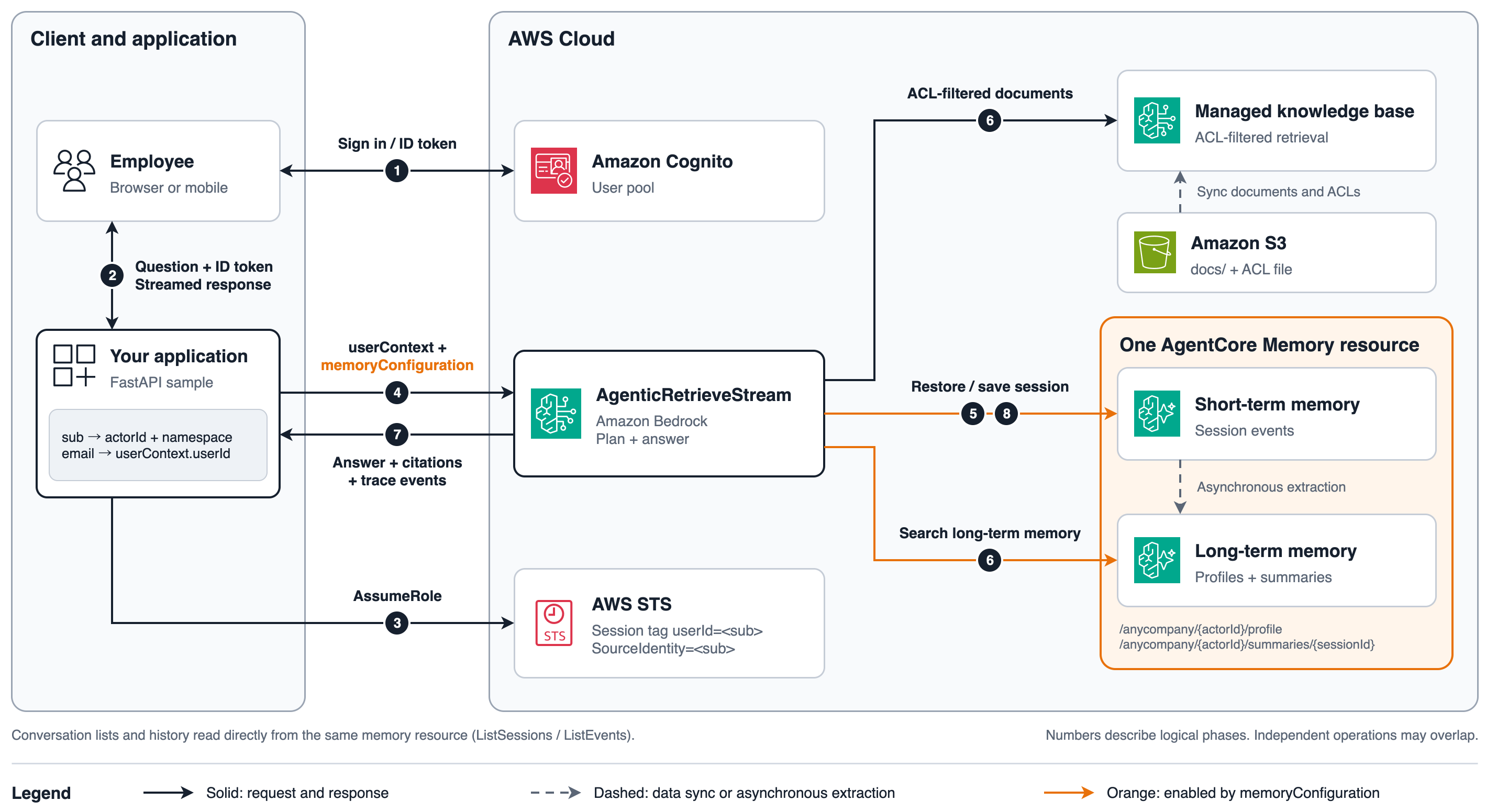
According to details first reported by AWS, the integration works through a single API call to AgenticRetrieveStream that now accepts a memoryConfiguration parameter. When enabled, the service automatically stores conversations, extracts durable facts about users, and retrieves relevant context when answering new questions—all while enforcing per-user document permissions through access control lists.
The architecture separates two critical identity functions. User email addresses determine which documents someone can access through knowledge base ACL filtering. Meanwhile, Amazon Cognito's immutable "sub" claim serves as the actorId for memory operations, ensuring one person's conversation history never leaks to another even if email addresses are reassigned.
How the memory system works
The service employs two extraction strategies that run asynchronously after each conversation turn. A summary strategy captures incidental facts users mention in passing—location, role, product tier, or technical environment. A user-preference strategy extracts structured preferences about how someone wants information presented, such as preferring bullet points or always deploying to specific AWS regions.
These extracted records live in namespaces organized by actorId. When a user asks a follow-up question weeks later, the planner autonomously decides whether retrieving a stored fact would improve the search query it sends to the knowledge base. The application code never touches this logic.
AWS designed the system for multi-tenant deployments where many users share one knowledge base and one memory resource. A sample implementation demonstrates an internal employee assistant for a fictional company where engineers see engineering runbooks, salespeople see commission plans, and everyone sees HR policies—all from the same underlying data source.
Why it matters
Enterprise AI applications have struggled to balance personalization with security. Building custom conversation stores, fact extraction pipelines, and permission enforcement layers requires substantial engineering effort and introduces security risks if implemented incorrectly. By moving these responsibilities into the managed service layer, AWS lets development teams focus on authentication and user experience rather than infrastructure.
The integration also uses IAM session tags to enforce memory isolation at the policy level, so even buggy application code cannot access another user's conversation history. This defense-in-depth approach matters for regulated industries where data leakage carries compliance consequences.
The feature works with existing managed knowledge bases and requires no vector store provisioning. Organizations using ACL-enabled data sources from Amazon S3, SharePoint, Google Drive, or Confluence can adopt the memory capability without changing their document storage architecture.
These details were first reported in an AWS Machine Learning Blog post demonstrating the integration with a working code sample.