Aviation Operator Deploys Autonomous Wingwalking Robots
Pentastar Aviation moves Airtrek's aircraft towing safety robots from pilot testing into routine daily operations at Michigan facility.
Aviation Operator Deploys Autonomous Wingwalking Robots
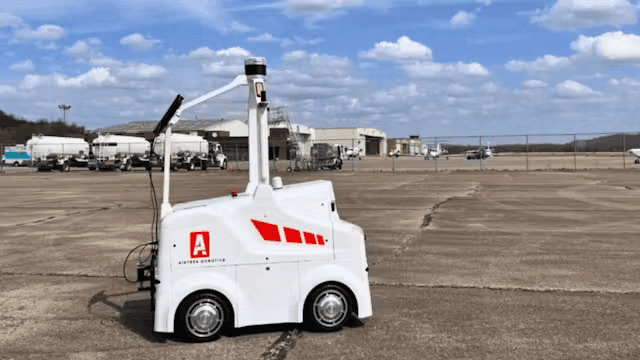
Pentastar Aviation has moved autonomous wingwalking robots into daily operations at Oakland County International Airport in Waterford, Michigan, transitioning an aviation automation application from testing to routine use. The robots, built by Cincinnati-based Airtrek Robotics, replace human wingwalkers who traditionally monitor clearances and obstacles during aircraft towing operations.
Pentastar began the deployment in August and expects full implementation by the fourth quarter of 2026. The company and Airtrek characterize this as the first use of autonomous wingwalking robots in routine aviation operations.
Why it matters
The deployment demonstrates a pragmatic automation strategy for safety-sensitive environments: automate a narrowly defined perception task while keeping humans responsible for the primary operation. If the economics prove viable, the approach could provide a template for introducing robotics into aviation ground operations without attempting to automate entire workflows at once. The system also creates digital records of every tow, potentially giving operators data to identify recurring safety issues across thousands of aircraft movements.
How the System Works
Airtrek's Groundwatch system uses two autonomous mobile robots that position themselves near an aircraft's wingtips during towing. Cameras and LiDAR monitor the aircraft and surrounding environment for obstacles and clearance issues. The tug operator remains responsible for moving the aircraft and receives four camera feeds, a bird's-eye view, and clearance information through an interface. When the system detects a potential conflict, it alerts the operator to stop the tow.
The division of responsibilities is deliberate. Groundwatch automates observation while a person controls the aircraft movement. Airtrek says the system operates under varying lighting and weather conditions, including darkness and glare.
Workforce and Economic Questions
A technician initiates the Groundwatch robots, and Airtrek says one technician can start multiple units. Pentastar has indicated affected employees can be reassigned to other activities, including customer service. Ben Hammond, vice president of FBO services at Pentastar Aviation, said the solution "complements our crew and their expertise."
The commercial test will be whether the system reduces total labor requirements while maintaining or improving safety. Pentastar and Airtrek have not publicly disclosed operating data sufficient to calculate labor savings, cost per tow, or payback periods—metrics other fixed-base operators will need to evaluate the technology.
Digital Records as Value Driver
Groundwatch records missions, alerts, and events that operators can review for incident investigation, training, and safety documentation. Conventional wingwalkers observe and communicate during a tow, but that information is temporary. A robotic perception system preserves video, clearances, and alerts after the aircraft has been parked.
Over hundreds or thousands of movements, those records could help operators identify recurring clearance problems, examine near misses, and improve procedures. The value proposition may extend beyond labor associated with individual towing operations.
Path to Deployment and Future Applications
The Pentastar installation follows demonstrations throughout 2025 and selection for the FLITE innovation program at Gerald R. Ford International Airport in Grand Rapids, Michigan, where Avflight hosted a proof of concept in January 2026. That progression—demonstration, operational pilot, commercial deployment—is particularly important for robotics systems in safety-sensitive environments.
Airtrek is developing Groundwatch applications for foreign-object-debris detection and aircraft inspection. A mobile perception platform that assists with towing, searches for FOD, and performs inspections could operate for a larger share of the day than a robot dedicated exclusively to aircraft towing. Utilization is fundamental to robotics economics; adding applications to common hardware can improve utilization without requiring separate machines for every task.
Chris Lee, co-founder and CEO of Airtrek Robotics, said Pentastar contributed operational expertise during development that helped refine how the technology works in practice.
Pentastar's planned full implementation should begin providing evidence about robot utilization, labor requirements, reliability, and how effectively recorded data improves ground operations. If the same machines can also inspect aircraft and detect FOD between towing assignments, the potential market becomes broader than autonomous wingwalking.
These details were first reported by Automation Watch.
This is an original analysis by the Omega editorial team. Source reporting: Automation Watch.
Want systems like this working for your business?
Book a Call
