Australian Dockers Reframe Automation Fight as AI Threat
Maritime Union of Australia links traditional port automation concerns to broader workplace AI adoption in new campaign.
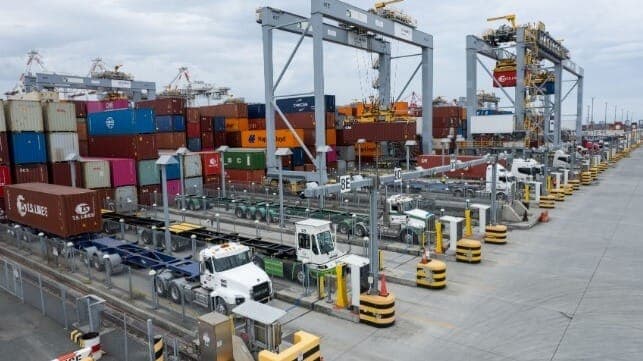
Union Connects Port Automation to AI Workplace Concerns
Australia's Maritime Union is taking a novel approach to fighting port automation by explicitly linking traditional concerns about robotic cranes and automated vehicles to the emerging threat of artificial intelligence in white-collar work. The Maritime Union of Australia (MUA) has launched a public advertising campaign warning that if DP World succeeds in automating its Australian terminals, "your job is next."
The union is battling DP World's plans to deploy automated trucks across the operator's four Australian container facilities. According to the MUA, the "AI automation program" could eliminate up to 1,000 positions—roughly 60 percent of the current docker workforce at those terminals.
Financial Analysis Shows Declining Worker Share
A report prepared by CICTAR, a pro-union tax justice organization, argues that automation would primarily benefit DP World's bottom line rather than customers or the broader economy. The analysis shows that while DP World's Australian revenues have increased since 2019—driven by higher landside charges per container—the proportion going to workers has dropped from approximately half to one-third of total revenue.
CICTAR projects this trend would accelerate with further automation: fewer workers would handle the same volume while service charges remain unchanged, expanding profit margins. The report also notes that equipment depreciation could reduce the company's tax obligations over time.
AI Extends Beyond Physical Automation
The union says DP World Australia is testing AI software to manage employee scheduling—work traditionally performed by administrative staff. This expansion into algorithmic workforce management represents a shift from purely physical automation to AI-driven decision-making systems.
Why it matters
This campaign represents a strategic evolution in how industrial unions frame automation debates. By connecting port robotics—a decades-old concern in maritime labor—to the broader anxiety about AI replacing knowledge workers, the MUA is attempting to build a coalition beyond traditional union constituencies. The approach could influence how other labor organizations position themselves as AI adoption accelerates across industries.
Union Demands Include Reduced Hours, New Regulations
The MUA is calling for a 28-hour workweek with no pay reduction for members whose positions would be eliminated by automation. The union has also launched a broader campaign urging the Australian government to amend the Fair Work Act, giving workers formal bargaining rights over how new technologies are introduced.
Under current law, the union cannot strike until its contract expires in 2028, though it is pushing for legislative changes that would provide more immediate leverage.
CICTAR's report concludes that the government "must explicitly support workers seeking to share the productivity benefits from AI through bargaining" and establish urgent safeguards on workplace AI use.
These details were first reported by The Maritime Executive.
This is an original analysis by the Omega editorial team. Source reporting: Automation Watch.
Want systems like this working for your business?
Book a Call
