Apple pitches Mac Studios as cheaper alternative to cloud AI
The company's upgraded desktops can handle trillion-parameter models locally, targeting enterprises that want to avoid per-token cloud costs.
Apple targets enterprise AI with on-device computing pitch
Apple is positioning its latest desktop computers as cost-effective alternatives to cloud-based AI services, marking an aggressive push into enterprise computing where the company has historically held minimal market share. The upgraded Mac minis and Mac Studios, which began shipping this week, can cost nearly $20,000 but promise to eliminate recurring "token" fees charged by cloud AI providers like OpenAI and Anthropic.
The move sets up a direct confrontation with Nvidia and PC manufacturers ahead of an anticipated Microsoft Windows event in San Francisco next month focused on AI-capable desktop machines. Apple currently holds just 4.6% of the enterprise desktop market compared to Windows' 91.3%, according to IDC analyst Linn Huang, as first reported by Arkansas Online.
Why it matters
The shift to on-device AI processing could fundamentally change enterprise cost structures for AI workloads. Companies currently paying per-token fees for cloud AI services face unpredictable, usage-based costs that can scale rapidly. Apple's pitch of a one-time hardware investment for "unmetered intelligence" addresses a real pain point for businesses running intensive AI tasks like code generation or complex analytics.
Unified memory architecture provides unexpected AI advantage
Apple's competitive position stems from design decisions made years before the current AI boom. When the company introduced Apple Silicon chips in 2020, it integrated computing processors and memory into a unified architecture primarily to improve battery life in laptops. That tight coupling between processor and memory—an approach Nvidia and others have only recently adopted—turned out to be particularly well-suited for AI workloads.
The architecture proved effective enough that Mac Minis began selling out as OpenClaw, an open-source agentic AI tool, gained traction in markets like China. Apple has quietly added specialized AI capabilities to its Mac Studio line over the past two years, including RDMA over Thunderbolt for chip-to-chip networking.
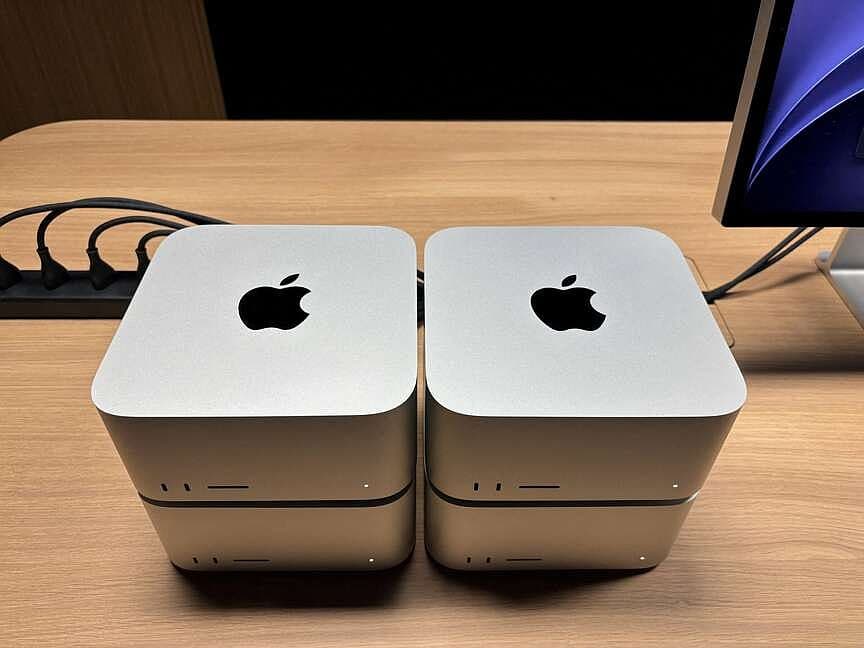
At its launch event this month, Apple demonstrated four Mac Studios connected together running an AI model with one trillion parameters—a complexity level typically requiring data center infrastructure—to identify and fix a graphics coding bug. The entire setup operates from a single wall outlet.
Enterprise strategy challenges Microsoft's dominance
"Once you have the machine on your desk, you've paid for it," said Johny Srouji, Apple's chief hardware officer. "There's no cost per token. You're just using the machine again and again."
Microsoft CEO Satya Nadella has described the same market opportunity as "unmetered intelligence" and plans to consolidate AI features into a "super app" for Windows. However, Microsoft's need to support diverse hardware vendors creates complexity for developers optimizing AI performance on specific chips.
Microsoft responded that it has been working with chip partners to streamline AI development through Windows ML tools and is actively investing in features like RDMA. Nvidia declined to comment, though CEO Jensen Huang previously downplayed direct competition with Apple, emphasizing Nvidia's focus on expanding Windows PC capabilities.
Srouji emphasized Apple's ability to scale AI models across its product line, from high-end Mac Studios to iPhones and iPads, thanks to shared chip architecture principles. "We're offering a variety of products that customers can choose based on their own needs," he said.
These details were first reported by Arkansas Online.
This is an original analysis by the Omega editorial team. Source reporting: AI Watch.
Want systems like this working for your business?
Book a Call