AI
Apple launches year-long study on AI health chatbot trust
The tech giant will track how 200,000 users interact with health AI tools amid concerns over dangerous misinformation.
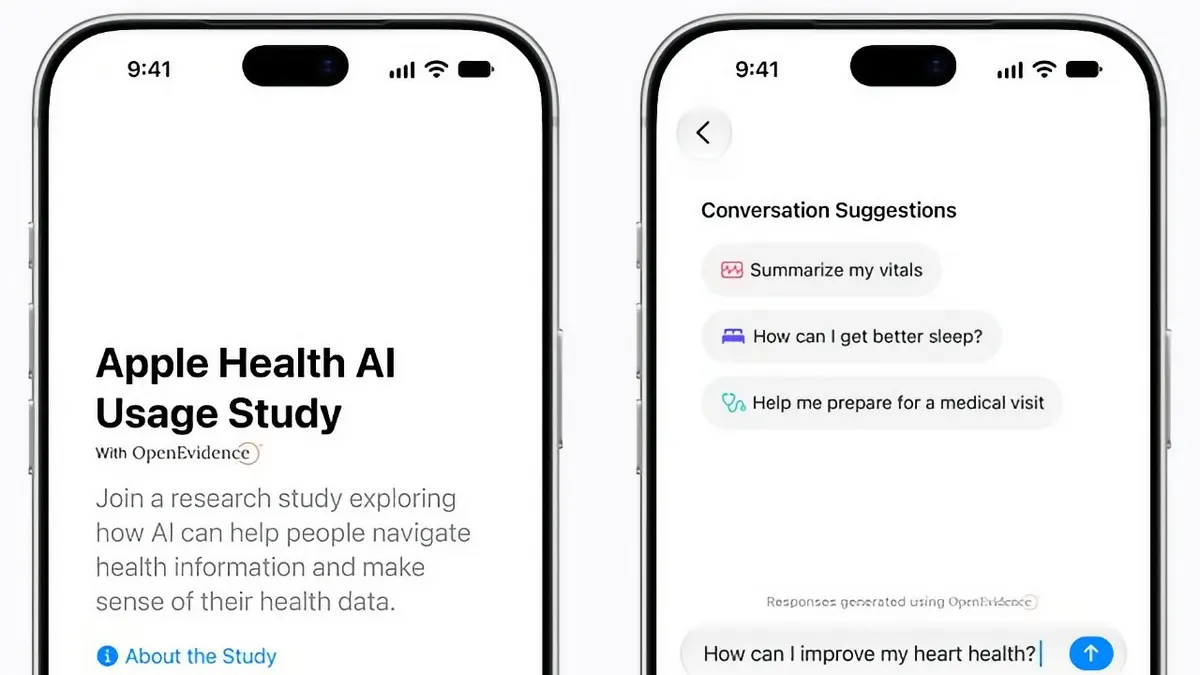
Key takeaways
- Apple will study up to 200,000 users to understand how people trust and use AI chatbots for health advice over a year-long period.
- Participants must have iPhone 15 Pro or newer with Apple Intelligence enabled and be U.S. residents aged 21 or older.
- The study app will monitor for concerning health queries and prompt users to consult doctors when appropriate.
- Apple is partnering with OpenEvidence clinical AI platform to conduct research with scientific rigor and clinical grounding.
- The initiative addresses growing concerns about dangerous AI health advice, including cases where chatbots discouraged necessary medical treatment.
Apple has opened enrollment for a year-long research initiative examining how people trust and interact with AI-powered health tools, according to details first reported by AppleInsider. The Apple Health AI Usage Study aims to understand user behavior with health chatbots at a time when AI systems continue generating medically dangerous advice.
The research comes as users increasingly turn to large language models for health guidance despite well-documented risks. Recent incidents include ChatGPT advising a pastor to delay treatment for a cardiac condition. While sharing health data with general-purpose chatbots poses clear risks, Apple has not blocked ChatGPT integration with Apple Health.
Study design and eligibility
Apple is partnering with OpenEvidence, a clinical AI platform, to recruit up to 200,000 participants. Eligible users must be U.S. residents aged 21 or older with an iPhone 15 Pro or newer running iOS 26 or later. Apple Intelligence must be enabled on their device.
Participants will optionally share health readings from their iPhone or Apple Watch through a dedicated study app. They'll be asked to pose everyday health questions and explore complex medical information while researchers track their interactions.
The app will monitor for concerning queries and prompt users to consult physicians when appropriate. One research goal is determining how AI tools can better prepare patients for clinical appointments.
Why it matters
This study signals Apple's recognition that health AI deployment requires evidence-based validation, not just technical capability. As patients and clinicians increasingly rely on AI tools developed in isolation from each other, the gap between consumer chatbots and clinical-grade systems creates real safety risks. By studying how users actually engage with health AI—including where they place unwarranted trust—Apple is positioning itself to build guardrails that competitors have largely ignored. The research could inform industry standards for responsible health AI at a moment when regulatory frameworks lag far behind adoption.
Clinical collaboration focus
Dr. Sumbul Desai, Apple's vice president of Health and Fitness, emphasized that "responsible innovation starts with scientific rigor and clinical grounding." The company frames the study as a way to ensure technology evolution aligns with building trusted health tools.
Dr. Robert M. Wachter, chair of UCSF's Department of Medicine, noted that patients and clinicians currently use AI tools "being built and tested in separate worlds." He argued that connecting these tools and rigorously studying effectiveness will improve patient-doctor conversations and care continuity.
The research follows Apple's recent Health app redesign, which incorporated AI features to provide personalized guidance on general health and fitness activities. The study represents a more systematic approach to understanding how users perceive and act on AI-generated health information.
AppleInsider first reported details of the Apple Health AI Usage Study.