Amazon Proteus Robot Now Understands Natural Language Commands
The upgraded warehouse robot can interpret everyday instructions and coordinate material movement autonomously across European fulfillment centers.
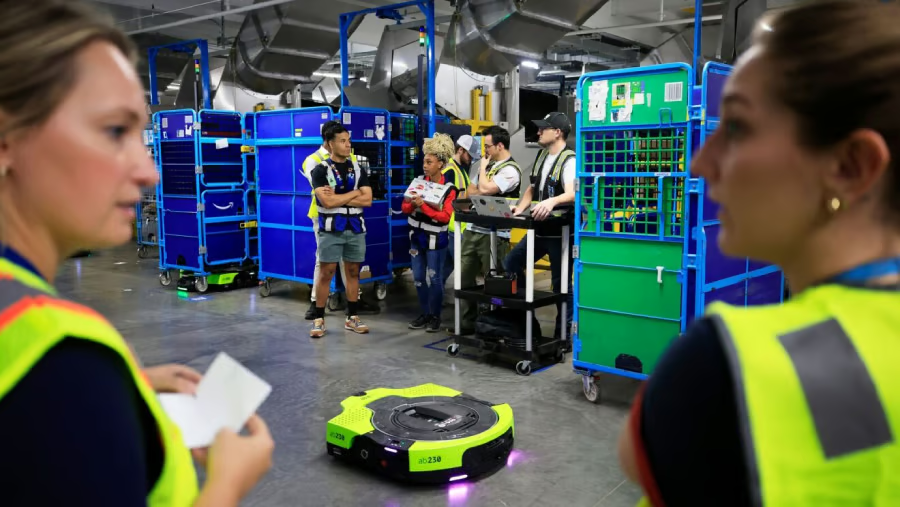
Amazon has upgraded its Proteus warehouse robot to understand natural language instructions, marking a shift toward more autonomous and flexible fulfillment operations. The enhancement allows the robot to interpret everyday commands and translate them into coordinated material-movement tasks without requiring specialized programming or control interfaces.
The company announced the upgrade at its Delivering the Future event in London, alongside plans for a €10 billion investment in European operations and a 25,000-person workforce expansion.
From command-driven to conversational
Proteus already handles one of the most physically demanding jobs in Amazon's fulfillment network: moving carts weighing up to 800 pounds. Unlike many warehouse robots that require fixed paths or constant human oversight, Proteus operates autonomously using onboard sensors to navigate facility floors.
The natural language capability represents a fundamental change in how warehouse staff interact with robotic systems. Scott Dresser, vice president of Amazon Robotics, explained that when workers tell Proteus what needs to be done, "it figures out the priority, the route, [and] the timing," effectively functioning as "your assistant for material movement."
Proteus currently operates in 25 fulfillment centers across the United States. The upgraded version with natural language processing will deploy to European facilities during the first half of next year.
Expanding the robotic workforce
Amazon also introduced STARK, a robot designed to lift heavy totes from conveyor systems and place them into transport carts. STARK made its debut in Barcelona and will reach 15 European fulfillment centers by 2027.
The company is also expanding deployment of Vulcan, a robot that uses vision systems and tactile sensing to handle delicate items requiring careful manipulation. Vulcan began operations in Spokane, Washington, and has already entered a Hamburg, Germany facility, with additional European sites planned.
Why it matters
Natural language interfaces for industrial robots could significantly lower the technical barrier for warehouse workers to direct automated systems. Rather than requiring specialized training or programming knowledge, staff can communicate objectives in everyday language while robots handle route planning, timing, and execution. This approach could accelerate automation adoption while making human-robot collaboration more intuitive across logistics operations.
Investment amid restructuring
The €10 billion European investment and 25,000-job expansion stand in contrast to workforce reductions Amazon implemented earlier this year during broader organizational restructuring. The company maintains that advanced robotics are designed to handle repetitive or physically demanding tasks while human workers focus on activities requiring judgment and oversight.
The expansion supports preparation for Prime Day 2026, a four-day shopping event scheduled for June 23-26.
These details were first reported by TechRepublic.
This is an original analysis by the Omega editorial team. Source reporting: Automation Watch.
Want systems like this working for your business?
Book a Call
