AI Tools Now Generate 685% More Security Alerts—But 94% Are Noise
Enterprise SOCs face a new triage challenge as coding agents and employee AI use trigger alarms that look like intrusions but almost never are.
A new alert category is flooding enterprise security operations
Security operations centers are seeing a dramatic shift in their alert streams: AI-related activity now triggers warnings that look identical to early-stage intrusions but stem from legitimate work. According to new research from The Hacker News, AI-generated alerts grew 685% between February and June 2026, even though they still represent just 0.43% of total SOC volume.
The challenge isn't the current share—it's the trajectory. Every month shows higher volume than the last, with sharp acceleration beginning in May 2026. Security teams sizing their AI-alert handling to today's numbers will be under-resourced within a quarter.
Why it matters
This isn't a story about AI attacks overwhelming defenses. It's about legitimate AI adoption creating a triage crisis. When coding agents spawn shells, read credential stores, and open network tunnels as part of normal development work, legacy detection rules fire at high severity. SOC analysts must now determine whether suspicious activity executed under a user's credentials represents compromise or an AI agent acting on that user's behalf—a distinction that didn't exist before enterprise AI adoption.
The composition problem: mostly noise, some real risk
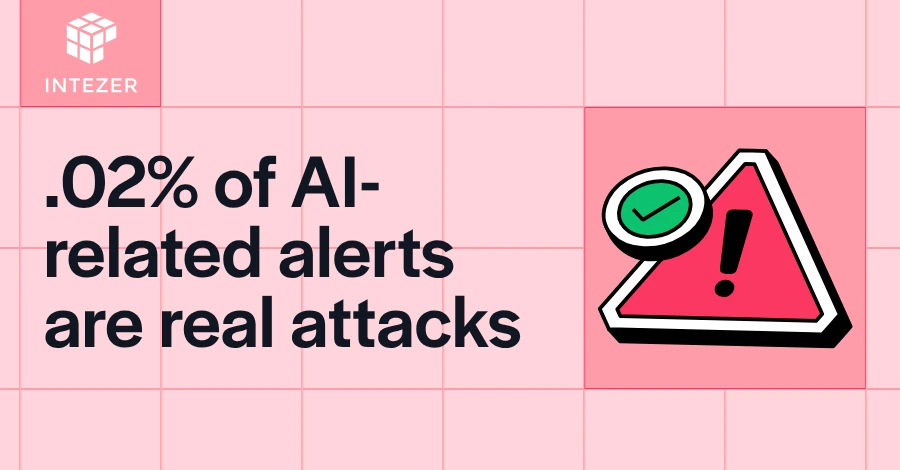
The research analyzed roughly 16.9 million SOC alerts, identifying approximately 73,000 as AI-related. When investigators sorted these by underlying activity, the breakdown was stark: 94.1% were noise, 5.8% represented genuine security risks, and just 0.02% were real attacks.
The noise category is specific and diagnosable. Detection rules written before AI agents existed now fire on routine agent behavior. For example, the legitimate Anthropic Claude Desktop installer triggered "Ransomware Operations detected" alerts across multiple customers. The software was genuine and code-signed; the detection simply described installer behavior using ransomware vocabulary.
Similarly, coding agents running with permission-bypass flags (the --yolo option that stops prompting users before executing commands) triggered ClickFix, DisableTools, and DLL-injection detections. Standard developer automation tripped "PowerShell created possible reverse TCP shell" warnings. Across the noisiest AI activity detections, benign activity accounted for 77% to 99% of alerts.
The quiet risk: unsafe use patterns
The 5.8% of alerts flagged as genuine security risks deserve the most attention. These detect unsafe AI tool use—not compromise, but material exposure. The primary pattern: agents running with permission safeguards disabled, the same precondition exploited in documented supply-chain attacks.
Other unsafe patterns included reverse tunnels opened by AI IDEs to the public internet, agents dumping entire macOS keychains to retrieve single tokens, and OAuth consent grants to third-party AI applications that create data exfiltration pathways nearly invisible to endpoint tooling.
Real attacks: phishing rides AI brand recognition
Actual attacks represented the smallest category. Notably, investigators found zero compromises caused by an organization's own AI agent. Every alert titled "AI agent running mimikatz" or "credential theft" resolved to legitimate developer work or detection misfires.
The real threats observed were phishing campaigns weaponizing AI brand names as lures. Malicious emails used subject lines referencing Anthropic, OpenAI, and Google Gemini—brands now familiar and routine due to AI adoption. One campaign spoofed "Anthropic Engagement approval & payment" to legitimize invoice fraud; another impersonated "OpenAI Partner Summit 2026" using Zoom infrastructure to add credibility.
What security teams should do now
The immediate step: tune legacy detections firing at high severity on routine agent work. Define policies on information sharing with third-party AI platforms, then proactively hunt for permission-bypass flags, unauthorized tunnels, and risky OAuth grants rather than waiting for alerts.
The harder challenge is adapting triage workflows. AI tools execute commands with user credentials, acting on the user's behalf. Before AI, suspicious activity under a user's account without their knowledge strongly indicated compromise. Now SOC teams face a new question first: was this the user or their agent?
These findings were first reported by The Hacker News, based on analysis of enterprise security data across multiple organizations.
This is an original analysis by the Omega editorial team. Source reporting: AI Watch.
Want systems like this working for your business?
Book a Call