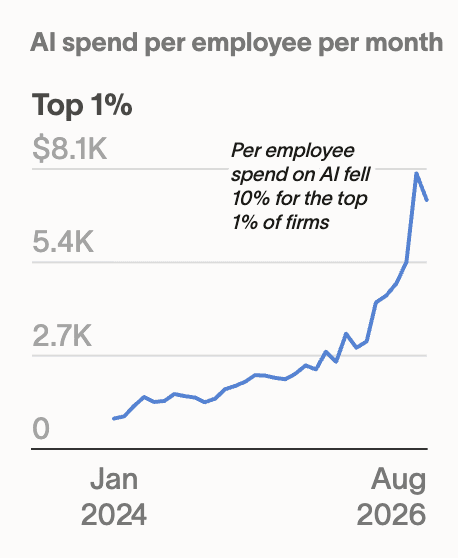
AI Spending Per Employee Drops 10% at Top Firms in August
Payment data from 70,000 companies shows slowing adoption and falling token costs as price competition intensifies between frontier labs.
AI Spending Per Employee Drops 10% at Top Firms in August
AI spending per employee at the highest-spending companies declined nearly 10% in August, falling to $7,205 according to payment data from Ramp tracking 70,000 businesses. The drop comes as overall AI adoption growth stalled, with just 56% of Ramp customers paying for AI products in August—up only 0.4% from July.
Why it matters
The massive infrastructure investments by AI labs and cloud providers depend on sustained revenue growth from business customers. If spending per employee continues declining even as token usage increases, the economics underpinning billions in chip orders and data center construction may need recalibration. For companies already using AI tools, however, falling costs represent a clear win.
Price competition drives costs down
The spending decline reflects aggressive price cuts from OpenAI and Anthropic, which have pushed average token costs down to $0.68 per million tokens from a March peak of $1.15. According to Ramp economist Ara Kharazian, the labs haven't yet compensated for lower prices with increased volume.
The competitive pressure is also changing customer behavior. Many businesses are opting for older, less expensive models like OpenAI's ChatGPT 5.6-Terra and Anthropic's Sonnet rather than the latest frontier releases. This shift threatens the revenue model at AI labs, where employees have indicated that training costs are typically recouped in the first weeks after a new model launches.
Seasonal slowdown or warning sign?
August's sluggish numbers may simply reflect summer vacation patterns. Ramp's data showed similar stagnation between August and October last year before adoption accelerated again in the fourth quarter.
Yet the timing is notable given the extraordinary pace of AI infrastructure buildout. Even temporary slowdowns draw scrutiny when hyperscalers have hundreds of billions in chip orders pending.
Ramp's customer base skews technical, likely overstating broader market adoption—a U.S. Census Bureau survey updated August 23 found just 22% of businesses reporting AI use. Still, direct spending data from Ramp offers one of the few real-time windows into enterprise AI economics.
Open-weight models remain marginal
Despite ongoing discussion about open-weight models threatening proprietary offerings, only 6.4% of AI-spending businesses used model-serving or inference platforms in August. That share is growing but remains too small to significantly influence overall adoption dynamics.
The competitive landscape helps explain why AI labs are increasingly focused on non-technical users and AI co-working tools—expanding beyond the software engineers who drove initial adoption of agentic coding assistants.
"We are showing that competition between OpenAI and Anthropic is making AI more accessible, and also driving the price down for companies—and not just driving the price down, but driving spend down at the top 1% of companies that previously the market was expecting to drive much of the growth going forward," Kharazian said.
These findings were first reported by TechCrunch based on Ramp's proprietary spending data.
This is an original analysis by the Omega editorial team. Source reporting: AI Watch.
Want systems like this working for your business?
Book a Call