AI-Powered Robots Now Design Their Own Biology Experiments
Ginkgo Bioworks demonstrates how artificial intelligence can autonomously conduct scientific research, raising questions about democratization and biosecurity.
A Boston biotechnology company has reached a milestone that blurs the line between human scientist and machine: artificial intelligence systems that don't just execute experiments, but design them.
Ginkgo Bioworks, founded by four MIT graduates nearly two decades ago, recently collaborated with OpenAI to let ChatGPT independently create a protein through laboratory experimentation. The AI didn't simply follow instructions—it wrote its own experimental plan, conducted over 30,000 trials in six months, and achieved results at 40 percent lower cost than traditional human-led approaches.
"The really, really wild moment was the first time I saw a lab notebook entry written by the model," says Reshma Shetty, one of Ginkgo's co-founders.
From Ramen to Robotics
The company's journey reflects the transformation of biotechnology investment. When Jason Kelly and his classmates started Ginkgo, they struggled to raise capital for their vision of replacing manual laboratory work with robotic systems. "We were living on ramen, buying equipment on eBay, and we could not raise venture capital," Kelly recalls.
The AI boom changed everything. After reading a 2014 blog post by Sam Altman about automating biotechnology, Kelly connected with the future OpenAI founder. Silicon Valley funding followed.
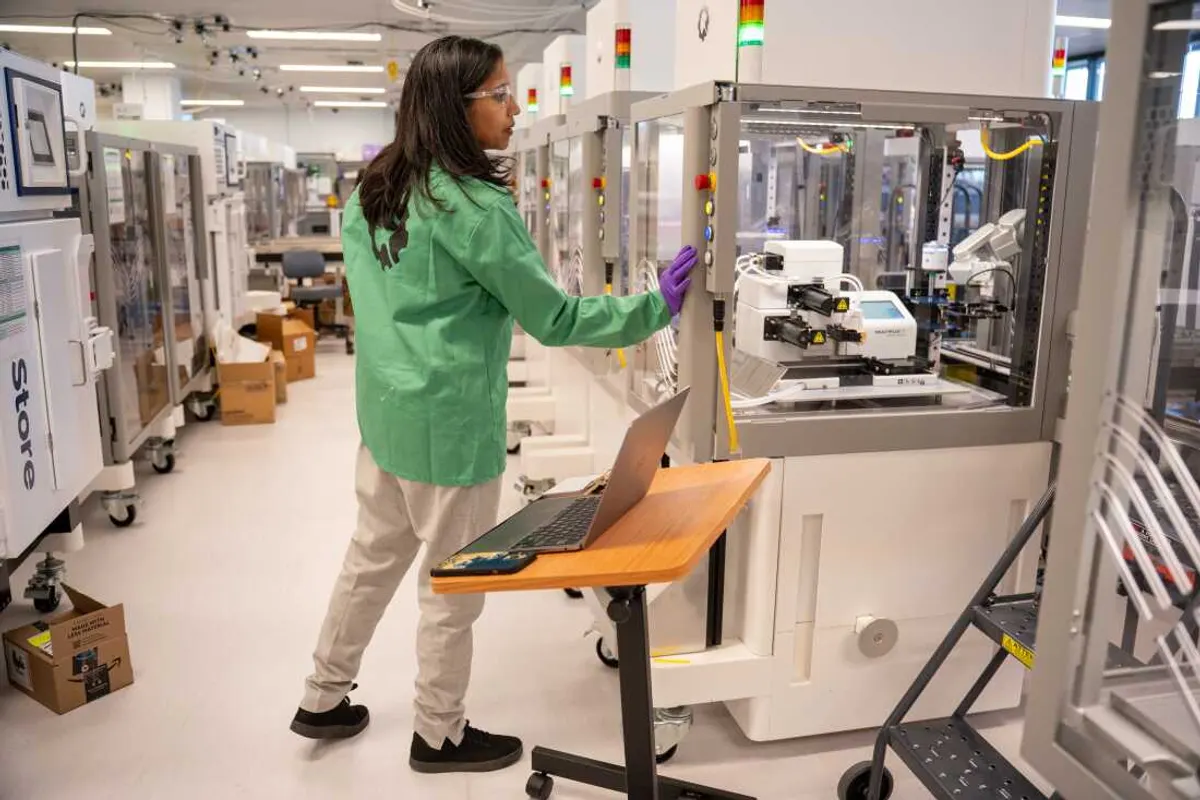
Today, Ginkgo operates an autonomous laboratory where robotic arms conduct experiments on pharmaceuticals, agricultural products, and government contracts. Projects range from engineering microbes for fertilizer to creating proteins that form snow and ice. Scientists translate experimental designs into machine instructions, while a track system shuttles materials between glass-encased robots working on separate projects.
Why It Matters
The shift from robots as laboratory assistants to autonomous experimental designers represents a fundamental change in how biological research operates. If AI can independently conduct complex experiments at significantly lower costs, it could accelerate drug development and scientific discovery. But it also means the specialized knowledge that once served as a natural barrier to dangerous research may no longer provide protection against misuse.
The Biosecurity Question
Drew Endy, a Stanford bioengineering researcher, sees both promise and peril in AI-driven biology. While he's enthusiastic about the research potential, he warns that artificial intelligence could enable people with minimal scientific training to conduct experiments with harmful objectives.
Endy and colleagues recently published a report outlining how AI might facilitate mass virus production or other biosecurity threats. "Biology has traditionally been hard for people to really gain control over," he explains. "AI could nudge it a little bit more towards concentration of power."
He argues that regulatory frameworks to address these risks are achievable but must be established before a biotechnological crisis occurs.
Ginkgo's founders acknowledge that human oversight remains essential for framing questions and setting experimental constraints. Yet Shetty says the technology has already transformed her workflow—she now spends more time designing experiments that robots execute overnight, rather than rushing through planning to handle manual laboratory tasks.
Kelly anticipates a future where scientific inquiry becomes widely accessible. "I do think you'll have a culture clash coming of what happens when everyday people can ask scientific questions," he says.
These details were first reported by NPR.
This is an original analysis by the Omega editorial team. Source reporting: AI Watch.
Want systems like this working for your business?
Book a Call