AI Output Surges While Economic Returns Remain Elusive
Studies show generative AI floods markets with content—apps, books, code—but productivity gains and GDP growth have yet to materialize.
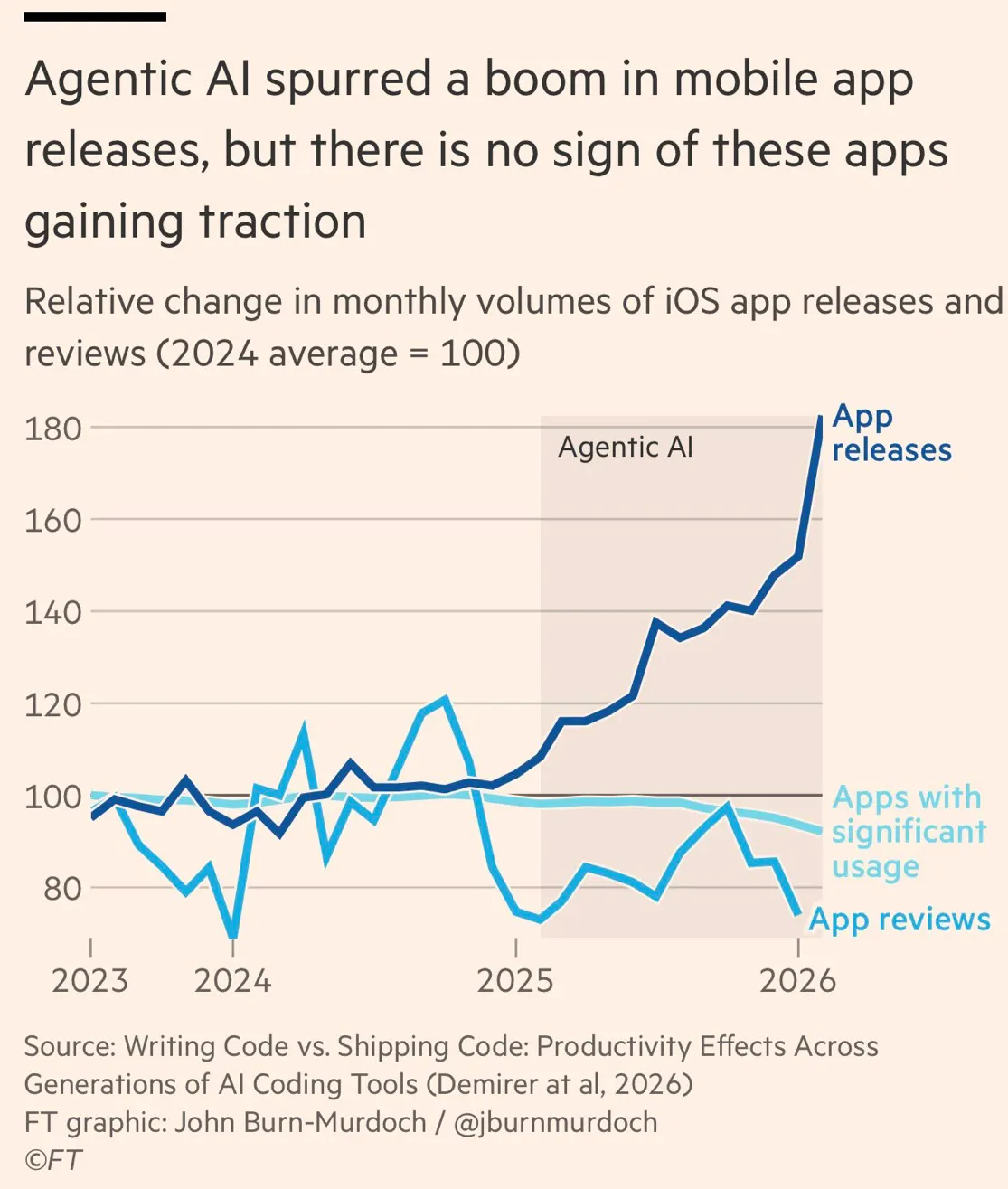
The volume paradox
Generative AI has unleashed a flood of output across nearly every content domain. Mobile apps, books, scientific papers, music tracks, and lines of code now appear at unprecedented rates. Yet multiple studies from MIT, McKinsey, and Bain reveal a troubling disconnect: this explosion in volume has not translated into meaningful return on investment for companies or measurable GDP growth.
Recent data visualization from the Financial Times illustrates this paradox starkly in the mobile app market. While app submissions have skyrocketed, the economic value generated remains flat. The pattern repeats across industries.
Book publishing offers a clear example. The Washington Post reported dramatic increases in books available over recent years, coinciding with the rise of generative AI tools. Yet book sales have actually declined slightly during the same period, and quality has not improved. Similar trends appear in music uploads, scientific paper submissions, and web content generation—more volume, no discernible improvement in quality or economic impact.
The slop problem
Much of this surge consists of what critics call "slop"—plausible-seeming content that lacks genuine value. The issue extends beyond consumer media into technical domains. A group of mathematicians recently issued the Leiden Declaration, reported by The New York Times, warning that automated techniques now produce mathematical arguments that appear credible but may contain errors difficult to detect. This threatens the peer review system that ensures correctness and verifiability in mathematical proofs.
Wikipedia, libraries, and academic repositories face similar inundation challenges as AI-generated material becomes harder to distinguish from human-created work.
Why it matters
The productivity metrics that guide business investment and economic policy may be fundamentally misleading when applied to generative AI. Traditional GDP accounting counts activity—even paying workers to dig and refill holes adds to GDP. Running AI models generates token costs and creates measurable output, but if that output lacks lasting value, the apparent productivity gains are illusory. Companies investing heavily in AI tools based on volume metrics may be overlooking the absence of real economic returns.
The economics don't add up
Even in coding—widely considered AI's strongest use case—the financial picture remains murky. Providers including OpenAI, Anthropic, and Cursor operate at substantial losses. One analysis suggests these companies may spend $1,000 for every $100 customers pay. Data center operators like CoreWeave also report losses. As providers raise prices to cover costs, AI-assisted coding could become more expensive than human developers.
Customers are already resisting new pricing models as usage costs climb. The circular financing and uncertain cash flows make it difficult to assess whether even chip manufacturers are seeing sustainable returns once accounting adjustments are made.
These details were first reported by Gary Marcus on AI Watch, who noted that the one productivity story generating the most excitement—agentic coding—also burns the most cash while creating systems of uncertain durability.
This is an original analysis by the Omega editorial team. Source reporting: AI Watch.
Want systems like this working for your business?
Book a Call