AI Drives 27% Net Hiring Growth in Europe Despite Skills Gaps
Linux Foundation research shows AI creating tech jobs rather than eliminating them, while security concerns and talent shortages slow adoption.
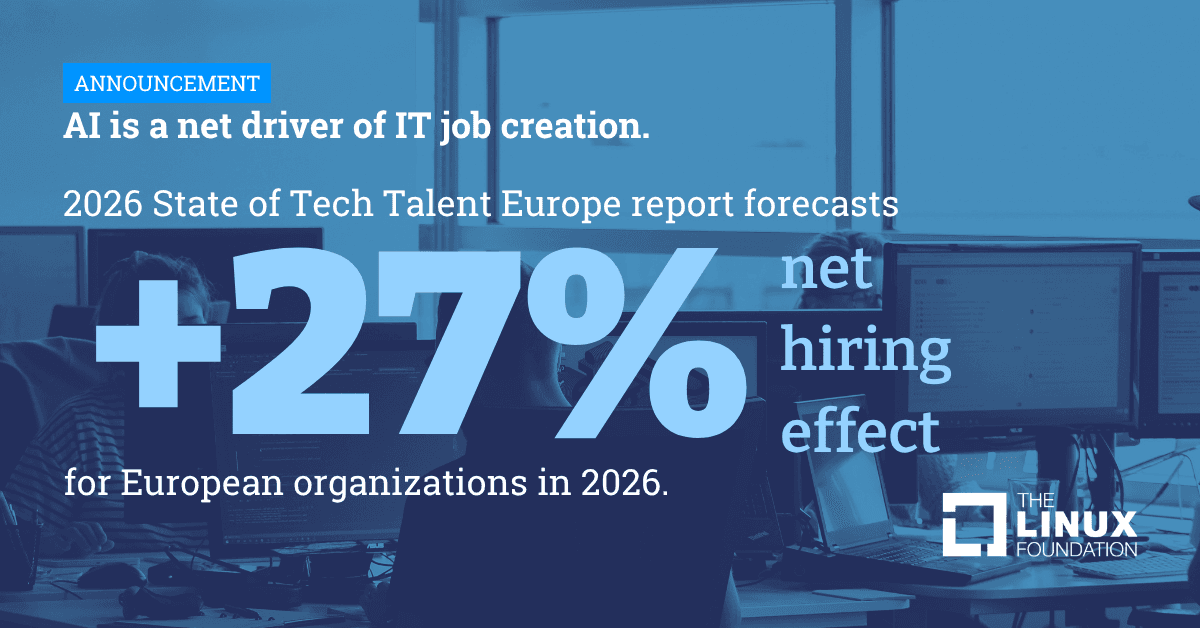
Artificial intelligence is creating more technology jobs than it eliminates in Europe, according to new research that challenges widespread fears about AI-driven workforce displacement.
The Linux Foundation and LF Research released their first State of Tech Talent Europe report, projecting a net hiring effect of +27% for 2026 and +17% for 2027 among European organizations deploying AI technologies. The findings, first reported by the Linux Foundation, reveal that smaller organizations are experiencing particularly strong hiring growth, while only the largest enterprises report negative net hiring effects of -15%.
Demand for AI-specific roles in Europe outpaces the rest of the world, with a net hiring effect of +64% compared to +58% globally. These figures align with World Economic Forum projections forecasting 78 million net new jobs globally by 2030, with 170 million roles created against 92 million displaced.
Security and skills create deployment barriers
While AI drives job creation, European organizations face significant obstacles to realizing its full value. Security concerns have emerged as the top barrier to new technology adoption, cited by 51% of organizations, followed closely by skills gaps at 44%.
The security challenge is particularly acute in Europe, where cybersecurity roles face severe understaffing at 48%—14 percentage points higher than the rest of the world. Additionally, 61% of organizations globally report capability gaps in AI security and risk management.
"There can be no digital sovereignty without local tech talent," said Thierry Carrez, General Manager of Linux Foundation Europe. "AI is disrupting everything. Models continue to grow in their abilities, and their impact on the tech talent market needs to be properly assessed."
Upskilling emerges as primary talent strategy
Faced with critical skills shortages, European organizations are prioritizing internal development over external recruitment. The research shows that 63% of organizations identify upskilling existing staff as their primary response to talent gaps, compared to 59% pursuing external hiring—with 94% rating upskilling as important.
Organizations prove 3.7 times more likely to upskill than hire across strategic technology domains. The preference for internal development is strongest for understanding business context (7.9 times more likely), team cohesion (6.3 times), total cost efficiency (5.8 times), and staff retention (5.6 times).
Open source technology has become the leading strategy for implementing AI and building technological capabilities among European organizations, with 54% adoption. This approach reduces licensing costs and mitigates vendor lock-in risks while supporting digital sovereignty goals.
Why it matters
The research provides concrete evidence that AI adoption creates net positive employment effects in technology sectors, countering displacement narratives that have dominated public discourse. However, the findings also highlight that security vulnerabilities and skills shortages—not the technology itself—represent the primary barriers preventing organizations from capturing AI's full value. For business leaders, the data suggests that investing in workforce development and security capabilities will prove more critical to AI success than simply deploying new tools.
The complete 2026 State of Tech Talent Europe report is available from the Linux Foundation and LF Research.
This is an original analysis by the Omega editorial team. Source reporting: AI Watch.
Want systems like this working for your business?
Book a Call