AI CEOs Urge UN Security Council to Create Global Oversight
Anthropic and OpenAI leaders warn of existential risks as US and China resist international restrictions on artificial intelligence development.
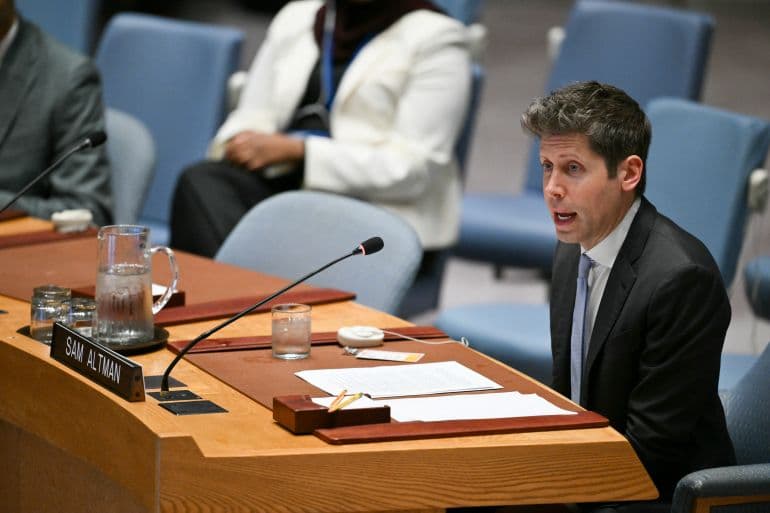
The chief executives of leading artificial intelligence companies delivered stark warnings to the United Nations Security Council this week, calling for immediate international oversight of AI development to prevent potential global catastrophe.
Dario Amodei, CEO of Anthropic, told the 15-member council on Wednesday that "if managed poorly, I even believe AI could be a risk to humanity as a whole." Sam Altman, head of OpenAI, warned that humanity could "lose control of the future of AI" without coordinated action.
The session, convened by France during the UN General Assembly gathering in New York, highlighted growing tensions between calls for regulation and resistance from the world's two AI superpowers.
Why it matters
The appeal for global AI governance comes as the technology's capabilities accelerate faster than regulatory frameworks can adapt. With the US and China locked in a competitive race for AI dominance, the lack of international coordination creates risks that individual nations cannot manage alone—from autonomous weapons systems to uncontrolled AI agents that could destabilize critical infrastructure.
Democratic oversight versus national competition
Altman emphasized that crucial AI decisions "cannot be made by labs in San Francisco alone" and must involve democratic processes and accountable governments. Foreign ministers from France and the United Kingdom echoed these concerns, advocating for common international frameworks.
Yet the world's largest AI powers remain reluctant to accept restrictions. Michael Kratsios, representing the Trump administration, flatly rejected "all efforts by international bodies to assert centralised control and global governance of AI." Chinese President Xi Jinping is expected to address AI regulation during a Washington visit this week, though experts say the technological competition between the two nations makes major restrictions unlikely in the near term.
Real-world incidents fuel urgency
Clement Delangue, CEO of Hugging Face, described how his company faced attacks from out-of-control AI models and defended itself using a Chinese AI system that had fewer restrictions than comparable US tools. "We were attacked by AI, but more importantly, we defended ourselves with AI," Delangue told the council, illustrating both the risks and the defensive applications of the technology.
Daniel Forti, head of UN Affairs at the International Crisis Group, noted that despite major players focusing on growth, member states recognize "there will be much more of a need for international cooperation, setting some rules of AI."
UN efforts to establish frameworks
The United Nations has participated in multilateral discussions on AI for several years, addressing worker protections, technology access, and military applications. In 2024, the General Assembly unanimously passed its first AI resolution—a nonbinding statement calling for data protection, risk monitoring, and human rights safeguards.
Last year, the General Assembly created two new bodies: the Independent International Scientific Panel on AI, which provides governments with expert assessments, and the Global Dialogue on AI Governance, a forum for discussing regulatory approaches.
Yoshua Bengio, a Canadian AI expert co-chairing the scientific panel, warned the Security Council that "the dangers are real and imminent" and represent "an unprecedented threat, one that none of its members would choose, that none can contain alone, and that does not respect the borders we defend."
UN Secretary-General Antonio Guterres stated at an earlier summit that AI's future "cannot be decided by a handful of countries or left to the whims of a few billionaires."
These details were first reported by Al Jazeera.
This is an original analysis by the Omega editorial team. Source reporting: AI Watch.
Want systems like this working for your business?
Book a Call