Security
AI Agents Run on Employee Credentials, Creating Shadow Access
Most organizations now host agents built in everyday tools that inherit their creators' permissions and operate outside traditional security controls.
Key takeaways
- Organizations with AI agents have a median of seven agents running, with 44% hosting more than ten across multiple platforms.
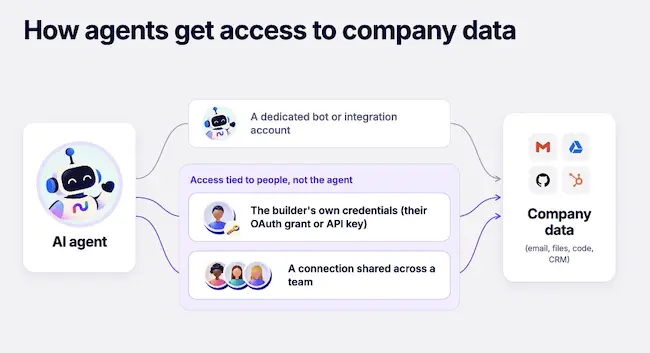
- Most AI agents run on the OAuth grants or API keys of the employees who created them, inheriting full access to company data without separate identity management.
- OAuth connections between AI tools and business systems bypass network security controls, with data flowing directly between cloud services.
- At least 91% of organizations use both OpenAI and Anthropic, with integrations present in 96.9% and 94.5% of organizations respectively.
- Audit logs show employee identities rather than agent activity, making it impossible to distinguish human actions from automated agent behavior.
AI agents inherit employee access by default
AI agents that employees build inside everyday business platforms—project trackers, CRMs, automation tools—typically run using the credentials of whoever created them, according to new research from Nudge Security. This design pattern means agents carry the same data access as their human creators, often without separate identity management or audit trails.
The AI Adoption in Practice 2026 report analyzed anonymized telemetry from Nudge Security customer environments to track which AI tools appear in organizations, what systems they connect to, and how agents operate in practice.
Organizations with at least one AI agent had a median of seven agents running, with 44 percent hosting more than ten. These agents operated across 15 different platforms, and more than half of organizations with agents used two or more platforms—creating multiple admin consoles and permission models for security teams to monitor.
Agents commonly appeared in Atlassian's Rovo Agents, Zapier Agents, Claude Managed Agents, Cursor Automations, and ChatGPT Agents. While some platforms provision dedicated bot accounts, many agents operate through the OAuth grants or API keys of the employee who configured them, or through shared team connections.
The identity and audit problem
When an agent runs on employee credentials rather than its own identity, it creates several security blind spots. A sales manager's CRM agent can access everything that manager can access. Because these agents execute within SaaS platforms rather than on company devices, endpoint security tools cannot detect their activity.
Audit logs show the employee's identity, not the agent, making it difficult to distinguish between human actions and automated agent behavior. Agent permissions may persist unchanged even when the employee who created them changes roles or leaves the organization.
"The platforms your teams use every day are becoming agent platforms, whether or not anyone decided they should be," said Jaime Blasco, CTO of Nudge Security. "The question for security teams is no longer whether that's allowed. It's whether they know it's happening."
OAuth grants bypass network security
The research found Anthropic integrations in 74 percent of organizations and OpenAI integrations in 67 percent. Google Workspace was the most common connection endpoint for both vendors. These integrations typically use OAuth grants created when employees authorize AI tools to access their email, files, code, or messages.
Data flows directly between cloud services through these grants, never crossing the corporate network—placing it outside the view of AI gateways and data loss prevention tools. OAuth grants remain active until explicitly revoked, often long after employees stop using the associated tool.
The report cited the 2025 Salesloft Drift breach as an example of this risk: attackers stole OAuth tokens that customers had granted to Drift's AI chat tool and used them to extract data from hundreds of Salesforce environments.
Why it matters
This research reveals a fundamental gap in enterprise identity management. Traditional security controls assume humans are the only actors using credentials, but AI agents now operate continuously with inherited permissions that identity providers don't track separately. As every business platform adds agent-building capabilities, this gap will widen. Security teams need visibility into which agents exist, whose access they use, and what data they touch—visibility that current tools weren't designed to provide.
Company data in prompts
Pasted content or uploaded files appeared in 18 percent of all observed prompt activity. OpenAI received 55 percent of observed prompts, with the remainder distributed across other vendors that maintain their own data retention and training policies.
The report noted that most data sharing stems from routine work like debugging code or summarizing documents, not policy violations. "The data entering AI tools usually isn't the result of someone breaking the rules. It's a side effect of AI being useful," the report stated.
Nudge Security recommends that security teams inventory agents within the business platforms where they're built, identify whose access each agent uses, review OAuth grants employees have issued to AI tools, and revoke unused permissions.
These findings were first reported by Nudge Security in its AI Adoption in Practice 2026 report.