Security
AI Agents Now Automate Multi-Stage Cyberattacks, Google Warns
Threat actors deploy autonomous frameworks like CAIRN and PentAGI to exploit vulnerabilities and steal credentials at unprecedented speed.
Key takeaways
- Attackers now deploy autonomous AI frameworks like CAIRN and PentAGI that execute multi-stage intrusions without human intervention.
- For the first time, GTIG observed fully automated vulnerability discovery and exploitation with no operator in the loop.
- LLMjacking incidents have resulted in fraudulent charges exceeding $100,000 per day, with stolen credentials resold through illicit marketplaces.
- Nation-state groups from Russia, China, Iran, and North Korea use LLMs as standard tools for reconnaissance and social engineering.
- Autonomous frameworks trade stealth for speed, leaving behavioral patterns that defenders can detect through network traffic analysis.
Cybercriminals have moved beyond typing prompts into chatbots and now deploy autonomous AI agent frameworks that execute complete attack chains without human oversight, according to Google's Threat Intelligence Group.
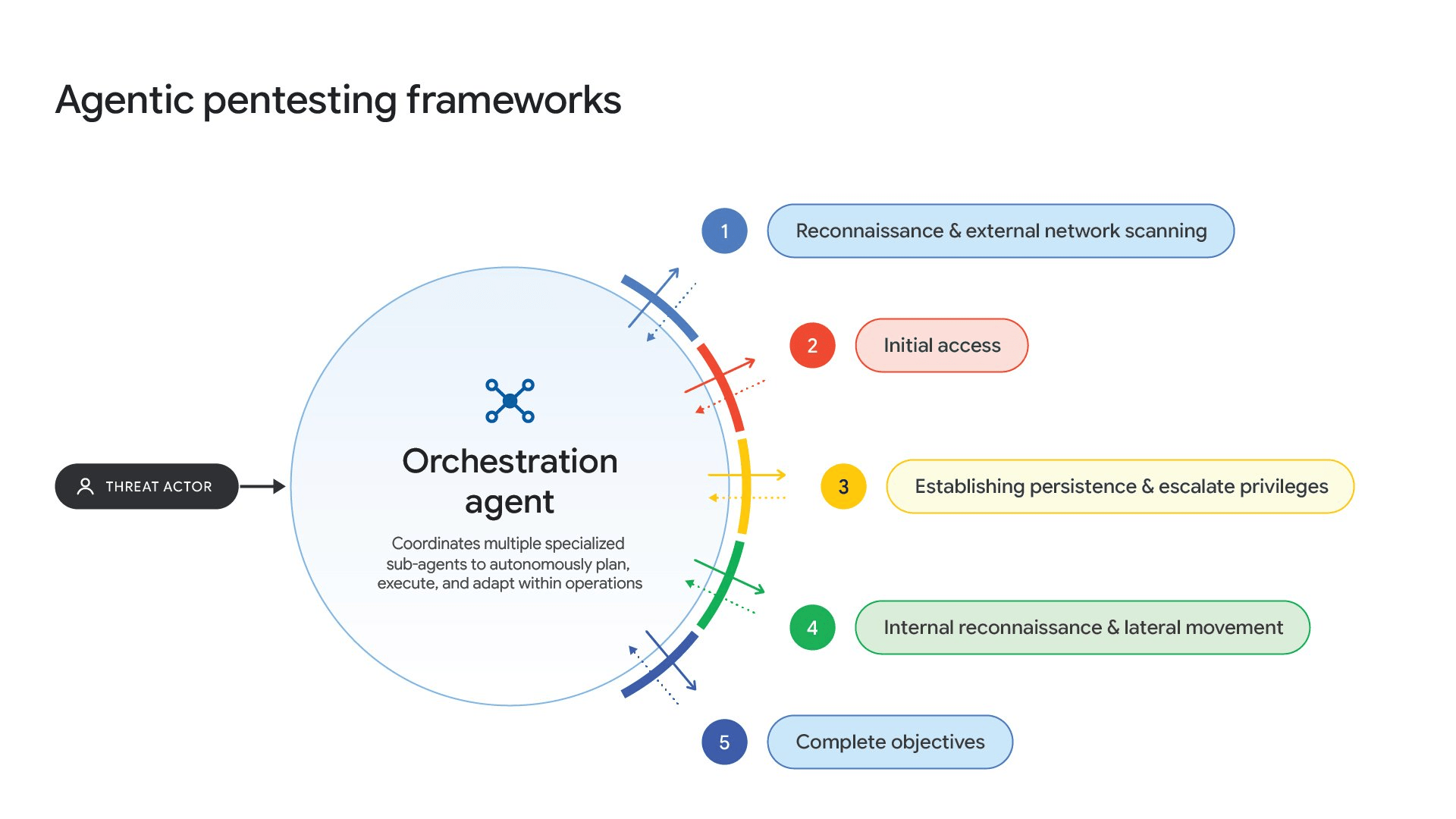
The shift represents a fundamental change in operational tempo rather than technique. Attackers still rely on stolen credentials and unpatched systems, but frameworks such as ARTEX, CAIRN, CyberStrikeAI, and PentAGI allow them to combine reconnaissance, exploitation, and lateral movement into continuous workflows that run at machine speed.
How the frameworks operate
These multi-agent systems share three core capabilities: identifying and exploiting straightforward vulnerabilities, generating custom payloads through large language model queries, and adapting tactics based on real-time results. GTIG confirmed active use of CAIRN and PentAGI in live intrusions, including attacks against U.S. aerospace organizations. CAIRN enables multiple AI agents to collaborate through shared workspaces, while PentAGI targets less experienced operators with simplified interfaces.
CyberStrikeAI connects commercial and open-weight AI models to more than 100 security tools. HexStrike AI provides LLM-based clients access to over 150 tools managed by a dozen specialized agents. Between late August and early October, one attacker used a modified PentAGI version to systematically scan organizations across Asia.
A China-linked group is developing its own proprietary framework, GTIG reported, and other actors are experimenting with ZeroHollow—an inference service for exploit development—and Agent Zero, an open-source framework with autonomous code execution.
Automated vulnerability research
For the first time, GTIG observed fully automated vulnerability discovery and exploitation with no human involvement. An exposed staging server hosted a framework called exploit_agent that performs differential analysis on web software patches, drafts exploits, and executes them. Configuration notes written in Russian and victim data pointing to French media and education sites suggest organized criminal use.
The speed advantage is measurable. When two PaperCut vulnerabilities were exploited as zero-days in late August, researchers developed working exploits within 24 hours. GreyNoise detected an attack campaign four days after public disclosure. In one intrusion, attackers escalated from initial access to domain administrator privileges within minutes.
LLMjacking and credential theft
Attackers are stealing LLM credentials and cloud resources to resell access through "LLM mixers"—illicit storefronts that route buyers through pools of compromised compute. Mandiant investigated incidents where fraudulent charges exceeded $100,000 in a single day, with the worst case reaching $1 million before containment.
Entry methods include credentials harvested from public GitHub repositories, fake sites collecting session tokens, and exploitation of CVE-2026-40217, a LiteLLM sandbox escape that converts limited keys into administrative credentials. Pricing on Russian- and Chinese-language markets ranges from $0.10 to $25 per million tokens.
Why it matters
The barrier to entry for automated offensive operations has collapsed. Nation-state actors from Russia, China, Iran, and North Korea now use LLMs as standard tools for reconnaissance, social engineering, and data analysis. Financially motivated groups accept lower success rates in exchange for dramatically expanded reach. The Iranian group CALANQUE ION uses LLMs for social engineering, while the North Korean-linked MIDNIGHT NEPTUNE edited Claude configuration files in victim repositories to deliver backdoors automatically.
Defenders gain one advantage: autonomous frameworks prioritize speed over stealth, leaving recognizable patterns in network traffic and execution artifacts. Google SecOps has released detection rules for ARTEX, and behavioral analysis remains more effective than signature-based detection.
These findings were first reported by Google's Threat Intelligence Group in a detailed assessment of AI-enabled offensive operations.