Xi Jinping calls for global AI cooperation, not single-country dominance
Speaking at Shanghai's World AI Conference, China's president outlined plans to share AI capacity with developing nations and stressed human oversight.
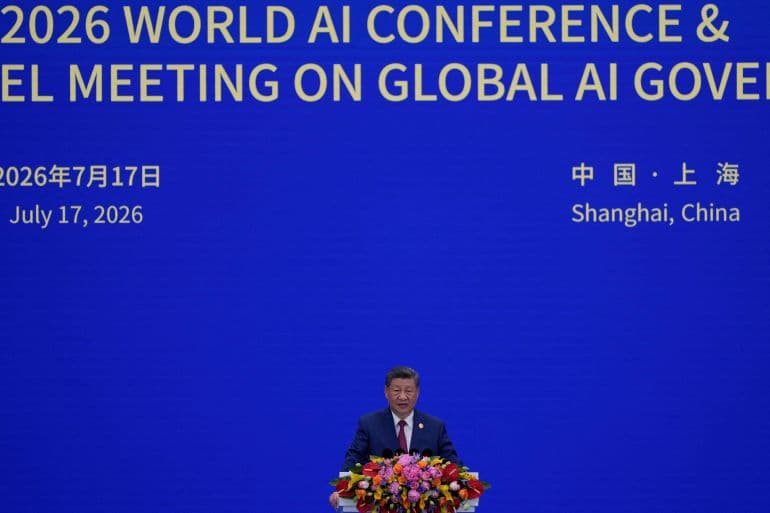
Chinese President Xi Jinping used a major artificial intelligence conference in Shanghai to advocate for international collaboration on AI development, warning against any single nation dominating the technology.
Speaking at the World Artificial Intelligence Conference on Friday, Xi outlined China's vision for equitable global access to AI capabilities and emphasized the need for human control over the technology. The remarks come as Chinese AI models increasingly compete with American offerings, often at lower price points, while geopolitical tensions shape how nations approach AI governance and export controls.
China's vision for AI cooperation
Xi framed AI development as inherently collaborative, stating that "AI development should not be a solo performance by a single country, but a symphony of international cooperation." He announced China's intention to partner with international bodies across Africa, Latin America, Asia, and BRICS countries to provide AI-related opportunities.
The Chinese president positioned this outreach as preventing "new historical injustices" by ensuring developing countries gain access to AI capacity-building. He also criticized what he characterized as overstretching national security concerns in the AI sector, arguing against placing one country's security above others.
Human oversight and regulatory frameworks
Xi stressed the importance of maintaining human control over AI systems, calling for a "people-centred" approach to the technology. He advocated for establishing comprehensive legal frameworks, technological monitoring systems, early warning mechanisms, and emergency response protocols to ensure AI remains under human supervision.
These remarks arrive as debates intensify globally over AI governance, particularly regarding military applications and potential misuse by criminals or hackers.
The geopolitical context
Xi's comments unfold against a backdrop of escalating technology restrictions. The United States and European Union have imposed limits on Chinese tech imports citing national security, while Washington has tightened semiconductor export controls. In May, the U.S. Commerce Department affirmed restrictions on advanced AI chip shipments to Chinese company subsidiaries located outside China, closing potential loopholes in export controls.
Despite facing restrictions on cutting-edge semiconductors, China maintains advantages in AI infrastructure. The country generates more than twice the electricity of the United States—a critical factor given that next-generation data centers can consume as much power as two million households, according to the International Energy Agency. State-led investment continues expanding China's energy grid capacity.
AI has become central to China's industrial policy, with state investment building a domestic ecosystem spanning chip production to consumer applications. Daily consumption of "tokens"—the industry standard unit for measuring AI usage—has increased a thousandfold in China over the past two years, according to state media citing officials.
Why it matters
Xi's call for AI cooperation signals China's strategy to position itself as a leader for developing nations while challenging U.S. technological dominance. As AI becomes increasingly critical to economic competitiveness and national security, the question of whether nations pursue collaborative frameworks or fragmented, competing systems will shape the technology's global trajectory. China's energy infrastructure advantages and growing domestic AI ecosystem give it leverage in this competition, even as semiconductor restrictions constrain access to the most advanced chips.
These details were first reported by Al Jazeera.
This is an original analysis by the Omega editorial team. Source reporting: AI Watch.
Want systems like this working for your business?
Book a Call
