Women Hold Just 26% of New AI Jobs Despite Higher Pay
LinkedIn data reveals a widening gender gap in the fastest-growing segment of the tech labor market.
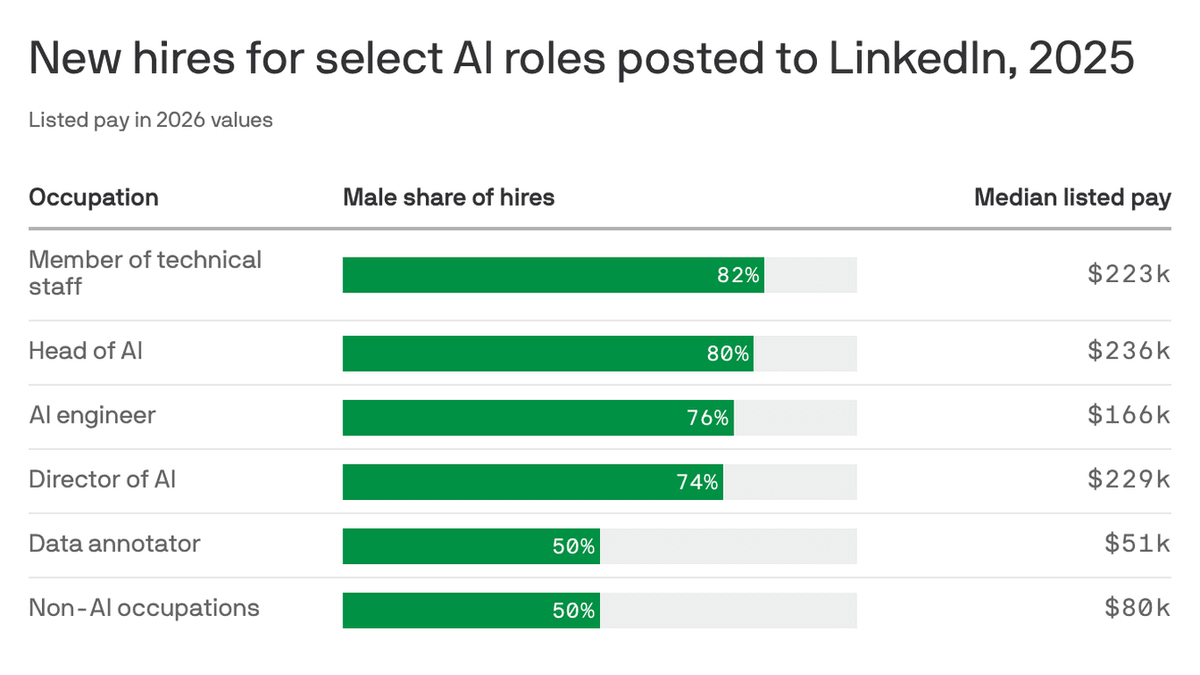
Women secured just over a quarter of new artificial intelligence job hires in the United States last year, according to LinkedIn data released Tuesday. Men captured 74% of these positions in 2025, compared to a roughly even gender split in non-AI occupations.
Why it matters
AI roles represent some of the fastest-growing and highest-compensated positions in today's sluggish labor market. The disparity means women are largely excluded from career paths offering substantial economic mobility and influence over technology that will shape business and society for decades.
The compensation divide
The gender imbalance grows more pronounced at higher salary levels. LinkedIn's analysis of job listings and member profiles shows men dominating the most lucrative positions.
Consider the "member of technical staff" role, a position common in AI labs that bridges advanced research and full-stack engineering. Men received 82% of new hires for these positions in 2025, which carry a median listed salary of $223,000.
By contrast, data annotator positions—paying a median of $51,000—show near-equal hiring between men and women at roughly 50-50.
A visible pattern
The numbers confirm what observers have noted throughout the AI boom: men comprise the overwhelming majority of public figures driving the technology's development. This visibility gap reflects the underlying hiring reality across the sector.
While AI constitutes a rapidly expanding economic segment, the actual number of these specialized jobs remains a small fraction of the overall labor market. Yet their influence extends far beyond their headcount.
Long-term implications
The findings extend a persistent pattern in technology employment. Women have historically faced underrepresentation in technical roles and leadership positions across the industry. The AI expansion is amplifying rather than correcting this imbalance.
"Women may be included in the AI economy, but not in the roles most likely to drive long-term economic mobility, leadership, and decision-making power," Sarah Steinberg, head of global public policy partnerships at LinkedIn, told Axios in an email.
The concentration of men in senior technical positions means they will disproportionately shape AI product decisions, research directions, and the technology's societal impact. This dynamic raises questions about whose perspectives and priorities guide systems increasingly embedded in business operations, healthcare, education, and public services.
The data was first reported by Axios.
This is an original analysis by the Omega editorial team. Source reporting: AI Watch.
Want systems like this working for your business?
Book a Call
