Women Hold 59% of AI-Threatened Jobs, But Aren't More Trapped
New research reveals that demographic exposure to AI automation tells only half the story about who faces the greatest career risk.
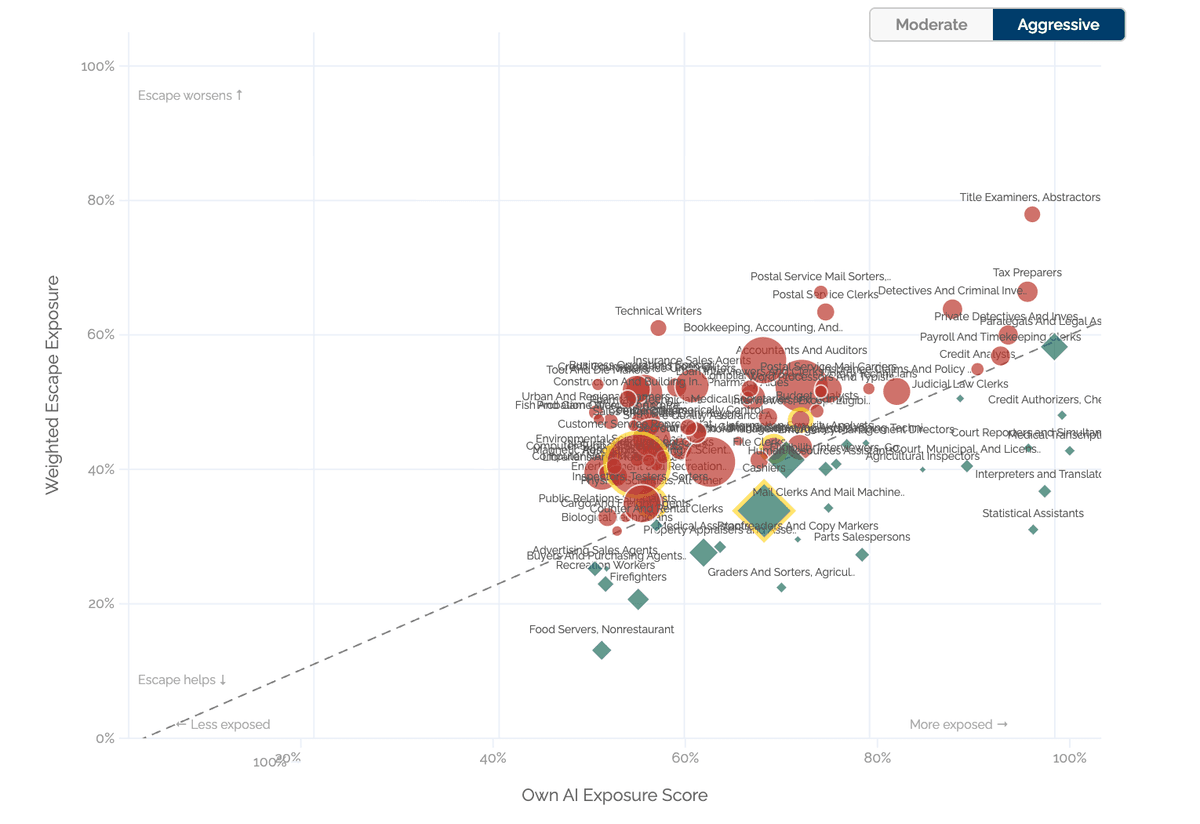
The exposure gap doesn't predict mobility outcomes
Women hold nearly 59% of jobs most vulnerable to AI automation, despite making up just 46.5% of the workforce analyzed in a new study. But that headline figure masks a more complex reality: once in those high-risk roles, women are no more likely than men to be "trapped" with no viable career path forward.
The distinction matters for policymakers designing workforce support programs. According to research from the Bipartisan Policy Center examining 595,000 worker transitions between 2019 and 2026, 18.7% of women work in highly AI-exposed occupations compared to 10.3% of men. Yet among workers in those vulnerable roles, 69.5% of women and 70.9% of men are trapped—meaning their most likely next jobs face equal AI disruption.
The gender gap in overall trapped status stems not from women getting stuck more often, but from their concentration in clerical, administrative, and business support roles that AI can readily automate. The five largest high-exposure occupations are all majority female, led by secretaries and administrative assistants at 91.9% female and bookkeeping clerks at 82.7%.
Young workers face high exposure but retain escape routes
Workers aged 16-24 face the highest AI exposure of any age group at 17.4%, yet show the lowest trapped rate at just 46.9%. The reason: 39% of highly exposed young workers are cashiers, a role with clear transition pathways into food service, retail, and healthcare support.
Remove cashiers from the analysis and the picture shifts dramatically. Young workers' exposure rate drops to 11.3% but their trapped rate jumps to 77.4%, nearly matching older cohorts. This suggests younger workers aren't inherently more mobile—they simply occupy different positions in the labor market structure, often in high-turnover roles that still offer multiple exit routes.
Older workers, by contrast, tend to be embedded in occupational networks where available moves keep them within similarly exposed work.
Black workers face near-term vulnerability
Under a moderate AI adoption scenario, Black workers show a trapped rate of 37.6%—roughly 8 percentage points above all other racial groups. This gap stems from their concentration in clerical and data-processing roles that fall within moderate AI capabilities.
However, under an aggressive scenario reflecting current AI capabilities as of early 2026, trapped rates converge across racial groups. Black workers' trapped rate drops to 69.4%, similar to white workers at 71.9% and Asian workers at 71.6%. The convergence suggests that as businesses close the gap between AI's technical capabilities and actual deployment, the racial disparity in trapped status may narrow.
Why it matters
Policies targeting AI workforce disruption based solely on exposure rates will miss critical nuances about who needs support most. A woman in a high-exposure administrative role may have viable career transitions, while a middle-aged worker in a moderately exposed technical role may face a dead end. The research underscores that effective workforce policy requires understanding not just whose job is at risk today, but where those workers can realistically go next—and whether those destinations offer genuine economic mobility.
The findings were first reported by the Bipartisan Policy Center in their Trapped Workers research series. Future briefs will examine implications by education level, geography, and wage outcomes.
This is an original analysis by the Omega editorial team. Source reporting: AI Watch.
Want systems like this working for your business?
Book a Call
