USDOT Unveils Federal Roadmap for Autonomous Truck Regulation
Five-year strategy outlines FMCSA rulemaking on automated commercial vehicles and NHTSA competency standards through 2030.
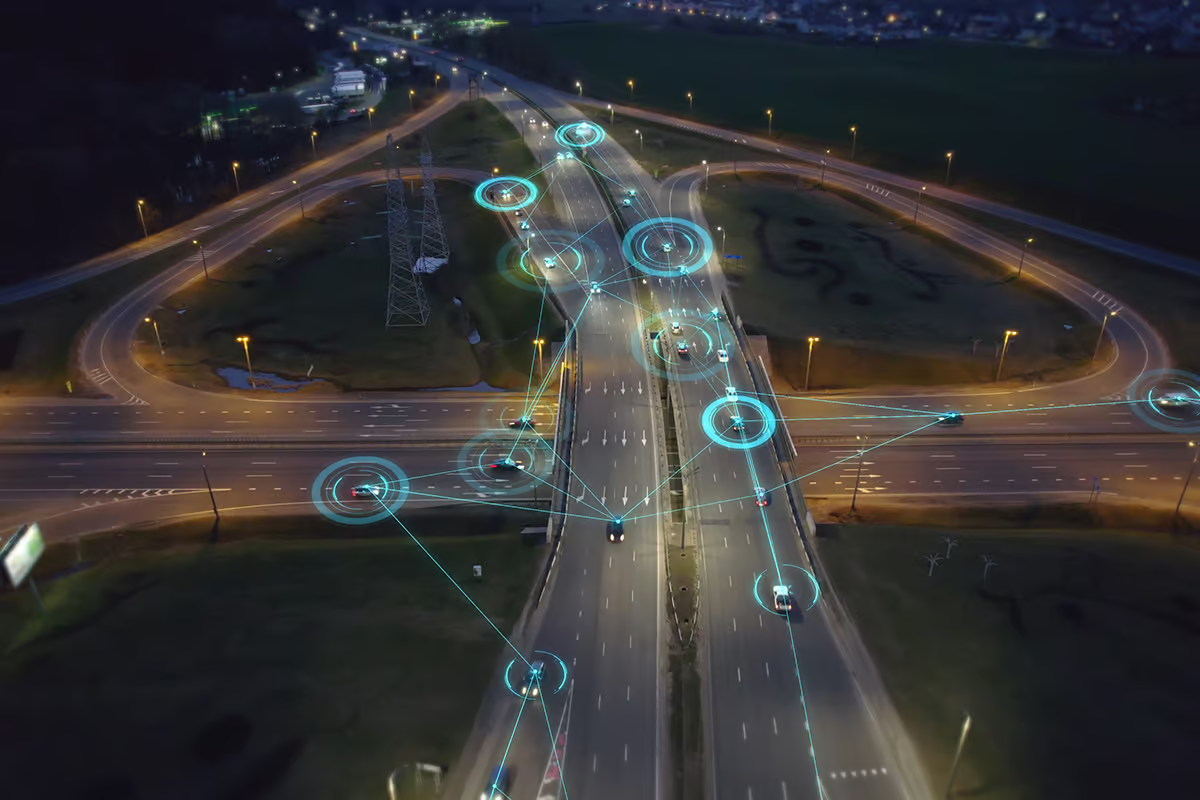
The U.S. Department of Transportation has published a comprehensive strategy for automated vehicle oversight that puts federal regulation of autonomous trucks at the center of its agenda through fiscal year 2030.
The plan, titled "America Leads: DOT's National Strategy for Automated Vehicles, Fiscal Years 2026-2030," establishes four core objectives: prioritizing safety, providing regulatory certainty, promoting domestic innovation, and facilitating interoperable corridors for interstate operations. The strategy addresses both passenger and freight applications, acknowledging that automated trucks are already hauling cargo on some interstate routes.
Why it matters
For the first time, federal regulators are committing to specific rulemaking timelines for autonomous commercial vehicles. The strategy signals that FMCSA will rewrite core trucking regulations to account for vehicles operating without human drivers—a shift that could reshape compliance requirements, inspection protocols, and operational oversight for carriers deploying automated fleets.
FMCSA to rewrite commercial vehicle regulations
The most significant development for the trucking industry is an upcoming FMCSA rulemaking focused specifically on automated driving system-equipped commercial motor vehicles. The agency is developing proposed changes to Federal Motor Carrier Safety Regulations that currently govern operations, inspections, repairs, and maintenance.
These regulations were written assuming a human driver is present. FMCSA's work will distinguish which requirements remain necessary for automated trucks and which need modification. The strategy does not detail specific requirements that would apply to carriers or fleet operators—those will emerge through the proposed rule and public comment process.
NHTSA developing competency standards
The National Highway Traffic Safety Administration is preparing an advance notice of proposed rulemaking to establish objective performance standards for automated driving system competency. USDOT describes this as the first federal safety standard for automated vehicle competency, though the strategy characterizes it as an early rulemaking step rather than a finalized standard.
These performance standards would define how an automated driving system must demonstrate safe operation within its intended conditions. Test procedures, compliance thresholds, and implementation timelines have not yet been established.
NHTSA is also updating Federal Motor Vehicle Safety Standards that were developed around conventional controls and human drivers, addressing equipment including transmission controls, windshield systems, lighting, braking systems, and occupant protection.
Emergency response and hazmat considerations
FMCSA is developing a framework to help first responders interact safely with automated trucks during crashes, roadside stops, and other incidents. Separately, the Pipeline and Hazardous Materials Safety Administration is reviewing how federal hazardous materials regulations should apply when no human is present in the vehicle, including access to shipping papers, emergency-response information, and automated incident notifications.
Federal-state coordination without infrastructure mandates
The strategy emphasizes reducing operational differences as automated vehicles cross state lines. USDOT plans to convene federal agencies, states, and private-sector stakeholders to develop consistent data structures and exchange protocols.
Notably, the strategy does not make connected infrastructure a condition for automated vehicle deployment. USDOT expects automated vehicles to operate safely with infrastructure and communications systems as they exist today, without requiring roadway operators to make AV-specific investments as a prerequisite.
The department maintains that existing federal authorities provide the foundation for overseeing automated vehicles. NHTSA will continue to oversee automated driving systems as motor vehicle equipment, while FMCSA handles operational and safety oversight of trucks and buses. State and local governments retain traditional roles in licensing, traffic enforcement, and rules of the road.
The strategy does not immediately impose new fleet requirements. Its practical effects will depend on future rulemakings, guidance documents, and federal-state coordination efforts that emerge over the five-year period.
These details were first reported by Automation Watch.
This is an original analysis by the Omega editorial team. Source reporting: Automation Watch.
Want systems like this working for your business?
Book a Call