US Ranks 24th in AI Adoption Despite Leading Global Development
Stanford's 2026 AI Index reveals a striking paradox: America builds the world's most advanced AI but lags far behind in actually using it.
A surprising disconnect in AI leadership
The United States dominates artificial intelligence development by nearly every measure—investment, research talent, and model creation. Yet when it comes to actually using AI tools, America ranks 24th globally, trailing countries like the United Arab Emirates, Singapore, and even Ireland by wide margins.
This striking paradox emerges from Stanford's 2026 AI Index, the field's most comprehensive annual assessment spanning 400 pages of data on technical performance, investment, labor markets, environmental impact, and adoption patterns across two dozen economies.
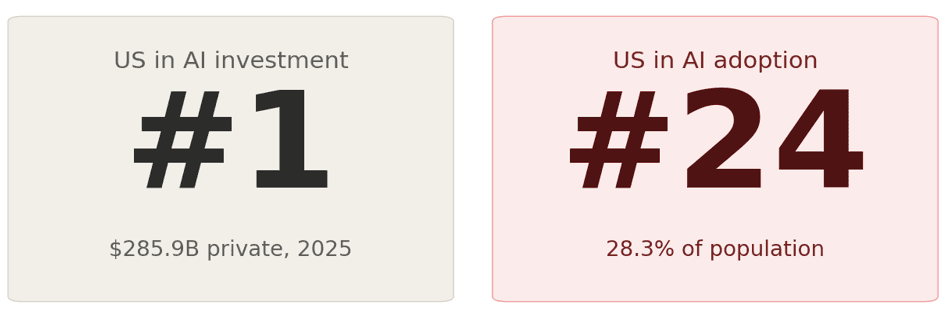
According to the Index's measurement of generative AI tool usage in the second half of 2025, the UAE leads global adoption at 64%, with Singapore close behind at 61%. The US registered just 28.3% adoption—sitting 13 percentage points below the trend line when plotted against GDP per capita, the largest gap of any wealthy nation.
The development-adoption gap
The contrast with America's development leadership is stark. US private AI investment reached $285.9 billion in 2025—23 times China's total and exceeding the rest of the world combined. Leading AI models continue to emerge from American labs, and despite an 89% decline in talent inflows since 2017, US researchers still outnumber any other country.
The adoption gap isn't explained by access barriers. Americans can use the same AI tools, on the same day, typically for free, as users anywhere else. Instead, the Index's adjacent findings suggest a trust and expectation problem: only 33% of American workers believe AI will improve their jobs, and just 31% trust government to regulate it—the lowest figure among surveyed countries.
Mixed signals from the broader landscape
The Index documents both progress and concern across AI's expanding footprint. On the positive side, frontier models now match or exceed human performance on PhD-level science problems and competition mathematics. Global corporate investment hit $581.7 billion, up 130% year over year. AI tools are cutting physician note-writing time by up to 83% in hospital systems.
But warning signs are accumulating. Training runs now consume massive energy—Grok 4's training emitted 72,816 tons of CO2, equivalent to 17,000 cars driven annually. Employment among US software developers aged 22 to 25 has dropped nearly 20% from its 2022 peak. Model transparency scores fell from 58 to 40 in a single year, with the most capable systems disclosing the least about their training and capabilities.
The US-China performance gap has narrowed to just 2.7 percentage points, while China leads in publication volume, patents, and industrial robot installations.
Why it matters
The adoption gap reveals a fundamental challenge for American competitiveness. Building advanced AI technology matters less if the workforce won't use it and the public doesn't trust it. While other nations integrate AI tools into daily work and decision-making, American hesitation could erode the practical advantages that should flow from technical leadership—a self-inflicted handicap in a technology race with profound economic and geopolitical stakes.
These findings were first reported by Oren Etzioni, writing about the Stanford 2026 AI Index release.
This is an original analysis by the Omega editorial team. Source reporting: AI Watch.
Want systems like this working for your business?
Book a Call