Trump's AI Data Center Push Faces Backlash from Unlikely Coalition
Religious leaders, labor unions, and local activists are uniting against rapid AI expansion, creating political headwinds ahead of midterms.
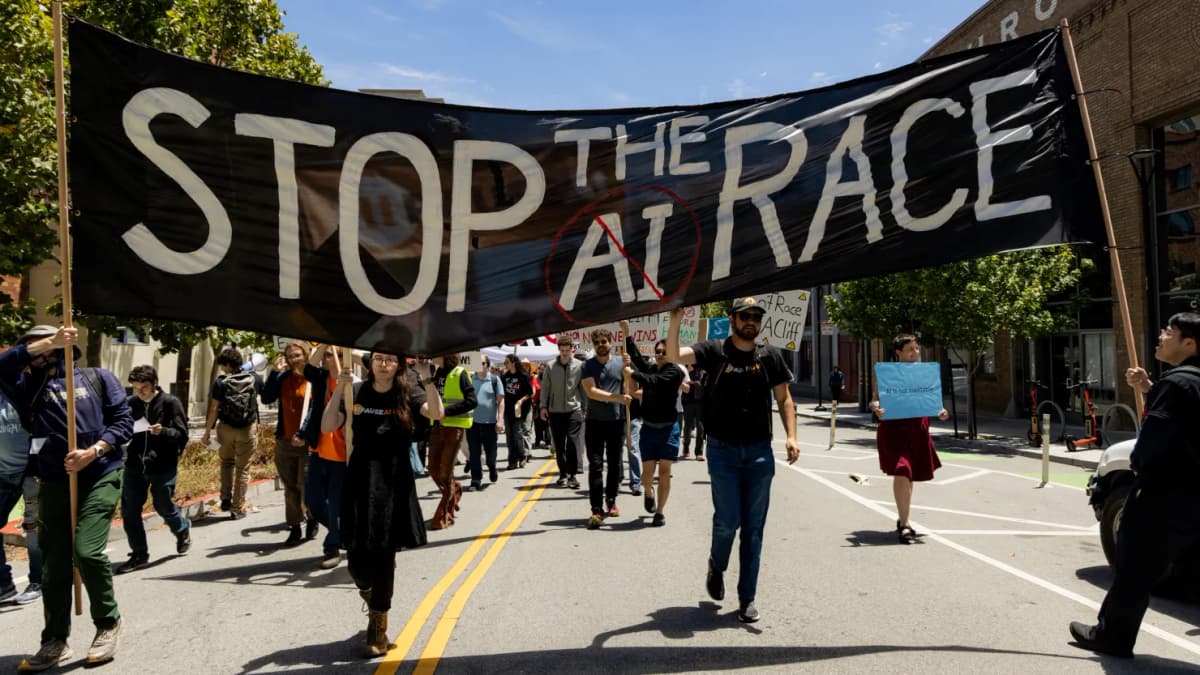
President Donald Trump is promoting artificial intelligence infrastructure development even as an unusual alliance of religious leaders, labor unions, and community activists mobilizes against the technology's rapid expansion—a political miscalculation that could cost Republicans in upcoming elections.
At an Environmental Protection Agency event Thursday, Trump urged governors and local officials to embrace data center construction in their states, framing opposition as futile. "You can't fight it. You have to go with it," he told the audience, suggesting someone would profit from the AI boom and it might as well be them.
The remarks came as Trump announced commitments from data center developers and utilities not to raise electricity prices, addressing widespread concerns that AI infrastructure will drive up energy costs for ordinary Americans. Yet his enthusiasm for the industry sits awkwardly alongside mounting public skepticism.
Why it matters
The emerging resistance to AI development cuts across traditional political lines and includes constituencies Republicans have courted aggressively. Evangelical Christians, union members, and local communities—groups that overlap significantly with Trump's base—are expressing serious reservations about AI's societal impact. With midterm elections 101 days away, the president's alignment with Big Tech on this issue creates vulnerability in races where economic anxiety and cultural concerns drive voter behavior.
Religious and labor opposition grows
Walter Kim, president of the National Association of Evangelicals, praised Pope Leo XIV's May encyclical warning that AI requires guardrails to protect humanity. Speaking on CNBC, Kim described AI's expanding role in healthcare, education, and warfare as "the construction of a Tower of Babel" that "disconnects us from God" and from each other.
While Kim's organization doesn't endorse candidates, his comments signal shifting sentiment among evangelicals who have supported Trump since his first campaign.
Labor leaders are equally pointed. Liz Shuler, president of the AFL-CIO, told delegates at the union's convention that presidential candidates seeking the highest office must prioritize "working people before algorithms." Sean O'Brien, head of the International Brotherhood of Teamsters who spoke at the 2024 Republican National Convention, noted that workers "never had a seat at the table" in AI discussions.
Palantir CEO Alex Karp, participating in an event with O'Brien, acknowledged "the biggest challenge to AI in this country is political unrest."
Local resistance crosses party lines
Opposition to data center construction appears in both red and blue communities. New York Governor Kathy Hochul imposed a moratorium on new data centers, but conservative Republicans also express concerns. A June poll by the Yale Program on Climate Communication found 53% of conservative Republicans oppose building data centers locally, compared to 74% of liberal Democrats and 58% of all registered voters.
Trump's pitch that Americans can get rich from data center development hasn't resonated. Despite the Nasdaq's 20 record closes this year, most Americans lack sufficient market exposure to benefit from Big Tech's gains. The recent SpaceX IPO illustrated the disconnect—shares dropped 30% after going public, disappointing retail investors who managed to participate.
These details were first reported by CNBC.
This is an original analysis by the Omega editorial team. Source reporting: AI Watch.
Want systems like this working for your business?
Book a Call
