Trump Backs Unfettered AI Growth as Economy Leans on Tech Boom
With AI investments driving a third of U.S. economic growth, the administration faces pressure to keep the buildout moving despite public skepticism.
Trump's AI Stance Reflects Economic Dependence
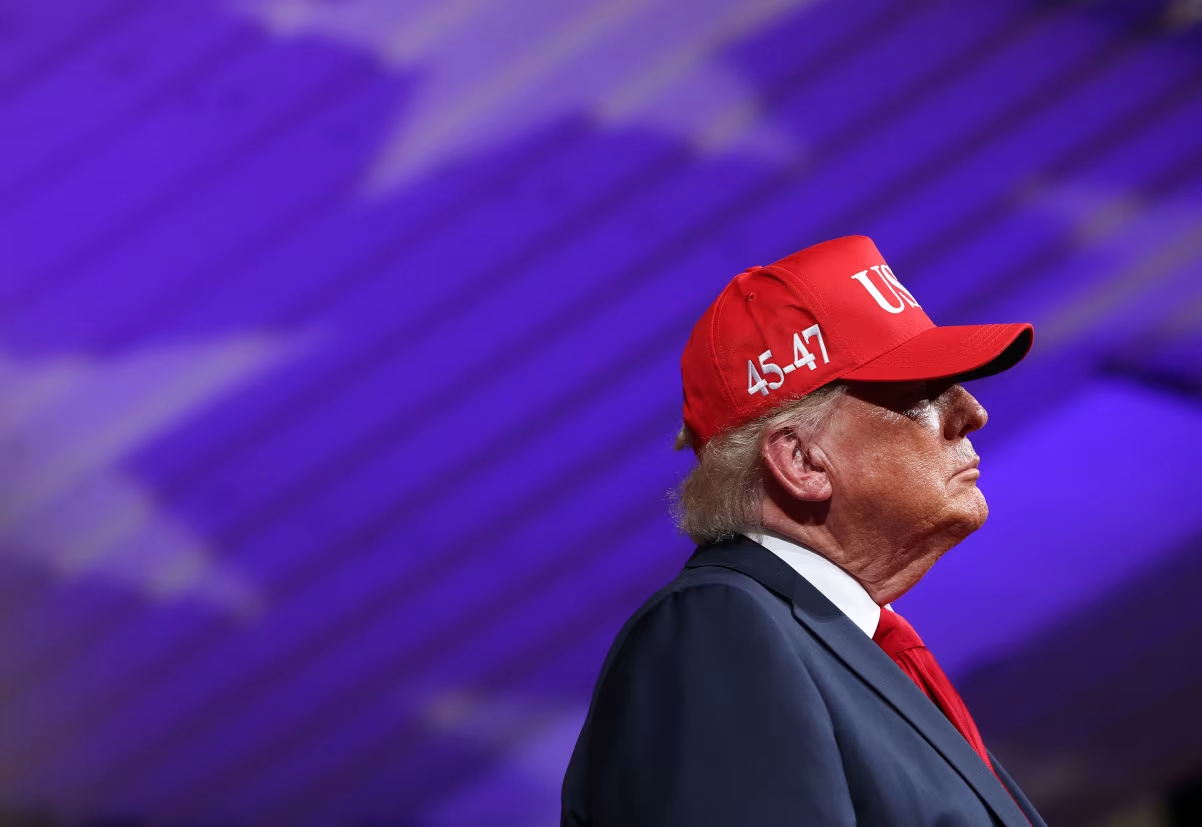
President Donald Trump has broken with technology executives who favor more measured AI development, choosing instead to champion rapid, largely unregulated expansion of the sector. The decision comes as economists quantify just how dependent the U.S. economy has become on artificial intelligence spending.
According to ING estimates, technology investments dominated by AI and data centers now account for roughly one-third of year-over-year economic growth in 2026. Goldman Sachs analysis indicates AI investment is driving half of all profit growth in the S&P 500. The position puts Trump at odds with public sentiment—most Americans oppose data center construction in their communities and remain wary of AI applications—but aligns with economic realities less than two months before midterm elections.
Why it matters
The U.S. economy has become structurally dependent on AI investment in ways that create systemic risk. If the sector contracts sharply, the effects would extend far beyond Silicon Valley, potentially triggering recession and erasing household wealth tied to stock portfolios. This dependence gives policymakers little room to impose restrictions that might slow the buildout, even as concerns mount about infrastructure strain, energy consumption, and social disruption.
Recession Risk if AI Spending Stalls
Fitch Ratings recently modeled what would happen if AI enthusiasm collapsed. In their scenario, U.S. stock prices fall 35% over six months—consistent with historical financial busts—and GDP contracts 1.5% the following year, meeting the technical definition of recession.
"If the music stops, and if it stops in a big, big way, it's likely that we're going to end up in stagnation or outright contraction over a period of at least a year," Olu Sonola, U.S. head of economic research at Fitch Ratings, said.
The ratings agency emphasized this sharp decline is not their base case forecast. Still, the analysis underscores vulnerability in an economy where consumer spending—itself supported by AI-inflated stock portfolios—remains the primary growth engine.
Interconnected Vulnerabilities
John Sedunov, a finance professor at Villanova University, pointed to the tightly coupled nature of the AI ecosystem as a source of fragility. Companies building data centers, manufacturing chips, developing models, and providing supporting services depend heavily on each other. A disruption in one segment could cascade through the chain.
These risks compound existing economic pressures. Bond markets are signaling concern over government debt levels and deficit spending. Inflation remains elevated, potentially forcing higher interest rates. Conflict in Iran adds geopolitical uncertainty. Corporate debt issuance to fund AI infrastructure has surged.
"The equity price bubble risk is definitely a big one," Sonola noted. "We've seen tariffs, we've seen the war. Another shoe is going to drop. We may just not know yet."
Optimists See Stabilizing Force
Not all economists view the AI boom as precarious. Jessica Wachter, a finance professor at the University of Pennsylvania's Wharton School, acknowledged the situation is unusual but doesn't expect a 2008-scale collapse.
"I actually think that (AI) is going to be a bit of a stabilizing force... generally promoting net job creation and growth," Wachter said. "I am, you can tell, an optimist, though. I know others have other views."
These details were first reported by CNN.
This is an original analysis by the Omega editorial team. Source reporting: AI Watch.
Want systems like this working for your business?
Book a Call