Trump and Xi Reveal Divergent AI Strategies Ahead of Summit
The U.S. president emphasizes maintaining technological lead while China's leader calls for open collaboration, exposing deep rifts in the AI superpower race.
Competing visions emerge as AI tensions escalate
The United States and China have staked out sharply contrasting positions on artificial intelligence development, with President Donald Trump declaring that "whoever wins AI wins" while Chinese President Xi Jinping called for international cooperation and open-source collaboration.
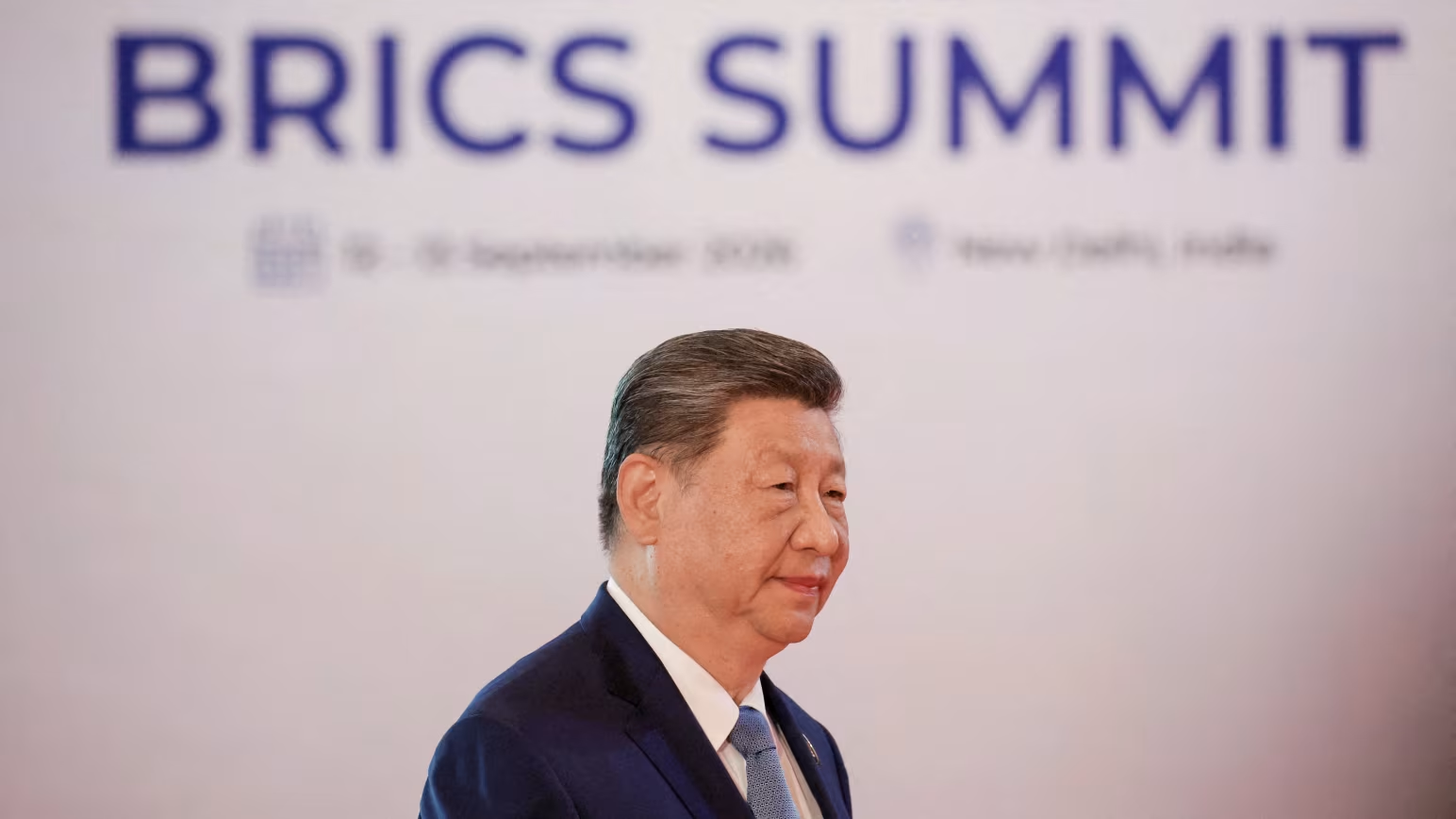
Trump made his remarks Saturday, explicitly rejecting calls from AI scientists and executives at Anthropic, OpenAI, and Google to slow development. His focus: maintaining America's lead against China. The following day, Xi addressed Global South leaders in India, proposing a global AI governance framework—though without specifics—and urging countries to embrace "open source, openness, collaboration and sharing," according to CNN.
The competing messages expose fundamental disagreements between the superpowers as they prepare for a summit in Washington in two weeks. The two leaders established an intergovernmental AI dialogue following their May meeting in Beijing, but produced limited concrete results.
Why it matters
The AI rivalry between Washington and Beijing will shape global technology development, trade relationships, and military capabilities for decades. Without meaningful cooperation on safety standards and governance, the world faces fragmented AI ecosystems, duplicated research efforts, and heightened risks of both accidental harms and intentional misuse. Business leaders investing in AI must navigate an increasingly bifurcated landscape where technology access, regulatory frameworks, and market opportunities depend heavily on geopolitical alignment.
Chinese models advance despite U.S. restrictions
Chinese AI has historically lagged American competitors, partly due to U.S. technology controls limiting access to advanced processors needed for training complex models. But Chinese startup DeepSeek disrupted that narrative last year with a model approaching leading American systems' performance while using far fewer computing resources, CNN reported.
Since then, Chinese labs including Alibaba, Z.AI, Minimax, and Moonshot have released similarly capable models challenging Anthropic and OpenAI's dominance.
Washington has responded with accusations of intellectual property theft. Last week, U.S. federal agencies including the FBI and National Security Agency claimed Chinese firms are conducting "industrial-scale" theft from American counterparts. Anthropic released a detailed report alleging Chinese government-affiliated operators misused its systems for weapons development and surveillance of Uyghurs in Xinjiang.
The report revealed that queries sent to Moonshot's Kimi model were secretly rerouted to Anthropic's Claude, exposing the Chinese company's practice of diverting user requests. Beijing has rejected the allegations, with Foreign Ministry spokesperson Guo Jiakun stating Monday that "spreading various threatening narratives" only disrupts global AI governance efforts.
Divergent safety priorities complicate cooperation
Beyond competitive tensions, the two nations view AI risks through fundamentally different lenses. While U.S. discourse focuses on existential threats like rogue AI agents, Beijing prioritizes political control and social stability. Chinese State Security Minister Chen Yixin criticized what he called "hegemonic practices"—a veiled reference to U.S. export controls and technology restrictions—arguing they fragment global AI supply chains.
Public attitudes also differ markedly. A 2025 Edelman survey found 72% of Chinese respondents trusted AI, compared with just 32% of Americans. China's top-down regulatory environment sets extensive rules governing AI outputs and deployment, while prominent U.S. executives publicly debate voluntary development constraints.
The trust deficit presents the central obstacle to cooperation. Washington fears technology sharing could strengthen China's military capabilities, while Beijing views U.S. "national security" concerns as pretexts for technological containment. A social media account affiliated with Chinese state broadcaster CCTV laid out conditions for dialogue last month, demanding Washington guarantee its AI companies would follow agreed-upon rules before negotiations proceed.
These details were first reported by CNN.
This is an original analysis by the Omega editorial team. Source reporting: AI Watch.
Want systems like this working for your business?
Book a Call