Terry Tao Leads Push for AI-Verified Mathematical Proofs
The Fields Medalist is formalizing his own research in Lean, signaling a shift in how elite mathematicians approach proof verification.
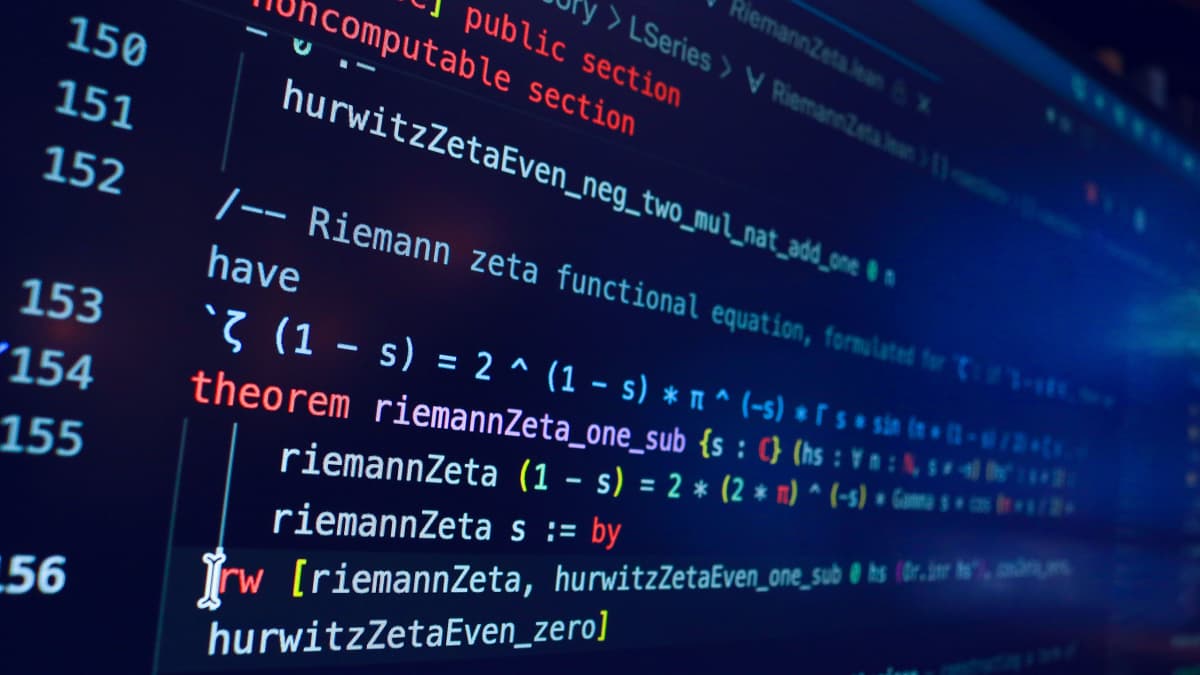
A shift in mathematical practice
Terry Tao, one of mathematics' most decorated researchers, is leading an unexpected transformation in how proofs are verified. The UCLA professor and Fields Medal winner has begun formalizing his own research using Lean, a proof assistant that checks mathematical arguments as computer code.
Tao's journey into formal verification began in October 2023, when he announced his intention to learn Lean 4. Within a month, he had formalized his first proof—a modest result about Maclaurin's inequality that took nearly four weeks to complete, far longer than the week he initially expected.
The experience revealed a counterintuitive reality: mathematically trivial steps required extensive formalization work, while conceptually difficult parts translated more easily into Lean. Simple assertions that mathematicians typically gloss over—like confirming that three numbers greater than 1 must sum to at least 3—demanded explicit proof statements and careful type specifications.
From Polymath to proof assistants
Tao's interest in computer-assisted mathematics has deep roots. In 2009, he became an early participant in the Polymath Project, an experiment in massive collaborative problem-solving launched by fellow Fields Medalist Timothy Gowers. The initiative allowed dozens of mathematicians to work together through blog comments, successfully proving results but revealing significant limitations.
The core challenge was verification. With many contributors working simultaneously, moderators had to manually check every submission for errors—a bottleneck that undermined the collaborative vision. Tao recognized that efficient large-scale mathematical collaboration would require automated verification, though the technology wasn't ready at the time.
By 2022, that had changed. Tao organized a workshop on computer-assisted mathematics, working with Kevin Buzzard, a prominent advocate for formal proof systems. Buzzard convinced Tao to try Lean himself, and Tao felt a responsibility to lead by example if he was going to promote these tools.
Formalizing frontier research
In November 2023, Tao and three collaborators—Ben Green, Tim Gowers, and Freddie Manners—proved the polynomial Freiman-Ruzsa conjecture, a significant result about patterns in number sets. Days after publishing the proof, Tao proposed formalizing it in Lean.
When his co-authors declined to learn the system themselves, Tao launched a public formalization project, opening a channel in a Lean-focused chat group on November 13. The move was characteristic of Tao's collaborative approach: any project he leads attracts attention and participants.
The polynomial Freiman-Ruzsa proof was well-suited for formalization because it used relatively standard techniques already represented in Mathlib, Lean's library of formalized mathematics. This made it accessible without requiring months of preparatory work adding new definitions.
Why it matters
Tao's adoption of formal proof verification carries weight beyond his individual practice. As one of mathematics' most influential figures, his public embrace of these tools legitimizes them for a field that has been slow to adopt computational methods for proof checking. His willingness to formalize his own frontier research—not just textbook results—demonstrates that proof assistants are becoming practical for working mathematicians. If formal verification gains traction, it could enable the kind of large-scale collaborative mathematics Tao envisioned with Polymath, with computers handling the verification bottleneck that previously required manual moderation.
Details of Tao's work with Lean and the polynomial Freiman-Ruzsa conjecture were first reported by Quanta Magazine.
This is an original analysis by the Omega editorial team. Source reporting: AI Watch.
Want systems like this working for your business?
Book a Call