South Korea Unveils $576B Chip and AI Investment Plan
President Lee Jae Myung announces massive semiconductor expansion with Samsung and SK Hynix to decentralize production beyond Seoul.
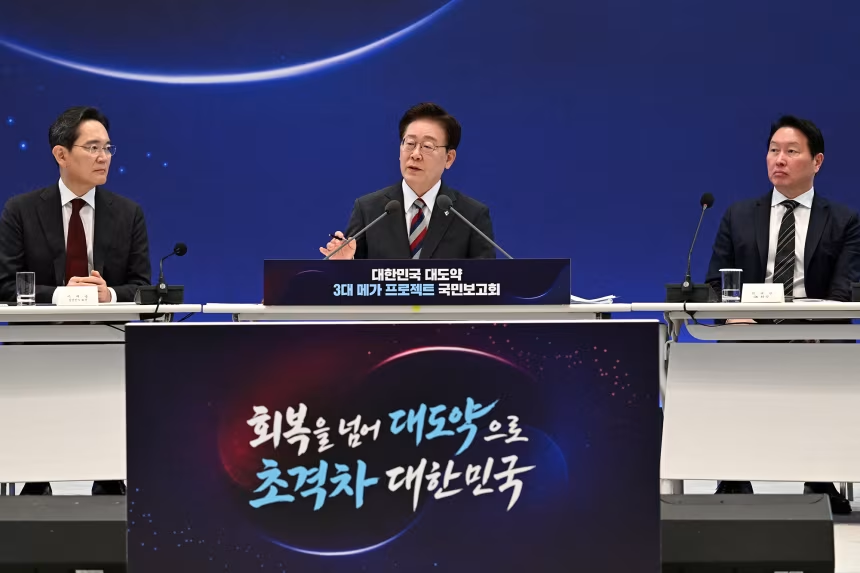
South Korea commits record investment to chip dominance
South Korea announced more than $576 billion in semiconductor and AI investments on Monday, marking the country's most ambitious effort yet to maintain its position atop the global memory chip industry while spreading economic development beyond the capital region.
President Lee Jae Myung unveiled the plan alongside executives from Samsung Electronics and SK Hynix, the world's two largest memory chipmakers, in a televised address that framed the initiative as essential to national competitiveness in artificial intelligence.
"We must secure the core elements of AI faster than any other country," Lee said. "Semiconductors, physical AI, and AI data centres are the triple axis for our great leap forward."
Why it matters
The investment represents a strategic bet that South Korea can maintain its semiconductor lead while solving two problems at once: meeting explosive AI chip demand and reducing the country's economic concentration in Seoul. High-bandwidth memory from Samsung and SK Hynix has become critical infrastructure for training advanced AI models, giving South Korea leverage in the global technology stack. But the plan's success hinges on whether new regions can rapidly build the power grids, water systems, supplier ecosystems, and skilled workforce that cutting-edge chip manufacturing requires.
Regional expansion targets southwestern Korea
Samsung and SK Hynix will invest 800 trillion won ($517.87 billion) with their suppliers to construct two new chip fabrication facilities each in South Korea's southwest region, according to Lee. The southwestern city of Gwangju and South Jeolla province will contribute between 5 trillion and 20 trillion won to the projects.
An additional 81 trillion won is earmarked for a chip packaging cluster in the Chungcheong area closer to Seoul.
Lee said the southwest was chosen in part because of "abundant, underused power" in the region. He noted that existing semiconductor sites around Yongin and Pyeongtaek in the Seoul metropolitan area "have already reached their limits."
Infrastructure challenges loom
Both Samsung and SK Hynix currently operate major semiconductor facilities in and around Seoul. Their high-bandwidth memory chips have become pivotal components in the race to build advanced AI systems, driving unprecedented demand.
Industry experts acknowledge that diversifying chip production beyond Seoul could relieve infrastructure bottlenecks. However, they caution that building cutting-edge fabrication plants requires vast electricity and water supplies, advanced logistics networks, deep supplier relationships, and highly skilled labor—resources that may not scale quickly enough in new regions to match the pace of AI demand growth.
The details were first reported by Reuters.
This is an original analysis by the Omega editorial team. Source reporting: AI Watch.
Want systems like this working for your business?
Book a Call
