Rippling tracks AI spending per employee, launches data analytics platform
Parker Conrad's HR platform now surfaces which workers generate value from AI tools and which burn budget without results.
Rippling is positioning its HR software as a business intelligence platform that can answer a question many executives are asking right now: which employees are actually getting value from expensive AI tools?
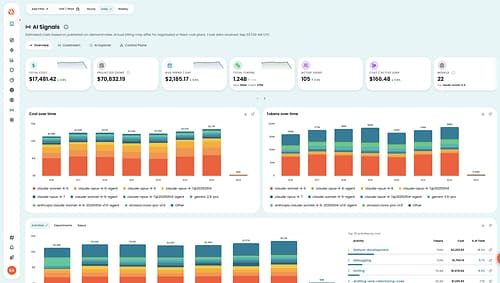
Parker Conrad, Rippling's CEO, demonstrated the capability using his own company's data. One employee was spending at a run rate of $30,000 annually on Claude for tasks like calendar analysis and email summarization. The spending wasn't unauthorized, Conrad noted, but the return on investment wasn't there either. Most companies have no systematic way to surface findings like this.
The capability is part of Rippling Data Cloud, launching today, which Conrad frames as a direct challenge to the modern data stack — the constellation of tools from vendors like Fivetran, Snowflake, dbt Labs, and Tableau that companies currently stitch together for analytics.
Tracking AI ROI at the individual level
Conrad showed dashboards that cross-reference Anthropic usage logs, GitHub pull request data, and performance ratings to identify patterns. High-performing engineers spend the most on AI tools, which tracks with expectations. But the system also flags engineers with high AI spending and high peer rejection rates on code reviews — colleagues frequently asking them to redo work.
"If your peers are telling you to go back and do this over all the time, maybe you're just generating a lot of slop," Conrad said, according to TechCrunch, which first reported the details.
The analysis has already prompted Rippling to cut spending limits for certain employees. The product can alert managers or automatically shut off access when employees exceed thresholds.
Why it matters
As AI tool costs scale with usage, companies lack visibility into whether individual employees are generating proportional value. Rippling's approach — combining usage data with performance metrics and workflow outcomes — offers a template for measuring AI productivity that goes beyond aggregate spending reports. The risk is that crude metrics like code rejection rates become proxies for value in ways that miss context, but the underlying question of AI ROI per employee is one finance and IT leaders increasingly need to answer.
Beyond data analytics
Rippling also announced Business Banking this week, offering high-yield checking and same-day payroll processing. Most payroll systems require two to four days of lead time; Rippling's banking product accepts changes as late as 1 p.m. on payday.
The move puts Rippling in direct competition with Ramp, which raised $750 million at a $44 billion valuation — nearly three times Rippling's $16.8 billion valuation from last year. Conrad acknowledged Rippling's banking business is smaller but said it's "growing very quickly" and benefits from centralization.
On AI models, Conrad said Rippling recently shifted significant workloads from Anthropic to OpenAI, calling the 5.5 model "both better and more cost-effective" for Rippling's use cases, though the company uses different models for different tasks.
Rippling Data Cloud is being used by approximately 560 companies, generating $5 million to $7 million in new monthly revenue. The base package runs around $20 per month with usage-based charges for heavier consumption. Conrad said the company isn't losing money on the product despite token costs.
Rippling remains roughly two years from cash flow positive, spending 45% to 50% of revenue on R&D compared to 8% to 9% for public HR companies like Paylocity and Paycom. Conrad said the company has no plans to go public despite favorable market conditions, calling public markets "a retirement community for slow growth companies."
The details were first reported by TechCrunch.
This is an original analysis by the Omega editorial team. Source reporting: AI Watch.
Want systems like this working for your business?
Book a Call