Regal Rexnord Motion Portfolio Extends Cobot Reach to 10 Meters
New integrated motion systems let one collaborative robot cover multiple workstations, reducing hardware counts in flexible manufacturing cells.
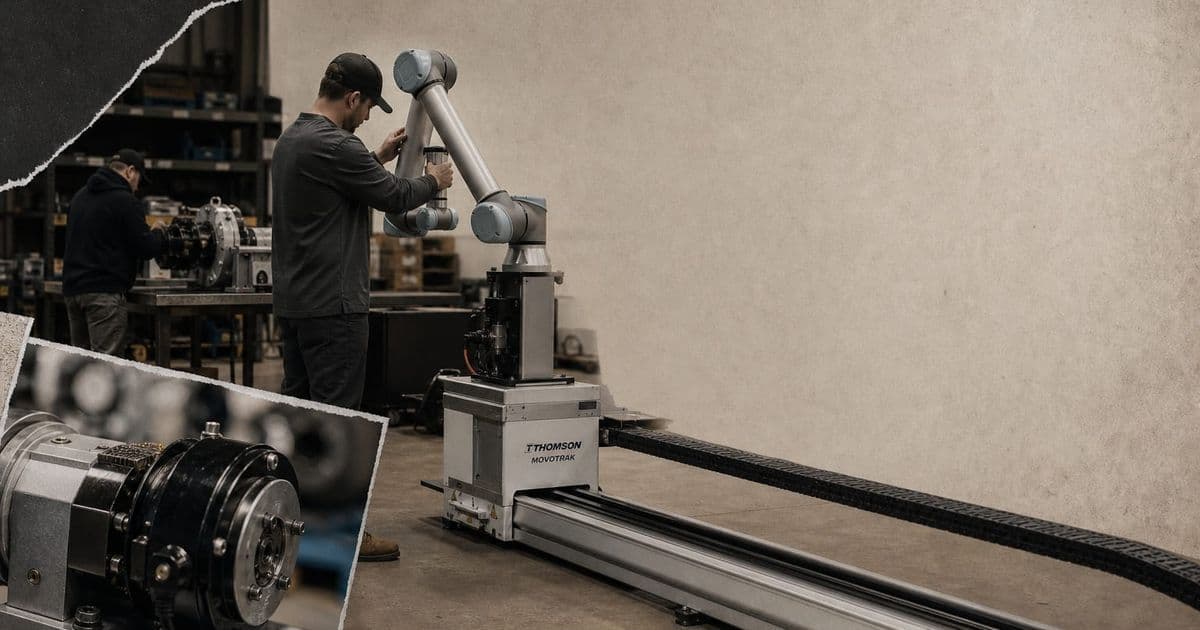
Longer reach, fewer robots
Regal Rexnord has released a motion systems portfolio designed to expand the working envelope of collaborative robots in flexible manufacturing environments. The centerpiece is a linear transfer system that extends a single cobot's horizontal range to 10 meters, allowing one robot to service multiple workstations without additional hardware purchases.
The Milwaukee-based company is targeting manufacturers and system integrators who need automation cells that can be reconfigured quickly as production requirements change. As robot deployments scale, the component count and integration complexity in each cell typically grows with them. Regal Rexnord's approach consolidates linear motion, servo control, braking, sensing, and power transmission into pre-integrated packages.
Why it matters
Flexible automation depends on how quickly a cell can be redeployed when a product line shifts. Reducing the number of robots, vendors, and discrete components in a cell directly affects commissioning time, safety assessments, and ongoing maintenance overhead. For operations teams evaluating cobot expansions, a 10-meter linear axis may defer or eliminate the need for a second robot purchase, changing the ROI calculation on automation projects.
Three core components
The Thomson Movotrak Cobot Transfer Unit operates as a seventh axis, sliding the cobot horizontally along a track. This lets one robotic arm cycle between workstations or span a larger process area. Fewer robots translate to fewer software licenses, simpler safety zones, and consolidated vendor management. The tradeoff is floor space and whether the track's footprint fits existing cell layouts or requires redesign.
The Kollmorgen Essentials Motion Systems bundle a servo motor, servo drive, and single-cable power-and-data connection into one configurable platform. These systems target packaging, warehouse automation, material handling, and forming applications where machine builders work under tight commissioning deadlines. Single-cable architectures reduce wiring labor and potential failure points, while pre-integrated bundles simplify procurement and warranty management.
The Warner Electric Integrated Position Brake combines parking, emergency braking, and absolute position sensing in one assembly. Historically, separating these functions across discrete components required more drivetrain length and additional wiring. Consolidation enables shorter, lighter drivetrains—important in space-constrained cells or when payload capacity is limited. Co-locating the position sensor with the mechanical stop can improve accuracy in applications where holding position after a stop is critical, such as vertical axes or precision assembly stations.
Integration as a design constraint
Kevin Long, executive vice president and president of automation and motion control at Regal Rexnord, noted that the right motion architecture helps manufacturers optimize space, reduce design tradeoffs, and build systems that adapt as production needs evolve. The portfolio strategy spans the company's Thomson, Kollmorgen, and Warner Electric brands, offering integrators a single source for motion components engineered to work together.
For system integrators, mismatched specifications between servos, gearboxes, brakes, and sensors have historically added weeks of engineering time during commissioning. Pre-validated component pairings can reduce that overhead, particularly on projects where interoperability issues surface late in the build cycle.
Evaluation checklist
Operations teams should audit current cobot deployments for idle time. If a robot waits for parts or operators, a linear transfer axis may improve utilization before justifying a second robot. When specifying servo systems, compare single-cable platforms against standard multi-cable setups on installation labor and mean-time-to-repair, not just unit cost. Evaluate integrated brake-and-sensor assemblies against drivetrain length constraints, especially on vertical axes where compact design affects counterbalance and structural costs.
These details were first reported by Assembly Magazine on July 2, 2026.
This is an original analysis by the Omega editorial team. Source reporting: Automation Watch.
Want systems like this working for your business?
Book a Call
