Radical Numerics raises $50M to build AI that reads entire genomes
The Stanford spinout's multimodal biology models can generate DNA at scale—and may also help defend against AI-designed bioweapons.
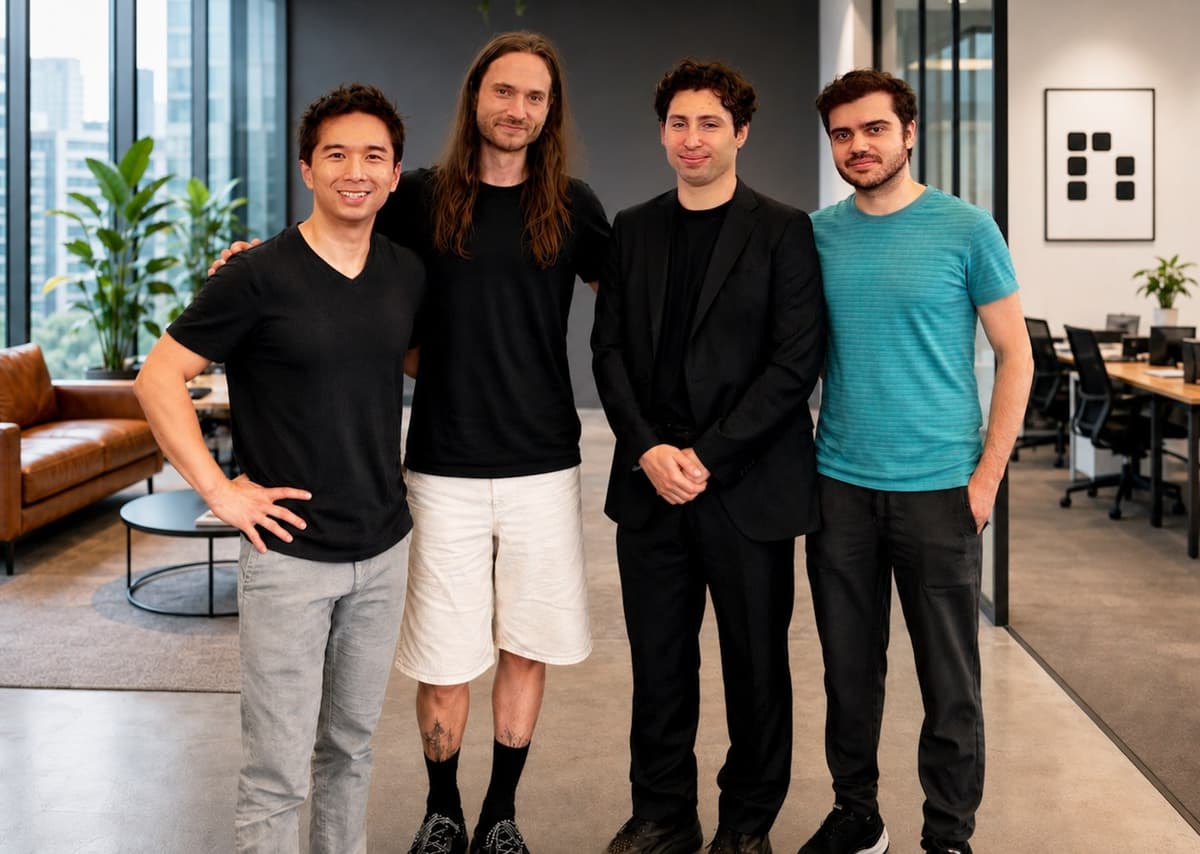
A new AI startup founded by the researchers who created the field of generative genomics has raised $50 million to build models that can read and manipulate the entire language of biology—not just individual molecules in isolation.
Radical Numerics emerged from stealth with seed funding led by Emergence Capital, with participation from Obvious Ventures, Triatomic Capital, Factory, and First Spark Ventures, Fortune has learned. Stripe CEO Patrick Collison backed the company at the pre-seed stage.
From academic breakthrough to commercial bet
The founding team—Eric Nguyen (CEO), Michael Poli (chief AI scientist), Stefano Massaroli (president), and Armin Thomas (CTO)—previously built core technology at Liquid AI, an MIT spinout focused on novel AI architectures. Three of the four worked together there before launching Radical Numerics.
Their academic work produced Evo and Evo 2, the first AI models capable of generating DNA sequences at scale after training on genomes from more than 100,000 species. Last September, researchers using Evo's open-source model weights created the world's first fully AI-designed functional virus, though it posed no threat to humans.
That milestone convinced the team to leave academia. Nguyen, who earned a master's in engineering at Cornell before pursuing a Stanford bioengineering PhD, told Fortune he returned to graduate school specifically to find a problem worth solving. "I wanted to find something that I thought I could contribute to, that if I didn't work on it, nobody else would," he said.
Why it matters
Most AI biology companies today focus on single molecule types—proteins, RNA, or DNA in isolation. Radical Numerics is betting that the real bottleneck in drug development isn't designing individual molecules, but understanding how they behave within complete biological systems. That architectural difference could determine whether AI actually accelerates drug discovery or simply automates one step in a still-slow process.
Multimodal biology versus specialized tools
The AI drug discovery market is projected to reach $25 billion by 2035. Competitors like Isomorphic Labs focus on proteins, while Inceptive specializes in RNA and recently signed a deal with Alnylam potentially worth $2 billion. Ginkgo Bioworks signed a five-year AI platform agreement with Google Cloud.
Radical Numerics is taking a different approach: building a single model that understands DNA, RNA, proteins, and other biological molecules simultaneously. "Getting the drug made won't be the bottleneck forever," Nguyen said. "You have to understand the whole system."
The company has secured two early partnerships—one applying its multimodal model to pancreatic and multi-cancer detection, and another with a national laboratory to detect and characterize pathogens, including those potentially designed by AI. The revenue model remains fluid, combining API licensing, custom fine-tuned models for pharmaceutical partners, and milestone payments.
The dual-use dilemma
The same technology that could accelerate cancer diagnostics could also lower barriers to designing biological weapons. Radical Numerics is acutely aware of this tension—its own open-source work enabled that first AI-designed genome.
"The defense side is sorely losing the race," Nguyen said. The company brought on Andrew Weber, former U.S. assistant secretary of defense for nuclear, chemical and biological programs, as an advisor. Future model releases won't automatically be made open-source.
Ninety-eight percent of the human genome remains unexplained. Nguyen is betting the same technology that could decode it might also protect against those who would weaponize it.
These details were first reported by Fortune.
This is an original analysis by the Omega editorial team. Source reporting: AI Watch.
Want systems like this working for your business?
Book a Call