Pentagon's GenAI Platform Reaches 1.5M Daily Users in Six Months
The military's generative AI tool has grown from 80,000 to 1.5 million users since December, driven by clearer guidelines and Google Gemini integration.
Explosive Growth in Military AI Adoption
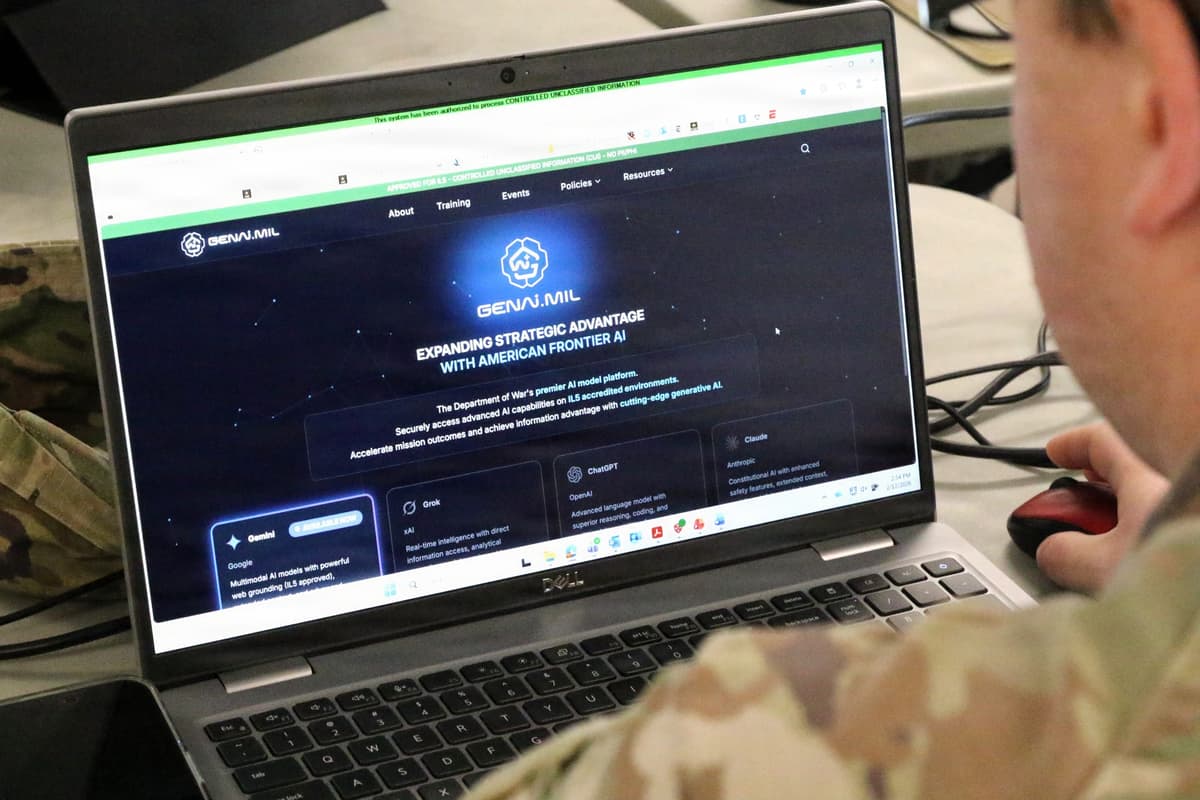
The Department of Defense has seen its generative AI platform surge to 1.5 million daily users, up from fewer than 100,000 just six months ago, according to the Pentagon's chief technology officer. The platform, GenAI.mil, now serves a substantial portion of the department's 3.5 million workers.
Emil Michael, undersecretary of defense for research and engineering, disclosed the figures at a Hudson Institute event last week, according to Business Insider. When GenAI.mil launched in December 2025, only 80,000 department employees were using the system.
Why it matters
This rapid adoption signals a fundamental shift in how the world's largest military organization approaches administrative work. The fifteen-fold increase in six months demonstrates that once barriers to entry are removed, government workers will embrace AI tools at commercial-sector speeds. For defense contractors and enterprise AI vendors, it validates that large-scale organizational AI deployment is achievable with clear policies and accessible interfaces.
What Changed to Drive Adoption
Michael attributed the dramatic uptick to two factors: clearer Pentagon directives on permissible AI uses and the integration of Google's Gemini onto unclassified Defense Department networks. Early adoption struggled because workers didn't understand where to access the tool, what tasks were appropriate, or what rules governed its use.
"It wasn't really clear where to go for it, what you could use it for, the rules were unclear, so we just blew through that," Michael said, as first reported by Business Insider.
The department also benefited from workers' growing familiarity with AI tools in their personal lives, making the transition to workplace adoption smoother.
Practical Applications Across the Department
Defense Department employees are using the AI platform for tasks common across industries. Michael highlighted paperwork automation as a primary use case, freeing workers to focus on higher-value activities.
Applications range from basic administrative functions—such as drafting job descriptions—to complex reporting requirements. Michael cited congressional reporting as one example where AI can compress 200 hours of staff time into five hours by processing and synthesizing multiple documents.
"So we just put it in front of them, and then we do case studies on what are the things people are using it for," Michael explained. "Those things are now proliferated through the department."
Beyond Administration
While current usage focuses on administrative efficiency, the Pentagon is simultaneously exploring AI applications in combat scenarios. The department has requested billions of dollars for next-generation AI and computing systems in its fiscal 2027 budget.
Defense officials have emphasized that human oversight will remain central to AI-assisted military operations, though they acknowledge that future warfare's speed may require AI to process data and support faster decision-making.
The details were first reported by Business Insider.
This is an original analysis by the Omega editorial team. Source reporting: AI Watch.
Want systems like this working for your business?
Book a Call