NVIDIA's AVO Agent Scores 100% on ARC-AGI-3 Benchmark
The same autonomous system that optimized GPU kernels for a week straight now masters interactive reasoning tasks without domain-specific training.
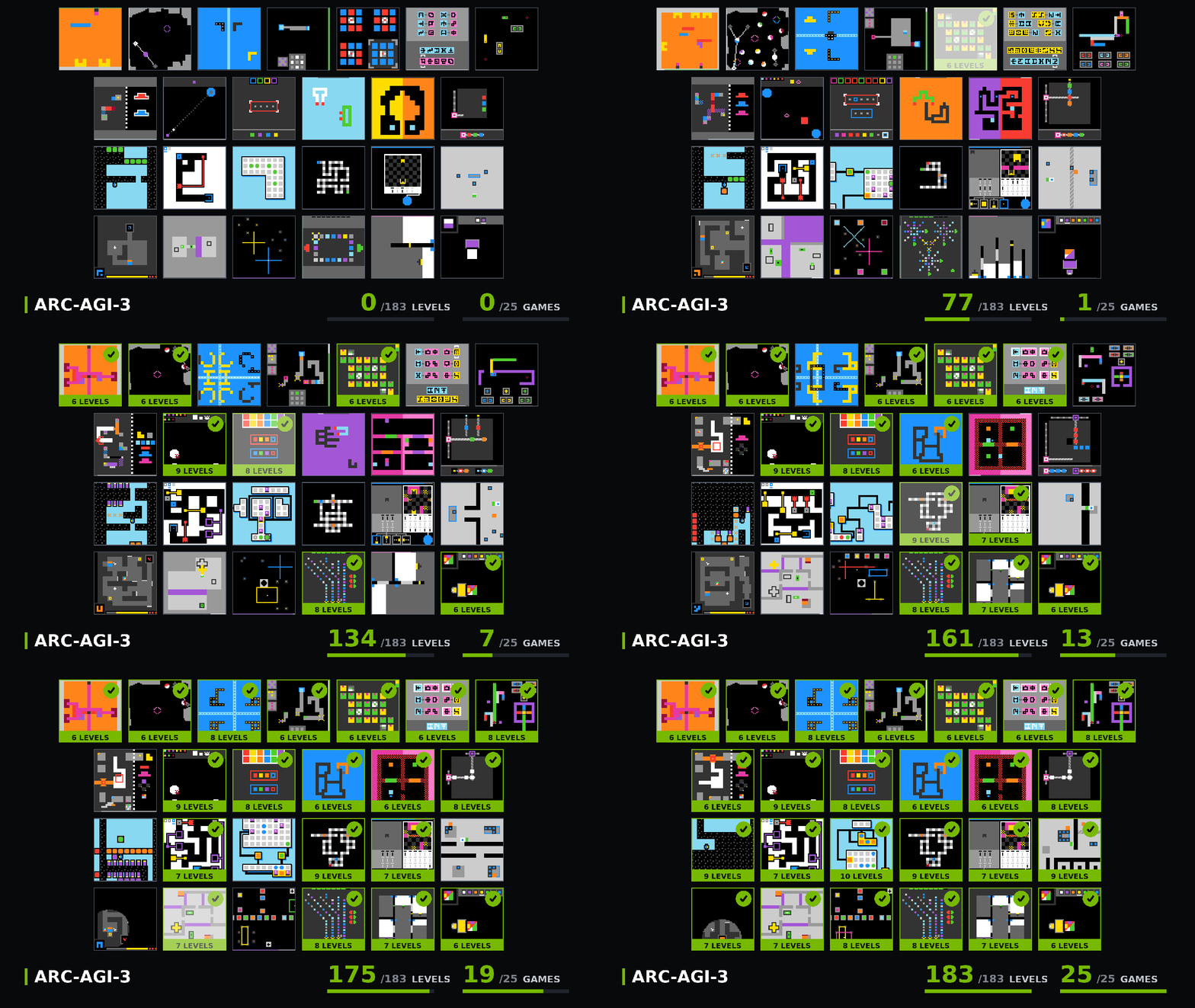
NVIDIA researchers have demonstrated that their Agentic Variation Operators (AVO) system can achieve perfect performance on the ARC-AGI-3 interactive reasoning benchmark, completing all 183 levels across 25 environments with a 100.00 RHAE score. The result matters less for the benchmark itself than for what it reveals about building general-purpose autonomous agents.
AVO wasn't designed for this benchmark. The system originally tackled GPU kernel optimization, where it ran continuously for seven days, explored over 500 optimization directions, and produced attention kernels that outperformed cuDNN by up to 3.5% and FlashAttention-4 by up to 10.5% on NVIDIA DGX B200 systems. The architecture then transferred to ARC-AGI-3 with only the task interface changed—the core agent loop remained identical.
Why it matters
Most discussions of AI agents focus on model capability. This work demonstrates that the surrounding system architecture—how an agent maintains state, recovers from failures, and sustains progress over extended tasks—determines whether frontier model capability translates into reliable autonomous work. Organizations building production agent systems need to invest as much in the harness as in the model itself.
How AVO sustains long-horizon work
Two mechanisms distinguish AVO's architecture. Persistent memory carries forward prior implementations, evaluation results, and accumulated reasoning, allowing the agent to resume from its current state rather than reconstructing context from scratch. A supervisor monitors the broader trajectory for stagnation or unproductive cycles and can redirect the main agent toward alternative strategies when progress plateaus.
During the seven-day GPU optimization run, the main agent decided what to inspect, change, test, and evaluate while the supervisor maintained forward momentum when the search stalled. This division of responsibility proved transferable: the same architecture applied to ARC-AGI-3, where agents enter unfamiliar game-like environments without instructions, explicit rules, or stated goals.
Performance and efficiency results
Using Claude Opus 5, AVO completed all 183 public-set levels in 6,624 environment actions. For comparison, VISTA—another direct-interaction system—reported 7,542 actions for the same levels, suggesting AVO used approximately 12% fewer actions. The researchers caution this isn't a controlled comparison, as the systems differ in observation representation, memory architecture, and context management.
NVIDIA also tested AVO with GPT-5.6 Sol on a subset of challenging games. Sol reached matched levels faster in wall-clock time in several cases, while Opus used fewer environment actions in matched-level comparisons, suggesting complementary operating profiles across frontier models.
The broader pattern
GPU kernel optimization and interactive reasoning appear unrelated. One involves compilers, profilers, and throughput metrics. The other requires inferring environment dynamics and objectives through exploration. But the computational pattern is identical: build hypotheses from incomplete evidence, take actions through an external interface, observe consequences, preserve useful state, revise the problem model, recover from incorrect assumptions, and continue making progress.
What transfers isn't domain knowledge but the machinery for sustained autonomous progress. The domain changes, the feedback channel changes—the core agent loop does not.
These findings were first reported by NVIDIA on the NVIDIA Developer Blog, where the research team detailed both the GPU optimization work and the ARC-AGI-3 results.
This is an original analysis by the Omega editorial team. Source reporting: AI Watch.
Want systems like this working for your business?
Book a Call