Nvidia's AI Edge Shifts From GPUs to Data Center Orchestration
As hyperscalers build competing chips, Nvidia is winning the infrastructure battle around memory management and system efficiency.
Nvidia's dominance in AI infrastructure is entering a new phase. While the company still leads in GPU sales, its strategic advantage increasingly comes from the specialized hardware that orchestrates data center operations at massive scale.
The shift became apparent following the company's recent earnings report, according to TechCrunch. As Amazon, Google, and other hyperscalers develop their own AI chips, Nvidia has quietly built a commanding position in the systems that surround the GPU — hardware designed to manage the complex challenge of moving data efficiently through gigawatt-scale compute environments.
Beyond the processor
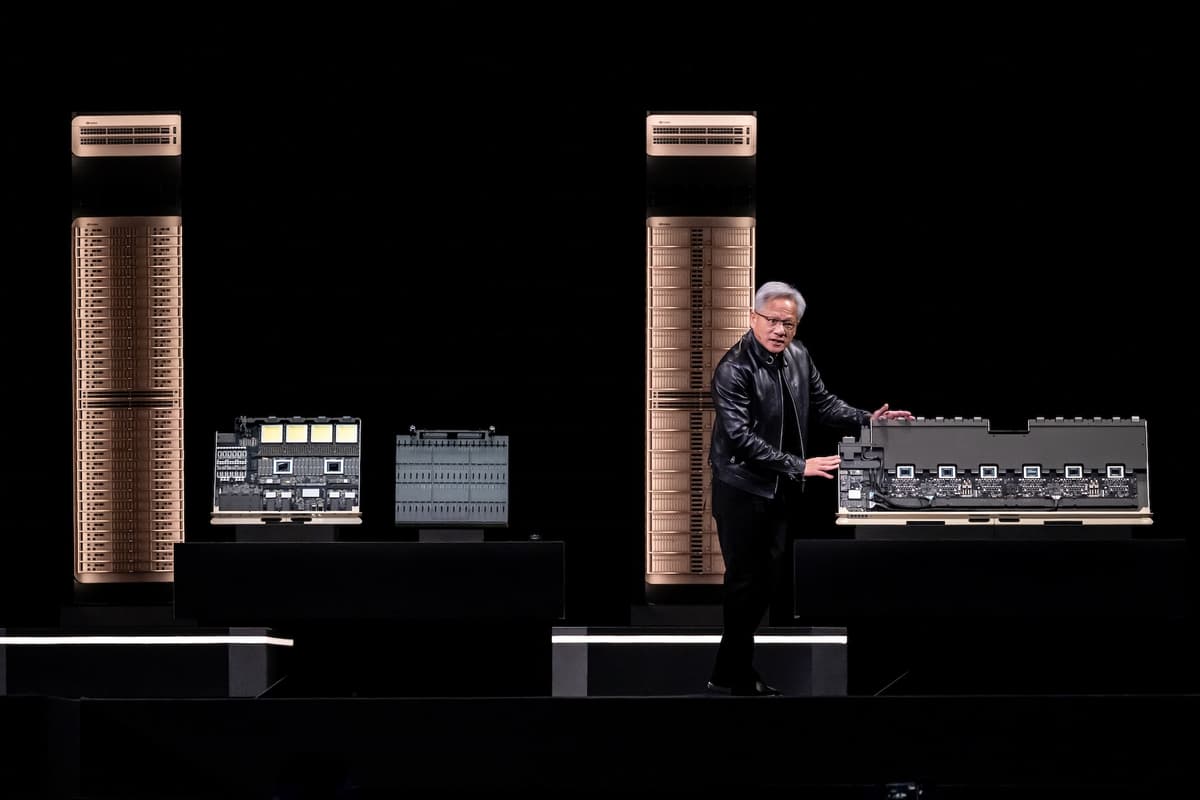
Nvidia's current Vera Rubin architecture illustrates this evolution. The platform pairs the Rubin GPU with the Vera CPU, the Groq 3 LPX inference accelerator, and dedicated racks for storage and networking. These components handle a different problem than raw computation: ensuring data reaches processors at the right time without bottlenecks.
"Vera is important because there's only so much memory that you can put in a single server or any sort of compute platform," Jason Hardy, Nvidia's VP of storage technology, told TechCrunch. The Vera CPU specifically addresses data orchestration, delivering what Hardy described as up to 3x performance improvements by maximizing flash storage utilization.
As AI workloads scale, memory capacity has grown alongside processing power — enriching companies like Micron in the process. But raw capacity means little if data movement creates inefficiencies. With companies focused on reducing tokens-per-watt, traffic management has become as critical as processing speed.
Competing approaches
Other companies recognize the same challenge. OpenAI's Jalapeño chip takes a different approach, minimizing data movement by keeping entire workloads within one integrated system. "Its large domain allows the entire workload to remain within one connected system, minimizing data movement and helping the complete request stay fast and efficient from beginning to end," OpenAI stated in an August blog post.
Whether through specialized orchestration hardware or integrated chip design, the industry is converging on a shared insight: efficiency gains increasingly come from smarter traffic control rather than additional processor cycles.
Why it matters
This shift opens a new competitive front in AI infrastructure. Building a rival GPU no longer guarantees market share if the surrounding system can't operate efficiently at scale. Nvidia's early lead in orchestration hardware gives it leverage even as GPU competition intensifies — though the company will face the same hyperscaler rivals in this layer. For enterprises planning AI deployments, the implication is clear: infrastructure decisions now extend well beyond processor selection to encompass entire system architectures.
These details were first reported by TechCrunch.
This is an original analysis by the Omega editorial team. Source reporting: AI Watch.
Want systems like this working for your business?
Book a Call