Nvidia Unveils $500B Financing Plan With Wall Street Giants
Jensen Huang recruits six major financial firms to back AI infrastructure deals, addressing investor concerns about circular funding.
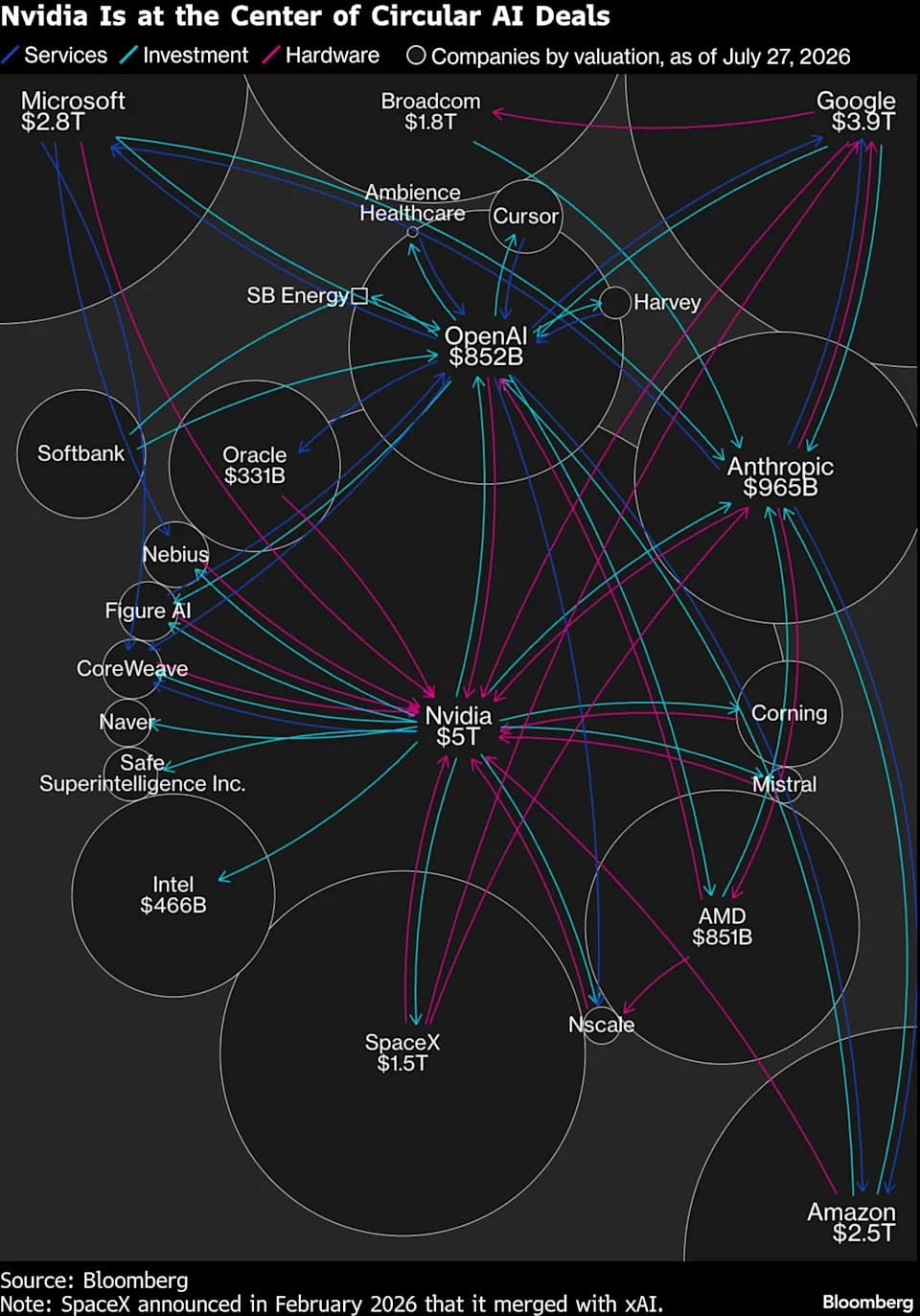
Nvidia CEO Jensen Huang has assembled a coalition of Wall Street's largest financial institutions to arrange up to $500 billion in financing for artificial intelligence infrastructure purchases, a move designed to reassure investors about sustainable demand for the chipmaker's products.
The initiative brings together Goldman Sachs, Blackstone, Apollo Global Management, KKR, BlackRock, and Brookfield to provide debt financing for AI developers and data center operators purchasing Nvidia chips. The announcement came after months of behind-the-scenes negotiations, with Nvidia adding three additional lenders just days before going public with the plan.
Why it matters
The financing structure addresses growing investor anxiety about circular funding in the AI sector, where Nvidia has invested in some of its own customers. By bringing in independent Wall Street firms to arrange the bulk of financing—with Nvidia backstopping only up to 25% of individual deals—the chipmaker is working to demonstrate that AI infrastructure spending rests on a foundation broader than its own balance sheet. This matters for sustaining the multi-trillion-dollar valuations now riding on continued AI capital expenditure.
Expanding beyond hyperscalers
The financing program targets a specific strategic goal: diversifying Nvidia's customer base beyond major cloud providers like Microsoft and Amazon, which are increasingly developing their own AI chips. AI startups including Anthropic and OpenAI represent critical future demand, but many lack the capital reserves of hyperscale cloud operators.
By facilitating access to hundreds of billions in debt financing, Nvidia aims to enable these smaller players to purchase the computing infrastructure they need to scale—infrastructure that currently depends heavily on Nvidia's chips.
Addressing circular funding concerns
Investors have questioned whether Nvidia's investments in customers like CoreWeave constitute circular financing that artificially inflates demand. The initial announcement of the financing partnership briefly unsettled debt markets, with investors concerned about Nvidia's exposure to leverage risk.
Huang moved quickly to clarify the structure. Nvidia will evaluate each project individually and limit its direct support to a maximum of 25% per deal. The six financial institutions will arrange and underwrite the majority of the financing, with Nvidia providing guarantees rather than direct capital in most cases.
No deals signed yet
Despite the $500 billion figure—a round number with no clear methodology disclosed—no financing agreements had been finalized at the time of the announcement, according to sources familiar with the discussions. The deliberately vague framing suggests the initiative functions more as a framework and commitment of intent than a set of concrete transactions.
The structure gives Nvidia's $5.5 trillion market capitalization a vote of confidence from Wall Street's elite, while the case-by-case evaluation approach preserves flexibility for both the chipmaker and its financial partners.
These details were first reported by Bloomberg.
This is an original analysis by the Omega editorial team. Source reporting: AI Watch.
Want systems like this working for your business?
Book a Call