Nvidia Texas Factory to Produce Optical Tech for AI Systems
The Sherman facility will manufacture indium phosphide lasers that connect chips into unified AI computing infrastructure, creating 1,000 jobs.
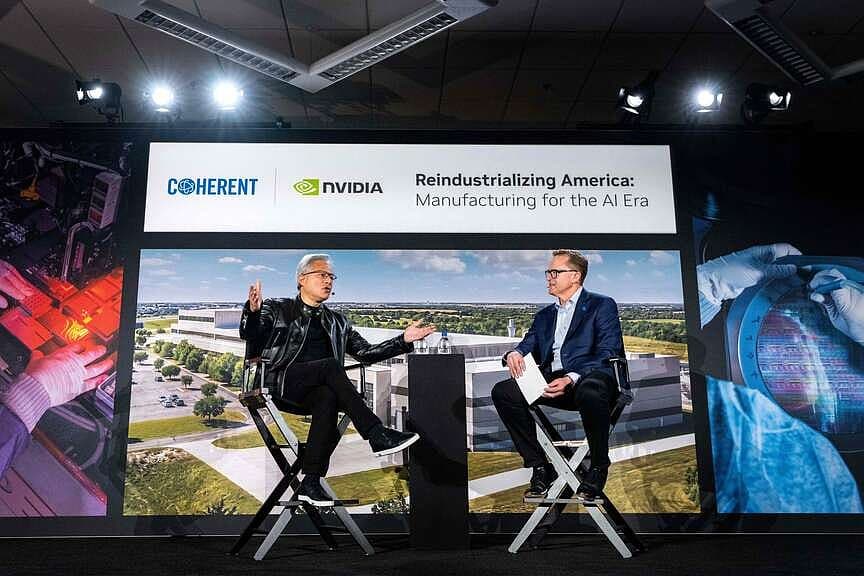
Nvidia expands beyond chips into AI infrastructure manufacturing
Nvidia has formalized plans for a major AI infrastructure upgrade through a $2 billion partnership with materials manufacturer Coherent, centered on a factory expansion in Sherman, Texas. The facility will produce indium phosphide, the raw material for lasers that enable optical data transmission between computer chips, allowing them to function as unified systems with greater power efficiency.
According to details shared by executives ahead of Tuesday's announcement, the technology addresses a critical bottleneck in AI computing. The lasers pulse light hundreds of billions of times per second through fiber optic channels, enabling Nvidia's chips to share information and operate collectively in what CEO Jensen Huang calls "AI factories."
The optical interconnect approach could reduce power consumption by up to 50 percent while accelerating computation speeds and lowering costs. This efficiency gain matters for the economics of AI deployment—reducing the cost per token, the industry's unit of AI usage, makes broader application of the technology more viable.
Federal backing spans two administrations
The Sherman factory received bipartisan government support totaling $50 million. The Biden administration approved $33 million through the CHIPS and Science Act, while the Trump administration added a $17 million grant to ensure domestic production of this AI infrastructure component.
Coherent estimates the expansion will create approximately 1,000 jobs, including 550 positions in advanced manufacturing, engineering, and technical roles. "This investment expands America's capacity to manufacture critical AI-enabling technologies, creates high-value jobs, and reinforces U.S. leadership in advanced manufacturing, photonics, and innovation," said Coherent CEO Jim Anderson.
Why it matters
Nvidia's move from chip design to complete system integration signals a strategic shift with implications for U.S. manufacturing competitiveness. By clustering chip production in Arizona and assembly operations in Texas, the company is building a domestic AI supply chain at a time when economists project AI could grow from 3 percent of GDP to between 8 and 39 percent based on current investment trajectories. The five largest U.S. tech firms invested $380 billion in AI infrastructure last year, a figure that could double in 2026, according to research published this month by economists Jessica Wachter and Jonathan Wachter.
From digital tools to factory floors
One Nvidia executive, speaking on background about industrial strategy, described the company's evolution from selling chips to providing complete AI systems—"brains and a nervous system" that customers can apply to create new products, identify cost savings, and potentially restore U.S.-based manufacturing previously dependent on foreign suppliers. The goal is moving AI from laptop screens to factory floors where it can "move atoms," not just process data.
President Donald Trump has emphasized AI's strategic importance, telling reporters last week: "It's an amazing industry. It's bigger than any industry anyone's ever seen. We are leading China by a lot. And whoever leads that is going to really lead the world to a large extent."
The Sherman factory represents a test case for whether AI infrastructure buildout can generate manufacturing employment even as the technology itself automates tasks across software development, data analysis, and industrial processes.
These details were first reported by AI Watch.
This is an original analysis by the Omega editorial team. Source reporting: AI Watch.
Want systems like this working for your business?
Book a Call