NVIDIA Rubin Servers Run Liquid Cooling at 113°F, Cut Data Center Water Use to Zero
The first 100% liquid-cooled AI infrastructure eliminates fans, slashes energy costs up to 40%, and can operate without consuming water in favorable climates.
NVIDIA's Rubin Platform Redefines Data Center Cooling
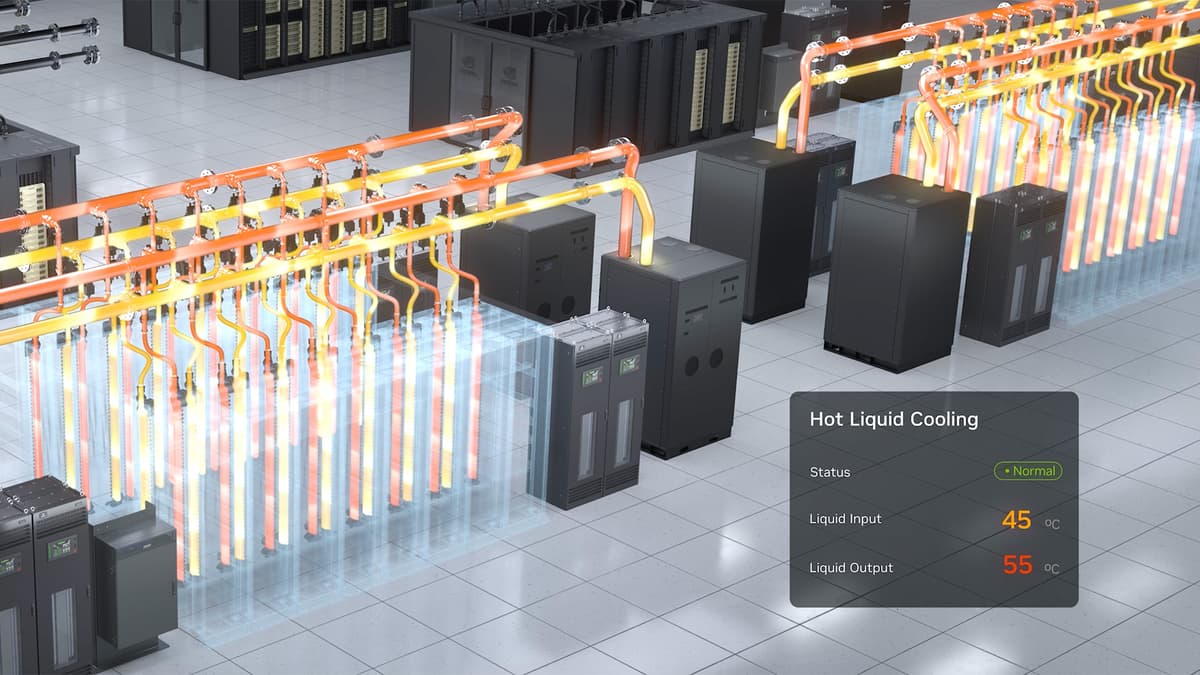
NVIDIA's Rubin generation AI servers operate with liquid coolant reaching 45 degrees Celsius — hotter than most hot tubs — and that elevated temperature is the key to dramatic efficiency gains. The platform represents the industry's first 100% liquid-cooled AI infrastructure, with every chip and networking component cooled entirely by liquid in closed loops with zero fans.
The architecture is detailed in NVIDIA's DSX AI factory reference design, which provides specifications for building and operating complete AI infrastructure stacks. According to Ali Heydari, director of data center cooling and infrastructure at NVIDIA, the design achieves zero water consumption through dry-cooler-based systems that eliminate evaporative cooling except for roughly 1% of annual operating hours in some climates.
Traditional data center cooling has consumed up to 40% of total facility electricity. Industry data shows that raising chiller plant temperatures by just one degree reduces cooling energy costs by approximately 4%. For a 50-megawatt hyperscale facility, transitioning to liquid-cooled infrastructure can save more than $4 million annually in combined energy and water costs.
Why it matters
As AI compute demand accelerates, cooling efficiency directly determines whether hyperscale deployment remains economically and environmentally viable. NVIDIA's approach addresses both cost and sustainability: a single data center can eliminate roughly 2.6 million gallons of water consumption per megawatt annually while cutting cooling energy nearly in half. With every major cloud provider building Rubin-based infrastructure, this shift sets a new baseline for the industry.
How Higher Temperatures Enable Lower Consumption
The counterintuitive principle: hotter coolant requires less energy to manage. Conventional air-cooled facilities depend on chilled air to remove heat, demanding energy-intensive refrigeration during warm weather. NVIDIA's 45-degree liquid cooling captures heat directly at the chip and transports it through loops operating at temperatures high enough for outdoor dry coolers to reject heat efficiently year-round in many geographies.
The coolant — 75% water, 25% propylene glycol — flows through cold plates mounted directly on processors. It enters chips at 45 degrees Celsius and exits at roughly 55 degrees after absorbing heat, yet processors maintain full performance because the cold plates keep device temperatures within operating specifications.
In suitable climates, facilities can reject heat through large radiator coils positioned outdoors, with the loop filled once and run closed for the facility's operational life. Richard Whitmore, CEO of Motivair (Schneider Electric's advanced cooling division), confirmed that in appropriate geographic locations, "you can just put big radiator coils outside and use the air temperature for all your cooling."
Engineering a Fanless Architecture
Previous liquid-cooled servers used hybrid approaches, with GPUs and CPUs receiving cold plates while other components relied on air cooling and heat sinks. Rubin's thermal engineering team redesigned component cooling to route liquid to multiple high-power chips using single inlet-outlet configurations per board.
The result: sealed front panels replace perforated bezels, rack density increases substantially — systems that required six rack units now occupy two — and ambient data center temperature becomes flexible since no components depend on cooled air. Noise levels drop from the 85-decibel range requiring hearing protection to near-silent operation.
The architecture also enables waste heat recovery, allowing residual thermal energy to heat nearby commercial or residential buildings.
These details were first reported by NVIDIA in a blog post outlining the DSX platform specifications and thermal engineering approach.
This is an original analysis by the Omega editorial team. Source reporting: AI Watch.
Want systems like this working for your business?
Book a Call